On Thursday, apartheid’s last leader, Frederik Willem de Klerk, died, sparking a national conversation among South Africans about his life and legacy.
Praise and support for De Klerk – who was South Africa’s president during its transition from white minority rule to democracy – has been muted in the country, not simply because of his association with apartheid, but because of his many shortcomings as a statesman.
In the words of Archbishop Desmond Tutu, “Mr De Klerk could have gone down in history as a truly great South African statesman, but he eroded his stature and became a small man, lacking magnanimity and generosity of spirit.”



During his presidency (1989-1994) and his time as deputy-president to Nelson Mandela (1994-1996), De Klerk had an opportunity to shape the views of his white compatriots, elevate the voices of Black South Africans, and play a leading role in building a democratic South Africa. Instead, he repeatedly chose to equivocate and lie during his time in political power. Instead of reckoning with the past, De Klerk and the white politicians he led, tried to dodge it. As a result, De Klerk became a historical footnote.
Although he released Mandela and other political prisoners and unbanned the liberation movements and their affiliates in 1990, De Klerk was a reluctant reformer. After he lost the election to Mandela in 1994, he became a deputy-president in his government of national unity. Although he held a senior position in the government led by Mandela, De Klerk was unable to admit to his role in apartheid-era violence against Black South Africans.

Instead of coming clean, he lied to the country’s Truth and Reconciliation Commission (TRC), which had been established in 1996 after the new democratic government came into power. Chaired by Archbishop Desmond Tutu, the commission’s aim was to probe apartheid human rights violations, including murders, kidnappings and forced disappearances.
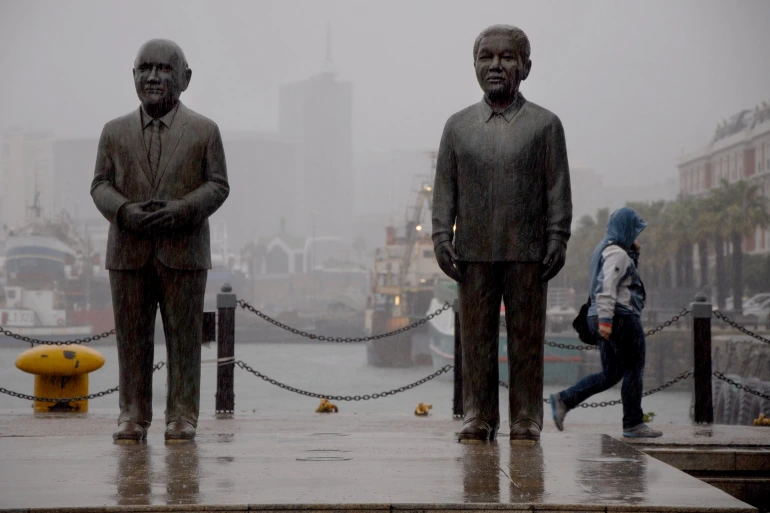
De Klerk could have used his appearance at the TRC to demonstrate his commitment to creating a new society based on the values he was credited with embodying when he was awarded the Nobel Peace Prize alongside Nelson Mandela in 1993. Instead, he insisted that it had “never been the policy of the government [or] the National Party that people should be murdered”.
He went on to accuse apartheid police officers who had killed civilians and activists of committing these killings without his knowledge or permission, and without the knowledge of any senior figures in government. He went so far as to say that low-ranking white officers had gone rogue and were using the TRC to “pass the buck” to their superiors now that apartheid was over. He then added, “[I] stand by our security forces who implemented [apartheid] policies and decisions and all reasonable interpretations thereof.”
It was a deeply disappointing performance, and one that lost him a great deal of respect among those who had hoped he might play a role in the transformation of white people’s views about apartheid and the transition to democracy.
The former leader’s testimony set a template for the appearances of other senior white leaders. The generals closed ranks and white political leaders boycotted and undermined the proceedings. In the end, of course, these denials and lies did not stop the TRC from revealing at least some of the truth. The final report of the commission made it clear that De Klerk and his generals knew of and authorised attempts to kill and injure anti-apartheid activists.
Although he was in the right place at the right time in 1990, his inability to meet the subsequent transitional period with honesty and integrity meant he was quickly overtaken by the momentum of South Africa’s transition and outgunned by his political opponent Nelson Mandela. Just three years after the democratic elections of 1994, De Klerk resigned from government. He never regained his political footing and spent most of the democratic era trying to manage how he would be remembered.
The former leader’s preoccupation with how he would be remembered was on full display this week. On Thursday, a few hours after its patron’s death, the De Klerk Foundation released a video statement by De Klerk recorded shortly before he died.
In the message, which he said would be his “last”, De Klerk apologised again for apartheid, and said he had always sought not only to, “admit the wrongness of apartheid”, but also “took far-reaching measures to ensure negotiation and a new dispensation which could bring justice to all”.
The video was seen by many as De Klerk’s final attempt to position himself as a man who had played a pivotal role in birthing a new nation.
As his time drew near, he seemed desperate to prove that he had played a central role in South Africa’s still-unfolding story. Instead, the clip confirmed what many had already suspected – that De Klerk was only an inconsequential actor on the sidelines of South Africa’s history.
Nelson Mandela arrived at this conclusion many years ago. In the Long Walk to Freedom, Mandela delivered a stinging pre-emptive political obituary of sorts for De Klerk, writing that, “Despite his seemingly progressive actions, Mr de Klerk was by no means the great emancipator. He did not make any of his reforms with the intention of putting himself out of power. He made them for precisely the opposite reason: to ensure power for the Afrikaner in a new dispensation.”
With his characteristic frankness, Mandela was refusing to confer the status of greatness on the former apartheid leader, denying De Klerk the accolades he so clearly craved. In death, as in life, apartheid’s last president was outmatched, outwitted and overshadowed by South Africa’s first Black one.

Sisonke Msimang writes about South Africa, race, gender and democracy. She is the author of two books: Always Another Country: a memoir of exile and home, and The Resurrection of Winnie Mandela.
The views expressed in this article are the author’s own and do not necessarily reflect The Southern African Times’s editorial stance. Ifyou want to contribute and have specific expertise, please contact us at editor@thesouthernafricantimes.com.