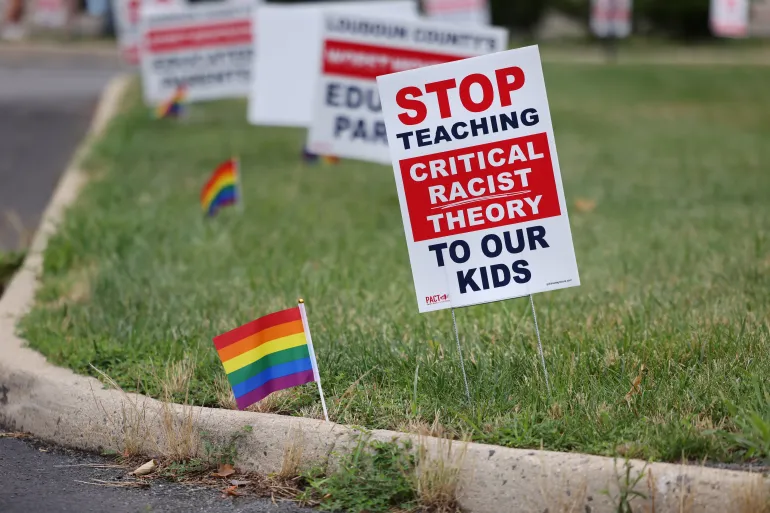
The past three years in the US and elsewhere have been a boon for conservative and fascist forces looking to whitewash public schools, public universities, and public libraries of anything not centring heterosexual white men in a purely positive light. Critical Race Theory has been their boogeyman and their proxy to attack any anti-racist efforts in the public sphere.
They have already managed to disrupt freedom of thought across educational institutions. In states like Florida, Tennessee and Oklahoma, professors without the protection of tenure (usually Black and Latinx) have been not-so-quietly cancelling courses that hint at Critical Race Theory.
At the University of Florida, Professor Christopher Busey felt compelled to file a grievance in 2021 against his university because administrators were censoring his work for using the words “critical” and “race” to describe the curriculum concentration he was hired to teach.



In Texas, there was even an attempt to ban the use of the word “slavery” in high school history lessons and replace it with “involuntary relocations” in 2022.
These attacks on Critical Race Theory as a way to get anti-racist ideas out of public institutions are themselves an example of what the theory is meant to interrogate and illuminate: the centrality and immovability of racism in the US and in Western civilisation.
In fact, they prove that Critical Race Theory is not really a theory – it is a hard reality. Like evolutionary biology, it has moved from hypothesis and theory to bedrock facts replicable through evidence and experiments.
The evidence
There is no simple or singular definition for Critical Race Theory, but it is more than the study of modern racism and more than just African American history. It is a set of methodological approaches meant to shine a light on the US and the West and their ultimate myth: That modern racism was an accidental consequence of exploring the globe and exploiting its diverse peoples, its lands, and its resources.
Modern racism was and remains a central component of Western civilisation, the bedrock upon which it built its economic and military greatness, as seen in its laws and policies the world over.
Social and legal theorists studying Critical Race Theory have pointed to the existence of laws, treaties, and customs that allowed the Transatlantic Slave Trade to expand in the 16th and 17th centuries.
They have highlighted how ruling French, Spanish, Portuguese, and English colonials enacted laws in the 16th, 17th, and 18th centuries collectively known as Slave Codes, making permanent chattel slavery through the lineage of enslaved African women.
Even after the end of chattel slavery in the 19th century, there was and remains the flourishing of racial apartheid in the US, in South Africa, and in Palestine. The use of “abeed” in the Arab world and of “kaalu” in South Asia as derogatory, n-word-like terms to denigrate darker skin and Blackness is part of the legacy of a millennium-long enslavement and trade of African peoples across much of the globe. Slavery may have ended, but the racist structures and customs that allowed it to flourish have never been dismantled.

At the same time, Critical Race Theory researchers have also shown how religious practices and medieval laws excused the genocidal actions of conquistadors and of English colonists seeking freedom, as these settlers deliberately and inadvertently wiped out millions of Indigenous people across the Western Hemisphere.
These practices continued with imperialist expansions across the rest of the globe in the 19th and 20th centuries, most notably in South Asia, Australia, and what is now Namibia and other parts of once-colonised Africa.
The European Christian anti-Jewish and Islamophobic predispositions combined with Social Darwinism also led to atrocities in 20th-century Europe, including the Holocaust and the Bosnian genocide. Nazi Germany codified into law the belief that Jews were racial misfits and undesirable in a society striving for racial purity through the Nuremberg Laws.
Meanwhile, in the US immigration laws between 1917 and 1924 were enacted to keep out “undesirables”, whether Southern and Eastern Europeans, Asians, Black Africans or Arabs. Today US and European migration policies continue to reflect the same racial logic and are designed to bar specific racial and religious groups from entering.
While resistance to Western expansion, genocide, and systemic white supremacist racism is as present in the historical record as the rise of modern anti-Black racism, so too are the global impacts on cultures and customs. The once prevalent use of lightening and bleaching creams in the US remains prominent on the African continent, in the Philippines and Brazil, in India, Latin America, and the Caribbean. It is not an accident that the descendants of people once enslaved or colonised under a white supremacist system would literally attempt to lighten or whiten their skin in order to benefit from systems that proclaim in essence that “white is right”.
The evidence of the rise of the West, and the US with it, centres around sanctifying the right of Europeans and their settler-colonials to exploit African, Asian, and Indigenous people, their labour, their land, and their progeny. That evidence can be sensed in how the world works today, including how climate change disproportionately affects Africa and the Global South, while the West hems and haws over spending money to solve it.
The Western civilisation and people of colour the world over have been a part of a half-millennium-long experiment known as systemic racism, a system that benefits those with power and wealth and those with proximity to whiteness. The results are with humanity every day.
Indeed, there is more than enough evidence already from practitioners showing Critical Race Theory to be much more than mere theory. When the same settler-colonial, enslavement or apartheid experiments are run over and over again and the same results are obtained, it means a theory has moved into the realm of established fact.
The lived experiences
UCLA law professor Kimberlé Crenshaw first coined the term Critical Race Theory in 1989 as part of the title for a conference she co-organised at the University of Wisconsin-Madison. She meant for the new term to put under an umbrella several strands of thought involving Western critical theory about societies, the human condition, and the centrality of racism within the US legal tradition.

Crenshaw also coined the term intersectionality, an idea integral to Critical Race Theory. Intersectionality allows practitioners to show the how and why of systemic racism and other forms of oppression by examining laws, policies, and customs.
The work that the world calls Critical Race Theory today predates the term by decades. In a recent op-ed for the Los Angeles Times, Crenshaw wrote that Dr Martin Luther King, Jr himself “was, in fact, a critical race theorist before there was a name for it”.
Like Dr King, one need not take additional graduate and law courses to turn a critical legal, sociological, or literary eye on humanity and craft theories around how societies and the human beings within them behave.
Critical Race Theory is about the everyday, the ordinary, and the extraordinary, building an ever-larger case for understanding that modern Western-dominated systems and institutions are built on racism at a quantum level.
And it was clear to the people who first started working on it that it would face stiff, brutal opposition. Back in 1995, the late Derrick Bell, a founding parent of Critical Race Theory, delivered a speech titled Who’s Afraid of Critical Race Theory?
The “work [of Critical Race Theory] is often disruptive because its commitment to anti-racism goes well beyond civil rights, integration, and other liberal measures,” Bell said to his University of Illinois Law School audience. And with the use of “the first person, storytelling, narrative, allegory, interdisciplinary treatment of the law, and the unapologetic use of creativity”, those against radical anti-racist efforts often object to the theory, he added.
More than two decades later, Donald Trump and his fascist followers would begin using Critical Race Theory as a proxy for attacking anything that does not centre heterosexual white males in US history and culture.
Opponents’ attempts to ban Critical Race Theory may seem ridiculous. But they do understand that it interrogates and sidelines white and Western views of history, culture, politics and their dominance of the present and future.
I gently suggest those in the scholarly community move away from the term Critical Race Theory and towards Critical Race Studies or Anti-Racism Studies, precisely because Critical Race Theory was never hypothetical. This theory is laser-focused on reality – a messy, squishy, blood-soaked reality that goes beyond academic ideas and categories.
In my own lifetime, Critical Race Theory has moved from dusty law theory books to bestselling nonfiction allegories like Bell’s Faces at the Bottom of the Well and to memoirs and essay collections like Kiese Laymon’s Heavy: An American Memoir, and Crystal Marie Fleming’s How to Be Less Stupid About Race. All this is part of the effort to get people who sense what is wrong with the world to move beyond a white supremacist worldview, to begin to disrupt and dismantle for a better future.