Sunday, July 5, 2026
  • Login
The Southern African Times
  • Home
  • Southern Africa
  • Business
    • African Start ups
    • African Continental Free Trade Area
  • Technology
    • Lifestyle
      • Health
      • Culture
      • Food and Drink
      • Entertainment
  • Opinion
  • Sports
  • SAT Jobs
    • Events
  • About Us
    • Advertise with Us
    • Contact Us
No Result
View All Result
  • Home
  • Southern Africa
  • Business
    • African Start ups
    • African Continental Free Trade Area
  • Technology
    • Lifestyle
      • Health
      • Culture
      • Food and Drink
      • Entertainment
  • Opinion
  • Sports
  • SAT Jobs
    • Events
  • About Us
    • Advertise with Us
    • Contact Us
No Result
View All Result
The Southern African Times
No Result
View All Result
Home Opinion

Colossal collapse of cash-strapped Afghanistan must be averted at all costs

by SAT Reporter
November 23, 2021
in Opinion
0
Colossal collapse of cash-strapped Afghanistan must be averted at all costs

Since September 2021, there has been little action in averting Afghanistan’s monetary meltdown, which the United Nations (UN) now considers an existential crisis for the cash-strapped country. While attention has been paid to managing the humanitarian consequences of the 20-year war, the rapidly collapsing banking sector, which was otherwise a key source of transactions for millions of Afghans in the post-war scenario, is alarming. Limits on withdrawals, the inability to pay for basic necessities and a perpetual state of bankruptcy can usher in indebtedness and liquidity crunches, stalling economic revival in the process. If current trends persist, Afghanistan could collapse in months with economic capitulation potentially breeding unrest, resistance and terrorism, which the international community can ill afford. 

The damning downward spiral of the financial sector has been unearthed by the United Nations Development Program (UNDP), which has warned that the financial system could take decades to rebuild as bank payment systems linked to  “bank-run” options need to be resolved to improve the country’s limited production capacity. While the UNDP’s proposals include establishing a deposit insurance scheme as well as providing credit guarantees with flexibility on loan repayments, the question remains as to whether such measures would suffice in alleviating a problem which has deeper roots and is subject to a whole host of variables. Contributing factors are both exogenous and unilateral in nature, where the Taliban’s ascension to power coincided with the drying up of international developmental aid and nearly $9.5 billion of Afghan Central Bank funds which continue to remain frozen. This has meant that the country now relies on coordination from international financial institutions such as the World Bank and the International Monetary Fund to save the flailing banking system. Secondly, Afghan banks have historically relied on the physical shipment of U.S. dollars, which has stopped since the withdrawal and has resulted in only 0.01 percent of the four-billion worth of the Afghani currency being currently circulated.
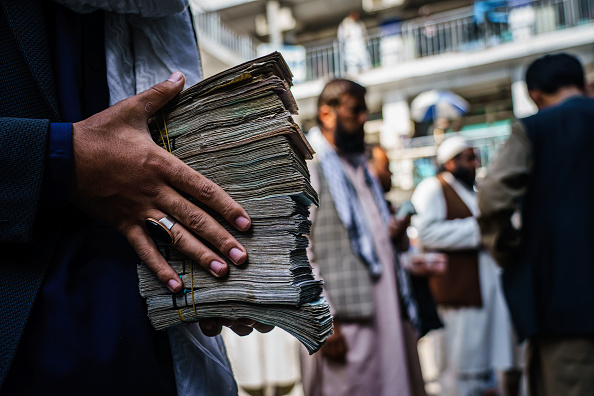
Money exchangers greet potential customers in the Sarai Shahzadah, Kabul’s currency exchange market in Kabul, Afghanistan, September 4, 2021. /Getty


ADVERTISEMENT

There are also exigencies involved with about 40 percent of Afghanistan’s deposit base risking a complete loss by the end of 2021, which necessitates swift proposals aimed at saving the banking sector that goes beyond establishing guarantees only. The link between banking collapses and trade finance has been established and explained by the head of the UNDP in Afghanistan Abdallah al Dardari, who cautioned that the 2020 imports of goods and services into the country risk a timeless interruption, which prevents average citizens from accessing basic necessities which are critical for survival. While the UNDP has provided a blueprint, it is up to the international community to jointly call for a revival of the banking sector, given its debilitating effect on a cash-reliant economy. Providing humanitarian assistance to the war-torn population and preventing famine from gaining a stronghold in one of the world’s most impoverished countries is important, but so is addressing structural issues, which are equally critical for survival.

Furthermore, an agrarian economy with a significant chunk of the population now resorting to the opium trade for survival has also witnessed non-performing loans accounting for a staggering 57 percent of credit in the country since September 2020 till the start of 2021, despite the Kabul government paying salaries to employees and moving to stabilize the Afghani currency by auctioning millions of dollars in the open market. These measures are, however, knee-jerk instead of strategic in nature, and the only way for Afghanistan’s economy to be rescued is to revive a sector which is a life line for millions of Afghan families and has been gravely damaged due to events linked to the U.S. withdrawal. Without access to funds, the current account deficit will also suffer as imports will simply not be possible as the current situation renders export capacity to be out of the question.

Given the causal links between the health of financial institutions and the wellbeing of the Afghan population, the international community must make a concerted attempt at lifting sanctions and providing Kabul with a lifeline toward financial revival. Otherwise, a collapse of the entire country will become imminent and impending.

Hamzah Rifaat Hussain is a former visiting fellow at the Stimson Center in Washington and former assistant researcher at the Islamabad Policy Research Institute. He is also a TV anchor at Indus News in Pakistan. The article reflects the author’s opinions and not necessarily the views of The Southern African Times.

Previous Post

South Africa’s Erasmus banned for criticizing ref in video

Next Post

Bitcoin, Ethereum fall as India moves to ban cryptos

SAT Reporter

Related Posts

The Algorithm Didn’t Create Xenophobia. It Made It Impossible to Ignore
Opinion

The Algorithm Didn’t Create Xenophobia. It Made It Impossible to Ignore

by Kundai Vambe
July 4, 2026
LONG READ | The Oldest Alibi: South Africa’s Xenophobia and the Economic Ruin It Presages
Opinion

LONG READ | The Oldest Alibi: South Africa’s Xenophobia and the Economic Ruin It Presages

by Times Reporter
June 30, 2026
President Cyril Ramaphosa’s Opinion: How South Africa’s Natural Splendour Can Drive Inclusive Growth
Opinion

Op-Ed by President Ramaphosa | Protest Is Both a Right and a Responsibility

by Times Reporter
June 29, 2026
The Insurance Hack More Drivers Should Know
Opinion

The Insurance Hack More Drivers Should Know

by Times Reporter
June 22, 2026
Southern African Times Announces Brendan Amadi as Recipient of the 2026 Editorial Recognition of the Year Award
The Editorial Board

Southern African Times Announces Brendan Amadi as Recipient of the 2026 Editorial Recognition of the Year Award

by The Editorial Board
June 19, 2026
Next Post
Bitcoin, Ethereum fall as India moves to ban cryptos

Bitcoin, Ethereum fall as India moves to ban cryptos

Browse by Category

  • Africa AI
  • African Continental Free Trade Area
  • African Debt
  • African Start ups
  • Agriculture
  • AI Africa
  • Algeria
  • All News
  • Analysis
  • Angola
  • Arts / Culture
  • Asia
  • Botswana
  • BOTSWANA
  • BREAKING NEWS
  • BRICS
  • Burkina Faso
  • Burundi
  • Business
  • Business
  • Business Wire
  • Cameroon
  • Central Africa
  • Chad
  • China
  • Climate Change
  • Climate Changev
  • Community
  • Congo Republic
  • Conservation
  • Côte d’Ivoire
  • COVID 19
  • CRYPTOCURRENCY
  • Culture
  • Democratic Republic of Congo
  • Diplomacy
  • Eastern Africa
  • Economic Development
  • Economy
  • Education
  • Egypt
  • Elections 2024
  • Energy
  • Entertainment
  • Environment
  • Eritrea
  • Ethiopia
  • Europe
  • Fashion
  • Feature
  • Finance
  • Financial Inclusion
  • Food
  • Food and Drink
  • Foods
  • GABON
  • Ghana
  • Global
  • Global Africa
  • Guinea
  • Health
  • Humanitarian Aid
  • Immigration
  • in Southern Africa
  • International news
  • International Relations
  • Investment
  • Ivory Coast
  • Just In
  • Kenya
  • Lesotho
  • Libya
  • Life Style
  • Lifestyle
  • Literature
  • Malawi
  • Malawi
  • Mali
  • Markets
  • Mauritius
  • Middle East
  • Mining in Africa
  • Morocco
  • Mozambique
  • Namibia
  • niger
  • Niger
  • Nigeria
  • North Africa
  • North-Eastern Africa
  • Obituaries
  • Obituary
  • Opinion
  • PARTNER CONTENT
  • Politics
  • Property
  • Racism
  • Rwanda
  • Rwanda
  • SADC
  • SAT Interviews
  • SAT Investigation
  • SAT Jobs
  • Saudi Arabia
  • Senegal
  • Seychelles
  • Somaliland
  • South Africa
  • South Sudan
  • Sports
  • Startup Africa
  • STOCK EXCHANGE
  • Sudan
  • Sustainability
  • Sustainablity
  • Tanzania
  • Technology
  • Telecommunications
  • The Editorial Board
  • The Power Of She
  • Togo
  • Trade
  • Travel
  • Travel
  • Tunisia
  • Uganda
  • Uncategorized
  • Wealth
  • West Africa
  • World
  • World
  • ZAMBIA
  • Zambia
  • ZIMBABWE
  • Zimbabwe

Browse by Tags

#NewsUpdate #SouthAfrica #SouthernAfricanTimes #TheSouthernAfricanTimes AfCFTA africa African Continental Free Trade Area African development African Development Bank African economies African economy African Union Agriculture Angola Botswana China Climate change Cyril Ramaphosa Economic Development economic growth energy transition fiscal policy governance industrialisation Inflation Infrastructure Infrastructure Development International relations Investment Kenya Mozambique Namibia news Nigeria Regional Integration renewable energy Rwanda SADC South Africa Southern Africa sustainable development Tanzania United States Zambia Zimbabwe
ADVERTISEMENT

WHO WE ARE

The Southern African Times is a regional bloc digital newspaper that covers Southern African and world news. The paper also gives a nuanced analysis on news and covers a wide range of reporting which include sports, entertainment, foreign affairs, arts and culture.

Welcome Back!

Login to your account below

Forgotten Password?

Retrieve your password

Please enter your username or email address to reset your password.

Log In
  • Home
  • Southern Africa
  • Business
    • African Start ups
    • African Continental Free Trade Area
  • Technology
    • Lifestyle
      • Health
      • Culture
      • Food and Drink
      • Entertainment
  • Opinion
  • Sports
  • SAT Jobs
    • Events
  • About Us
    • Advertise with Us
    • Contact Us
Not enough quota to unlock this post
Unlock left : 0
Are you sure want to cancel subscription?