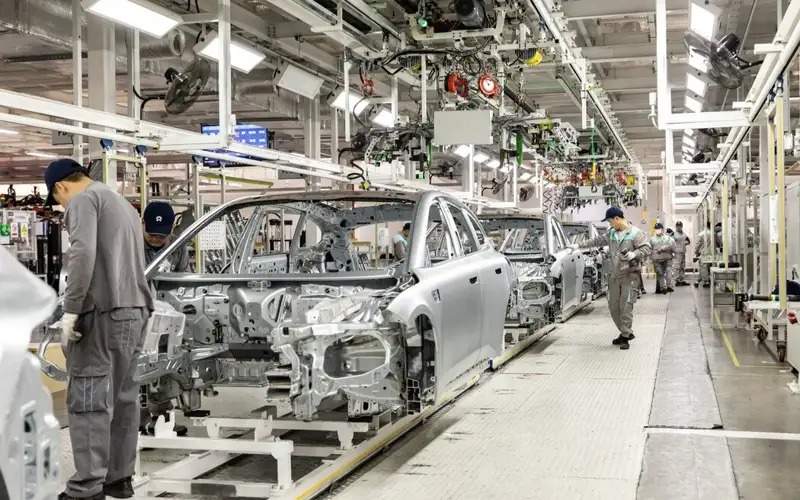
In the industrial heart of Egypt’s Giza Governorate, the production floor of Jetour Auto’s welding facility is alive with the rhythm of coordinated machinery and human skill. Automated welding systems work alongside technicians, producing vehicle frames with precision that reflects years of technological refinement. This factory, a centrepiece of a US$123 million joint venture between Chinese manufacturer Jetour and Egypt’s Kasrawy Group, marks a significant development in the country’s ambitions to advance its automotive manufacturing sector.
For Yasser Ahmed Mansour, a plant supervisor who has overseen operations since the early stages of the facility’s setup, the factory symbolises the integration of advanced engineering with Egypt’s growing industrial capacity. He observes that a growing number of Egyptian consumers are now choosing Chinese cars over their German, Japanese, and other counterparts, attributing this trend to what he describes as a combination of advanced technology, near-premium features, and competitive pricing.
The welding factory is scheduled to begin production of Jetour’s T1 and T2 models in 2026, aiming to supply both the domestic market and overseas buyers. These will complement the existing output of Jetour’s X70 Plus, currently manufactured at a 55,000 m² plant in Egypt. Expansion plans are already underway with an additional 86,000 m² facility scheduled for completion in 2025. The new plant is expected to significantly increase production capacity, creating conditions for Egypt to become a regional hub for automotive exports.



Mostafa Hussein, Vice President of Kasrawy Group’s automotive division for Jetour vehicles, emphasises the depth of collaboration between the two partners. Before production ramps up, engineers, supervisors, and technical teams from Egypt will travel to China to participate in intensive training programmes. These programmes will expose them to the latest automotive manufacturing systems, quality control processes, and technological upgrades. Upon their return, further training sessions will be conducted in Egypt to ensure knowledge transfer is embedded across the workforce. The initiative is designed to equip Egypt’s manufacturing teams with the skills needed to operate advanced equipment and apply global best practices in quality assurance. By the time the expansion is complete, the number of employees is expected to rise from 200 to approximately 900, a significant boost for local employment.
Hussein recalls his first visit to China in 1990 as a turning point in his understanding of industrial growth and technological innovation. He remarks on the leaps in technology and the richness of the culture that left a lasting impression on him both professionally and personally. This long-term engagement has shaped the cooperation between Jetour and Kasrawy, allowing the venture to navigate both technological integration and market adaptation effectively.
Egypt’s automotive market has been undergoing gradual transformation, with increasing interest in electric vehicles and hybrid technology. This aligns closely with Chinese manufacturers’ strengths in battery technology, electric vehicle design, and cost-effective production methods. Former Egyptian Prime Minister Essam Sharaf, who recently toured the Giza facility, underlined the importance of this partnership in advancing Egypt’s industrial ambitions. He highlighted that Egypt is taking concrete steps to localise production of Chinese automotive technologies, particularly in the field of electric vehicles. According to Sharaf, China’s capabilities in both electric vehicle manufacturing and battery production are key assets for Egypt’s long-term mobility strategy.
The welding factory stands as one of the tangible outcomes of Egypt–China cooperation under the Belt and Road Initiative. Since Egypt formally joined the initiative, Chinese investments have played a role not only in automotive manufacturing but also in infrastructure, energy, and logistics. Sharaf described such projects as examples of mutually beneficial cooperation, generating employment, enabling technology transfer, and producing export-ready vehicles while giving Chinese companies a strategic base in African and Middle Eastern markets.
Egypt’s approach to industrial development is rooted in building capacity for both local supply and international trade. By working with partners such as Jetour, the country is enhancing its ability to meet domestic demand while also positioning itself as an exporter of fully assembled vehicles. The location of the Giza facilities offers strategic access to trade routes across Africa, the Middle East, and potentially Europe via the Suez Canal corridor.

The decision by Egyptian consumers to increasingly purchase Chinese cars reflects broader global trends in which Chinese automakers have made notable progress in improving vehicle safety, integrating smart features, and offering competitive after-sales support. Combined with favourable pricing, these attributes have given them a stronger foothold in markets traditionally dominated by Western and Japanese brands.
For Egypt’s automotive workforce, the expansion of Jetour’s facilities represents more than just job creation. It offers opportunities for skills development, exposure to international manufacturing standards, and the chance to contribute to an industry with significant export potential. The partnership also illustrates how countries in Africa can collaborate with global manufacturers to accelerate industrial growth while fostering local expertise.
Once fully operational, the combined facilities in Giza are expected to serve as a benchmark for Sino-Egyptian industrial cooperation. The project underscores how investment capital, workforce training, and technology transfer can be combined in a model that benefits both partners. If successful, it may encourage other African economies to explore similar ventures, using foreign partnerships to build domestic manufacturing capability and climb the industrial value chain. In doing so, Egypt is not only bolstering its industrial base but also positioning itself at the forefront of a regional transformation in vehicle production and technology adoption.