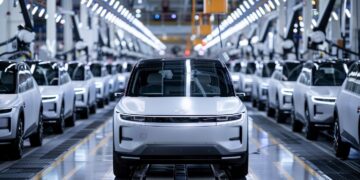
Chinese automotive giants Great Wall Motors (GWM) and Chery Automobile Co. Ltd. have announced plans to establish vehicle assembly operations in South Africa, marking a strategic move that underscores both nations’ deepening industrial and trade ties. The initiative responds to a sharp rebound in domestic vehicle demand, with South Africa’s September 2025 sales climbing 24% year-on-year to 54,700 units—a milestone suggesting a return to pre-pandemic sales levels and renewed confidence in the national economy.
According to Tony Liu, Chief Executive of Chery South Africa, the company intends to nearly double its annual sales to 39,000 vehicles by the end of 2025. Liu revealed that the automaker is evaluating whether to develop a new complete knock-down (CKD) facility or repurpose an existing assembly plant, with a final decision expected within six months. “We’re almost there,” Liu confirmed, indicating that discussions with stakeholders are nearing conclusion.
Meanwhile, GWM, which markets the Haval and Tank brands locally, is exploring joint manufacturing ventures with South African assemblers. Conrad Groenewald, Chief Operating Officer of GWM South Africa, explained that the company is weighing the economic viability of local assembly under the country’s Automotive Production and Development Programme (APDP), which requires high local content and output thresholds. Initial feasibility studies suggest that importing fully built units from China currently yields a 4% margin advantage, though GWM aims for at least a 10% improvement to justify local production.



Both companies’ interest aligns with South Africa’s broader industrialisation strategy, which seeks to balance foreign investment with job creation and skills transfer. However, this expansion also intensifies debate within the sector over import tariffs. Several local manufacturers have urged the government to revise existing policies to incentivise local assembly and protect domestic employment, particularly as imports from China and India increase rapidly.
Chery’s portfolio—which includes the Jetour, Omoda, and Jaecoo brands—registered 4,280 passenger vehicle sales in September, placing the company fourth in national rankings, ahead of global competitors such as Hyundai, Ford, and Kia. GWM followed closely in sixth place, with both brands steadily gaining market share in a landscape traditionally dominated by Toyota, Volkswagen, Ford, BMW, and Mercedes-Benz, all of which maintain long-established manufacturing bases in South Africa.

The strategic expansion of Chinese automakers into local assembly marks a turning point in Africa’s automotive narrative, shifting the continent’s role from consumer market to co-producer in global value chains. It signals a transition toward industrial participation that could strengthen intra-African trade under the African Continental Free Trade Area (AfCFTA) framework, provided policy alignment and investment coordination follow suit.
As Africa’s largest automotive market, South Africa remains a gateway for continental mobility development. The arrival of Chery and GWM’s assembly operations not only reflects China’s evolving industrial diplomacy in Africa but also redefines the continent’s agency in shaping its own manufacturing trajectory—anchored in partnership rather than dependency.