

Wednesday, April 29, 2026
  • Login
The Southern African Times
  • Home
  • Southern Africa
  • Business
    • African Start ups
    • African Continental Free Trade Area
  • Technology
    • Lifestyle
      • Health
      • Culture
      • Food and Drink
      • Entertainment
  • Opinion
  • Sports
  • SAT Jobs
    • Events
  • About Us
    • Advertise with Us
    • Contact Us
No Result
View All Result
  • Home
  • Southern Africa
  • Business
    • African Start ups
    • African Continental Free Trade Area
  • Technology
    • Lifestyle
      • Health
      • Culture
      • Food and Drink
      • Entertainment
  • Opinion
  • Sports
  • SAT Jobs
    • Events
  • About Us
    • Advertise with Us
    • Contact Us
No Result
View All Result
The Southern African Times
No Result
View All Result
Home Markets

Botswana Makes Its Case to Global Investors as Frontier Markets Re-enter Focus

by SAT Reporter
April 29, 2026
in Markets
0
Botswana Makes Its Case to Global Investors as Frontier Markets Re-enter Focus

Neo Mooki, chairperson of the Botswana Stock Exchange, addresses delegates at the African Capital Markets Investment Conference (ACMIC) in London, outlining Botswana’s strategy to position itself as a gateway for global capital.

In the wood-panelled conference rooms of the City of London, where frontier markets are too often relegated to the margins of institutional portfolios, Botswana advanced a proposition that was both measured and quietly disruptive.

At the African Capital Markets Investment Conference (ACMIC), hosted by Financial Markets Indaba, the Botswana Stock Exchange chairperson Neo Mooki presented a case that challenges prevailing assumptions: Botswana is not merely stable by regional standards, but structurally under-owned relative to the strength of its institutions and macroeconomic management.  

This argument arrives at a moment when global capital is being recalibrated. Investors, confronted by persistent inflationary pressures, geopolitical fragmentation and uneven growth trajectories across developed markets, are increasingly exploring diversification into frontier economies. Yet such allocations remain cautious, often constrained by concerns over governance, liquidity and policy unpredictability.


ADVERTISEMENT

Botswana’s pitch rests on precisely these points of differentiation. The country retains an investment-grade sovereign rating, underpinned by prudent fiscal discipline and an independent central bank. Its long-standing reputation for political stability and relatively low levels of corruption has fostered an environment that is both predictable and transparent. These fundamentals, combined with competitive corporate tax structures and targeted incentives in key sectors, suggest a risk profile that may be misaligned with its current level of global capital allocation.
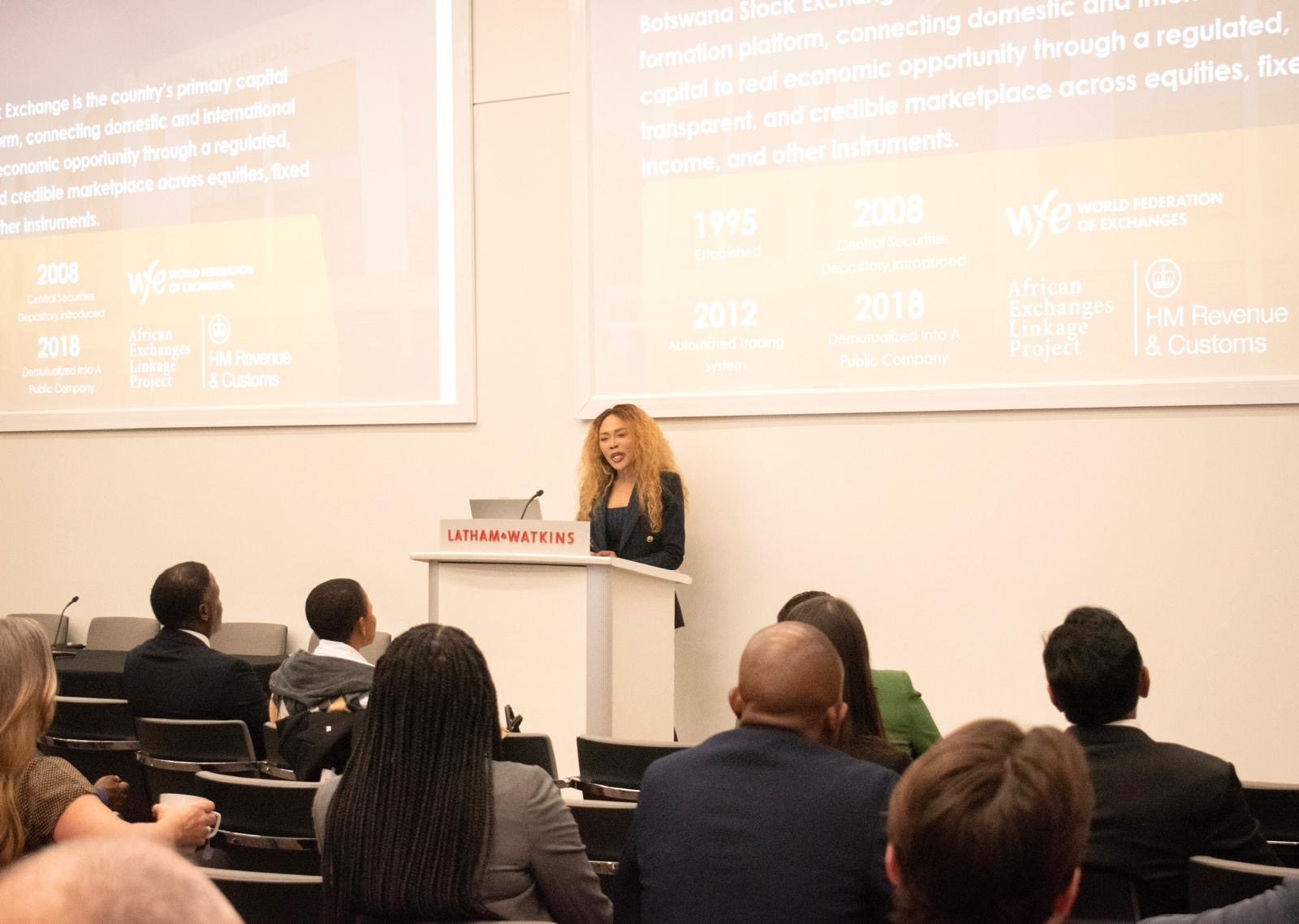
Neo Mooki delivers a keynote presentation at ACMIC London, highlighting Botswana’s investment-grade stability, capital market reforms and pipeline of infrastructure-led growth opportunities.

However, the more substantive dimension of Botswana’s case lies in its economic transition. Historically reliant on diamond exports, the country is actively repositioning itself through structured national programmes aimed at diversifying into financial services, energy, logistics, tourism and agribusiness. Crucially, this is not diversification in rhetoric alone. The emphasis, as articulated in London, is on execution, with clearly defined strategies supported by measurable implementation frameworks.

This shift is reinforced by a pipeline of investment-ready projects. Rail corridor infrastructure, energy grid modernisation, airport expansion and industrial processing initiatives form part of a broader effort to unlock new growth channels. For investors accustomed to high-level reform narratives that lack tangible entry points, Botswana’s presentation offered a degree of specificity that is often absent in frontier market discussions.

Within this framework, the Botswana Stock Exchange operates as both facilitator and barometer. Since its establishment in 1995, the exchange has undergone a series of reforms, including the introduction of a central securities depository, automated trading systems and demutualisation into a public company. These developments have strengthened governance standards and improved operational efficiency, aligning the market more closely with international expectations.  

Recent performance indicators provide some validation of this trajectory. Equity turnover has reached P5.9bn, with year-on-year growth exceeding 250 per cent, while the Domestic Total Return Index has risen by more than 16 per cent. Although these figures remain modest when viewed against global benchmarks, they suggest a market gaining depth and attracting incremental investor participation.  

Equally significant is the role of domestic capital. Botswana’s pension fund assets, estimated at approximately P170bn, represent a substantial reservoir of long-term investment capital. Regulatory initiatives aimed at increasing domestic asset allocation to 50 per cent by 2027 are expected to create sustained demand for local instruments, enhancing liquidity and providing a degree of insulation from external volatility. This internal capital base distinguishes Botswana from many peer markets, where dependence on foreign inflows often exacerbates cyclical instability.

The exchange has also sought to align itself with the growing prominence of environmental, social and governance considerations in global investment strategies. Initiatives such as a dedicated sustainable bond segment, alignment with international ESG frameworks and the early development of a voluntary carbon market indicate a recognition that future capital flows will be increasingly shaped by sustainability mandates.

Yet the most striking element of Botswana’s presentation may have been its reframing of perceived limitations. Market size, liquidity constraints and economic concentration, typically cited as deterrents, were positioned instead as sources of opportunity. An under-allocated market, by definition, offers the potential for early entry, diversification benefits and the possibility of mispricing relative to underlying fundamentals.

This framing, while compelling, warrants careful examination. Frontier markets have historically been subject to cycles of enthusiasm and retrenchment, often driven more by global liquidity conditions than domestic realities. Botswana’s challenge will be to attract sustained foreign investment without exposing itself to the volatility that has characterised similar markets. Maintaining the balance between openness and macroeconomic stability will be critical.

Nonetheless, the clarity and coherence of Botswana’s investment narrative set it apart. Rather than relying on speculative growth projections or broad reform agendas, the country is presenting a grounded proposition: institutional credibility, policy consistency and a pipeline of tangible opportunities, mediated through a functioning and increasingly sophisticated capital market.

For global investors navigating an increasingly fragmented economic landscape, such attributes may prove more valuable than headline growth rates alone. The question is no longer whether Botswana is investable, but whether international portfolios, still heavily concentrated in developed and larger emerging markets, are prepared to adjust their assumptions.

If the reception in London is any indication, Botswana is no longer content to remain peripheral. It is, instead, positioning itself with quiet confidence as a credible gateway for capital seeking both resilience and long-term growth.

Tags: ACMIC LondonAfrican capital marketsBotswana economyBotswana Stock ExchangeEmerging MarketsESG investingFinancial Markets Indabafrontier marketsglobal capital flowsinfrastructure investmentinvestment opportunities Africapension funds Africa
Previous Post

Zimbabwe warns nationals in South Africa after reports of anti-foreigner unrest

Next Post

DR Congo Clarifies Financing Strategy for Planned Mining Guard

SAT Reporter

Related Posts

Africa Faces Prolonged Energy and Fertiliser Shock as Policy Uncertainty Grows
Markets

Africa Faces Prolonged Energy and Fertiliser Shock as Policy Uncertainty Grows

by SAT Reporter
April 27, 2026
AFRINEX highlights global capital platform at African markets conference
Markets

AFRINEX highlights global capital platform at African markets conference

by SAT Reporter
April 27, 2026
ASEA President Highlights African Markets Growth and Integration Drive
Markets

ASEA President Highlights African Markets Growth and Integration Drive

by SAT Reporter
April 27, 2026
Oil rises and global markets steady as US Iran diplomacy stalls
Markets

Oil rises and global markets steady as US Iran diplomacy stalls

by SAT Reporter
April 27, 2026
S&P Warns Middle East Conflict May Raise Africa Credit Risks
Markets

S&P Warns Middle East Conflict May Raise Africa Credit Risks

by SAT Reporter
April 25, 2026
Next Post
DR Congo to deploy 20,000 strong Mining Guard to reinforce sector governance

DR Congo Clarifies Financing Strategy for Planned Mining Guard

Browse by Category

  • Africa AI
  • African Continental Free Trade Area
  • African Debt
  • African Start ups
  • Agriculture
  • AI Africa
  • Algeria
  • All News
  • Analysis
  • Angola
  • Arts / Culture
  • Asia
  • Botswana
  • BOTSWANA
  • BREAKING NEWS
  • BRICS
  • Burkina Faso
  • Burundi
  • Business
  • Business
  • Business Wire
  • Cameroon
  • Central Africa
  • Chad
  • China
  • Climate Change
  • Climate Changev
  • Community
  • Congo Republic
  • Conservation
  • Côte d’Ivoire
  • COVID 19
  • CRYPTOCURRENCY
  • Culture
  • Democratic Republic of Congo
  • Diplomacy
  • Eastern Africa
  • Economic Development
  • Economy
  • Education
  • Egypt
  • Elections 2024
  • Energy
  • Entertainment
  • Environment
  • Eritrea
  • Ethiopia
  • Europe
  • Fashion
  • Feature
  • Finance
  • Financial Inclusion
  • Food
  • Food and Drink
  • Foods
  • GABON
  • Ghana
  • Global
  • Global Africa
  • Guinea
  • Health
  • Immigration
  • in Southern Africa
  • International news
  • International Relations
  • Investment
  • Ivory Coast
  • Just In
  • Kenya
  • Lesotho
  • Libya
  • Life Style
  • Lifestyle
  • Literature
  • Malawi
  • Malawi
  • Mali
  • Markets
  • Mauritius
  • Middle East
  • Mining in Africa
  • Morocco
  • Mozambique
  • Namibia
  • niger
  • Niger
  • Nigeria
  • North Africa
  • North-Eastern Africa
  • Obituaries
  • Obituary
  • Opinion
  • PARTNER CONTENT
  • Politics
  • Property
  • Racism
  • Rwanda
  • Rwanda
  • SADC
  • SAT Interviews
  • SAT Investigation
  • SAT Jobs
  • Saudi Arabia
  • Senegal
  • Seychelles
  • Somaliland
  • South Africa
  • South Sudan
  • Sports
  • Startup Africa
  • STOCK EXCHANGE
  • Sudan
  • Sustainability
  • Sustainablity
  • Tanzania
  • Technology
  • Telecommunications
  • The Editorial Board
  • The Power Of She
  • Togo
  • Trade
  • Travel
  • Travel
  • Tunisia
  • Uganda
  • Uncategorized
  • Wealth
  • West Africa
  • World
  • World
  • ZAMBIA
  • Zambia
  • ZIMBABWE
  • Zimbabwe

Browse by Tags

#NewsUpdate #SouthAfrica #SouthernAfricanTimes #TheSouthernAfricanTimes AfCFTA africa African Continental Free Trade Area African development African Development Bank African economies African economy African Union Agriculture Angola Botswana Business China Climate change Cyril Ramaphosa Economic Development economic growth energy transition fiscal policy food security industrialisation Inflation Infrastructure Development International relations Investment Kenya Mozambique Namibia news Nigeria Regional Integration renewable energy Rwanda SADC South Africa Southern Africa sustainable development Tanzania United States Zambia Zimbabwe
ADVERTISEMENT

WHO WE ARE

The Southern African Times is a regional bloc digital newspaper that covers Southern African and world news. The paper also gives a nuanced analysis on news and covers a wide range of reporting which include sports, entertainment, foreign affairs, arts and culture.

Welcome Back!

Login to your account below

Forgotten Password?

Retrieve your password

Please enter your username or email address to reset your password.

Log In

  • Home
  • Southern Africa
  • Business
    • African Start ups
    • African Continental Free Trade Area
  • Technology
    • Lifestyle
      • Health
      • Culture
      • Food and Drink
      • Entertainment
  • Opinion
  • Sports
  • SAT Jobs
    • Events
  • About Us
    • Advertise with Us
    • Contact Us
Are you sure want to unlock this post?
Unlock left : 0
Are you sure want to cancel subscription?