Tuesday, May 26, 2026
  • Login
The Southern African Times
  • Home
  • Southern Africa
  • Business
    • African Start ups
    • African Continental Free Trade Area
  • Technology
    • Lifestyle
      • Health
      • Culture
      • Food and Drink
      • Entertainment
  • Opinion
  • Sports
  • SAT Jobs
    • Events
  • About Us
    • Advertise with Us
    • Contact Us
No Result
View All Result
  • Home
  • Southern Africa
  • Business
    • African Start ups
    • African Continental Free Trade Area
  • Technology
    • Lifestyle
      • Health
      • Culture
      • Food and Drink
      • Entertainment
  • Opinion
  • Sports
  • SAT Jobs
    • Events
  • About Us
    • Advertise with Us
    • Contact Us
No Result
View All Result
The Southern African Times
No Result
View All Result
Home Mining in Africa

Botswana Confronts an Uncertain Future as Synthetic Diamonds Disrupt the Industry

by SAT Reporter
June 14, 2025
in Mining in Africa
0
Botswana Confronts an Uncertain Future as Synthetic Diamonds Disrupt the Industry

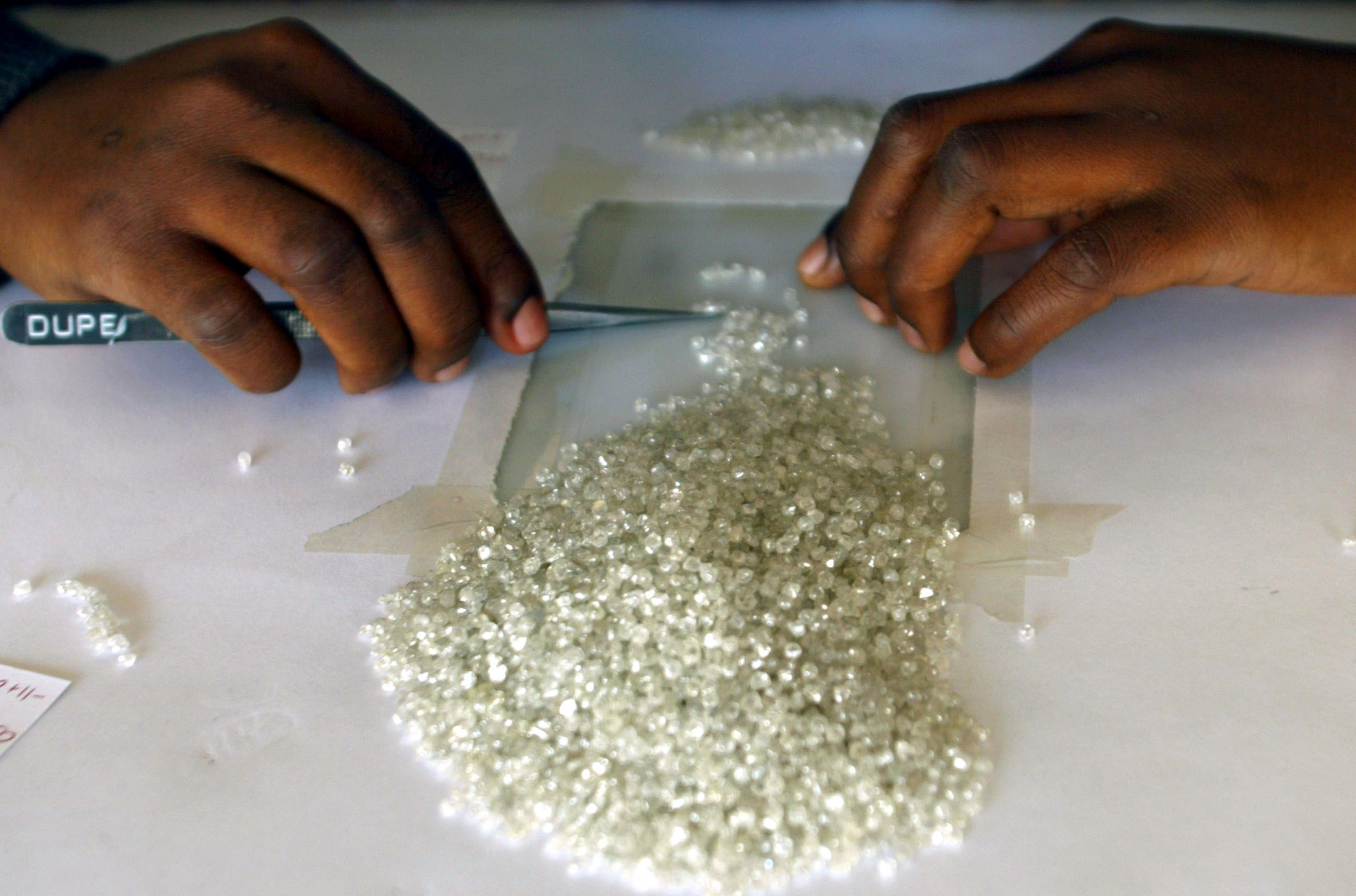
FILE PHOTO: A worker at the Botswana Diamond Valuing Company displays a rough diamond during the sorting process at the purpose-built centre in the capital Gaborone August 26,2004. REUTERS/Juda Ngwenya jn/DBP/File Photo

Diamonds, once emblematic of wealth, exclusivity and permanence, are rapidly losing their economic luster—at least the ones mined from the earth. The proliferation of laboratory-grown diamonds, chemically and visually identical to their natural counterparts, has catalysed a profound transformation in the global diamond industry. Now indistinguishable from mined diamonds without specialist testing, synthetics are produced within weeks and at a fraction of the cost, a development that threatens the economic bedrock of diamond-dependent nations, especially Botswana.

Just five years ago, lab-grown diamonds cost more than their natural equivalents. Today, they are approximately 80 per cent cheaper. This drastic reduction has depressed the global price of mined diamonds, which now sell for nearly 40 per cent less than their 2022 peak. The ramifications of this shift are deeply felt in Southern Africa, particularly in Botswana, the world’s leading diamond producer by value.

Botswana’s economy has historically been intertwined with diamond revenues, which account for nearly 80 per cent of its exports. However, this dependency has turned precarious. In May 2025, the government announced the retrenchment of 1,000 workers at its largest diamond mine—operated by Debswana, a joint venture between the state and De Beers. In parallel, some mines will suspend operations for three months, a move reflecting the broader volatility of the market. The layoffs are not only economically disruptive but also politically sensitive. The current administration, elected in 2024 on a platform promising economic revitalisation, must now manage an unfolding crisis, with growth forecasts slashed from 3.3 per cent to nearly zero.


ADVERTISEMENT

This upheaval is not confined to Botswana. In Lesotho, diamonds dominate exports; in Namibia and Angola, they rank as the second-largest export earners. These economies briefly flourished in 2022 when Russian diamonds faced sanctions and were excluded from Western markets. Yet this windfall proved fleeting.

The current downturn represents a kind of reckoning long postponed. Since the late 19th century, diamond scarcity was meticulously curated rather than naturally occurring. When Southern Africa’s rich deposits were first unearthed in the 1870s, the threat of oversupply was imminent. This risk was deftly mitigated by the establishment of De Beers in 1888, which controlled supply and maintained elevated prices. The discovery of major deposits in Botswana during the 1960s entrenched this model further, catalysing the transformation of a former British protectorate—whose capital once lay beyond its borders—into one of Africa’s most stable and prosperous nations.

This prosperity, however, is now under threat. De Beers, long the emblem of diamond dominance, has itself suffered dramatically. Having lost its global monopoly in the early 2000s, its fortunes revived briefly due to burgeoning Chinese demand. Yet recent declines in Chinese sales have contributed to significant losses. Its parent company, Anglo American, announced plans in 2024 and 2025 to divest De Beers, reducing its valuation by a cumulative $4.5 billion. Today, the company is worth less than half of its value just two years ago.

This instability casts a shadow over Botswana’s new diamond marketing agreement with De Beers. The deal, hailed as a strategic victory, allows the country to gradually increase its share of independently marketed diamonds from 10 per cent in 2010 to 50 per cent by the late 2030s. For the first time, Botswana can also negotiate long-term contracts with select buyers. Sales are slated to begin in September 2025. Yet, the stark question remains: will there still be demand for these diamonds in a market saturated with indistinguishable synthetic alternatives?

The broader cultural shift may prove just as decisive as the economic one. Natural diamonds have long symbolised rarity, romance and luxury. Today, however, synthetic stones—virtually identical to the untrained eye—undermine that aura of exclusivity. The discovery of a 2,492-carat stone at Karowe Mine in 2024 is a testament to nature’s grandeur, but such spectacles may lose their awe when replicated at scale in laboratories.

This symbolic erosion coincides with real economic peril. Southern African nations must now chart post-diamond futures at a time of global trade fragmentation, waning investor confidence, and shrinking development assistance. In Botswana’s case, the shift comes with added urgency. With only around 10,000 individuals employed in the mining sector, the industry’s contribution to jobs has always been limited. However, its centrality to national revenues and social services cannot be overstated.

The transformation of the diamond industry may well be irreversible. For Botswana and its regional peers, the challenge is not just economic reorientation, but the reinvention of a national narrative no longer anchored in precious stones. In an era of synthetic abundance, these nations must discover new paths to prosperity—and quickly. The geological epochs that birthed diamonds took billions of years, but the next chapter of development for Southern Africa must unfold within a much shorter timeframe.

Previous Post

Africa’s Fintech Capitals: Lagos, Nairobi, Cairo Dominate

Next Post

Angola Sees Substantial Growth in Wireless Service Penetration

SAT Reporter

Related Posts

Valterra Keeps Platinum Operations Stable Amid Iran War Risks
Mining in Africa

Valterra Keeps Platinum Operations Stable Amid Iran War Risks

by SAT Reporter
May 19, 2026
Zambia Forms Gold Mining Joint Venture to Diversify Beyond Copper
Mining in Africa

Zambia Forms Gold Mining Joint Venture to Diversify Beyond Copper

by SAT Reporter
May 19, 2026
Caledonia Mining reports higher Q1 revenue as gold prices strengthen
Mining in Africa

Caledonia Mining reports higher Q1 revenue as gold prices strengthen

by SAT Reporter
May 18, 2026
Zimbabwe Expands Diamond Ambitions Despite Global Turbulence
Mining in Africa

Zimbabwe Expands Diamond Ambitions Despite Global Turbulence

by SAT Reporter
May 18, 2026
Zimbabwe Signals Review of Lithium Export Quotas as Processing Capacity Expands
Mining in Africa

Zimbabwe Signals Review of Lithium Export Quotas as Processing Capacity Expands

by SAT Reporter
May 13, 2026
Next Post
Angola Sees Substantial Growth in Wireless Service Penetration

Angola Sees Substantial Growth in Wireless Service Penetration

Browse by Category

  • Africa AI
  • African Continental Free Trade Area
  • African Debt
  • African Start ups
  • Agriculture
  • AI Africa
  • Algeria
  • All News
  • Analysis
  • Angola
  • Arts / Culture
  • Asia
  • Botswana
  • BOTSWANA
  • BREAKING NEWS
  • BRICS
  • Burkina Faso
  • Burundi
  • Business
  • Business
  • Business Wire
  • Cameroon
  • Central Africa
  • Chad
  • China
  • Climate Change
  • Climate Changev
  • Community
  • Congo Republic
  • Conservation
  • Côte d’Ivoire
  • COVID 19
  • CRYPTOCURRENCY
  • Culture
  • Democratic Republic of Congo
  • Diplomacy
  • Eastern Africa
  • Economic Development
  • Economy
  • Education
  • Egypt
  • Elections 2024
  • Energy
  • Entertainment
  • Environment
  • Eritrea
  • Ethiopia
  • Europe
  • Fashion
  • Feature
  • Finance
  • Financial Inclusion
  • Food
  • Food and Drink
  • Foods
  • GABON
  • Ghana
  • Global
  • Global Africa
  • Guinea
  • Health
  • Humanitarian Aid
  • Immigration
  • in Southern Africa
  • International news
  • International Relations
  • Investment
  • Ivory Coast
  • Just In
  • Kenya
  • Lesotho
  • Libya
  • Life Style
  • Lifestyle
  • Literature
  • Malawi
  • Malawi
  • Mali
  • Markets
  • Mauritius
  • Middle East
  • Mining in Africa
  • Morocco
  • Mozambique
  • Namibia
  • niger
  • Niger
  • Nigeria
  • North Africa
  • North-Eastern Africa
  • Obituaries
  • Obituary
  • Opinion
  • PARTNER CONTENT
  • Politics
  • Property
  • Racism
  • Rwanda
  • Rwanda
  • SADC
  • SAT Interviews
  • SAT Investigation
  • SAT Jobs
  • Saudi Arabia
  • Senegal
  • Seychelles
  • Somaliland
  • South Africa
  • South Sudan
  • Sports
  • Startup Africa
  • STOCK EXCHANGE
  • Sudan
  • Sustainability
  • Sustainablity
  • Tanzania
  • Technology
  • Telecommunications
  • The Editorial Board
  • The Power Of She
  • Togo
  • Trade
  • Travel
  • Travel
  • Tunisia
  • Uganda
  • Uncategorized
  • Wealth
  • West Africa
  • World
  • World
  • ZAMBIA
  • Zambia
  • ZIMBABWE
  • Zimbabwe

Browse by Tags

#NewsUpdate #SouthAfrica #SouthernAfricanTimes #TheSouthernAfricanTimes AfCFTA africa African Continental Free Trade Area African development African Development Bank African economies African economy African Union Agriculture Angola Botswana China Climate change Cyril Ramaphosa Economic Development economic growth energy transition governance IMF industrialisation Inflation Infrastructure Infrastructure Development International relations Investment Kenya Mozambique Namibia news Nigeria Regional Integration renewable energy Rwanda SADC South Africa Southern Africa sustainable development Tanzania United States Zambia Zimbabwe
ADVERTISEMENT

WHO WE ARE

The Southern African Times is a regional bloc digital newspaper that covers Southern African and world news. The paper also gives a nuanced analysis on news and covers a wide range of reporting which include sports, entertainment, foreign affairs, arts and culture.

Welcome Back!

Login to your account below

Forgotten Password?

Retrieve your password

Please enter your username or email address to reset your password.

Log In
  • Home
  • Southern Africa
  • Business
    • African Start ups
    • African Continental Free Trade Area
  • Technology
    • Lifestyle
      • Health
      • Culture
      • Food and Drink
      • Entertainment
  • Opinion
  • Sports
  • SAT Jobs
    • Events
  • About Us
    • Advertise with Us
    • Contact Us
Not enough quota to unlock this post
Unlock left : 0
Are you sure want to cancel subscription?