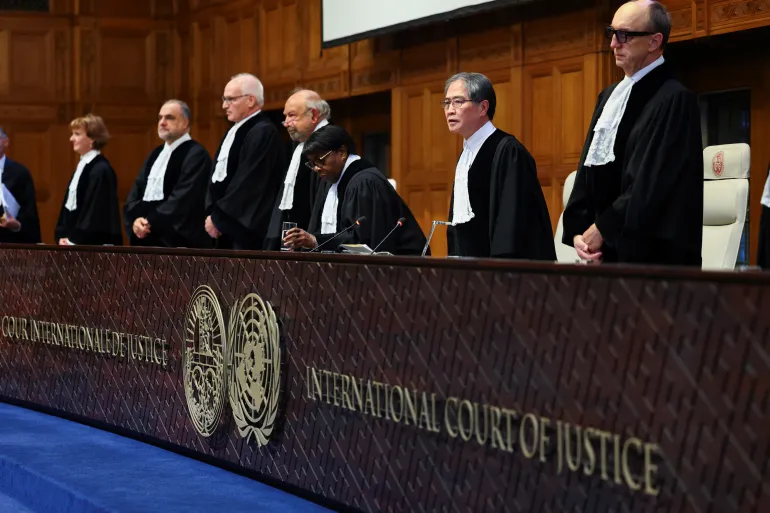
Belgium has formally joined South Africa’s legal action against Israel at the International Court of Justice (ICJ) in The Hague, signalling a deepening international engagement with one of the most significant legal challenges concerning the war in Gaza.
In a declaration of intervention filed earlier this week, Belgium stated that its participation does not amount to endorsement of either South Africa’s allegations or Israel’s defence. Instead, the government affirmed that its purpose is to clarify its interpretation of international law under the 1948 UN Convention on the Prevention and Punishment of the Crime of Genocide. Belgian officials underscored that the existence of an armed conflict does not exempt any party from accountability under international humanitarian law.
The case, brought by South Africa in December 2023, accuses Israel of violating the Genocide Convention through its military operations in Gaza. Israel has firmly denied these accusations, maintaining that its military actions are directed at Hamas following the 7 October 2023 attacks, and that it has no intention of targeting civilians.



Belgium joins a growing list of states including Brazil, Colombia, Ireland, Mexico, Spain and Turkey that have filed declarations to intervene in the proceedings. Their participation reflects an evolving international consensus that questions of genocide, humanitarian law and state responsibility must be adjudicated through established global mechanisms.
In its earlier provisional rulings issued in January, March and May 2024, the ICJ ordered Israel to take all measures within its power to prevent acts of genocide in Gaza. The Court also required Israel to facilitate humanitarian assistance to avert famine. Although these orders are legally binding, the ICJ has no enforcement mechanism to ensure compliance.
South Africa’s case has drawn significant attention within the Global South, particularly across the African continent, where the use of international legal instruments to assert moral and political agency is increasingly seen as a means of redefining participation in global governance. Pretoria’s recourse to the ICJ has been interpreted by scholars and policymakers as a reflection of Africa’s enduring commitment to international law as a tool for justice rather than coercion.

Belgium’s involvement also follows its announcement in September 2025 that it would recognise the State of Palestine, though the government emphasised that formal recognition would depend on the exclusion of Hamas from Palestinian leadership structures. This position aligns with Belgium’s long-standing advocacy for a negotiated two-state solution and its emphasis on adherence to international norms.
The ICJ proceedings are expected to continue for several years before a final judgment is reached. Regardless of the outcome, the case has already altered the global discourse on accountability and humanitarian law. It underscores the capacity of states from the Global South, such as South Africa, to influence the parameters of international justice and reshape narratives surrounding the moral and legal dimensions of warfare.
The unfolding process at The Hague may ultimately test not only the limits of international law but also the willingness of the global community to uphold its principles in contexts marked by asymmetry and deep historical grievance.