

In February 2019, Eat’n’Go, the Nigerian franchisee of popular pizza maker Domino’s, introduced a miniature version of the pizza boxes the market was familiar with, for 550 naira ($1.50).
Smaller in size and far cheaper than the medium-sized pizza which costs N3,900 ($9), this new version was designed to be affordable for everyone.
It was a necessary decision given the economic instability at the time, CEO Patrick Michael told Al Jazeera.



“The Nigerian market is diverse, and the potential for profit remains high,” he said. “However, we can’t overlook the economic instability [which] has, in some way, affected purchasing power. At times like this, it becomes pertinent for industry players like ourselves to cushion the effect of this situation on customers.”
Two years earlier, StarTimes, a Chinese satellite TV provider with a strong presence in Nigeria, had added daily and weekly subscriptions – with fewer channels – at N60 (15 cents) and N300 (72 cents) respectively, to its existing monthly option.
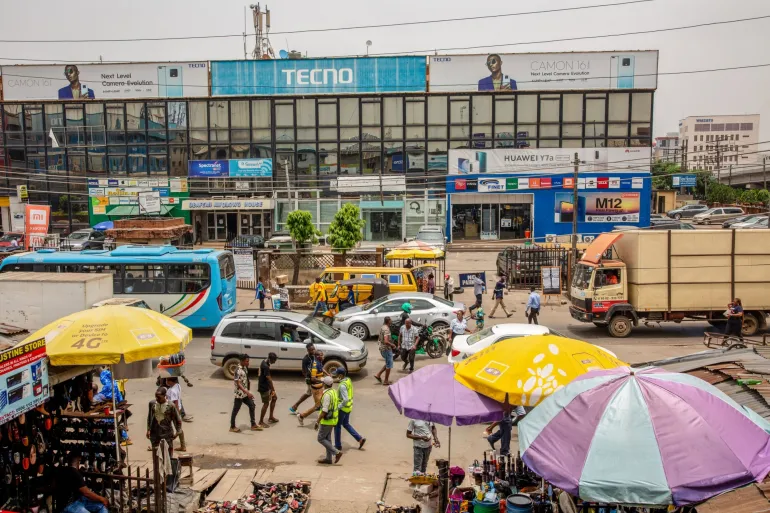
Since 2015, Nigeria, Africa’s largest economy, has gone into recession twice and in that time, the naira has plummeted against the dollar, losing 70 percent of its value. That put the economy in a chokehold. But things could become even worse in the coming days.
According to a recent World Bank report[PDF], by 2022, the number of poor people in the country is projected to reach 95.1 million – more than 40 percent of the population. And even as the adverse economic effects of the COVID-19 pandemic linger, commodity prices are on the rise due to the effect of Russia’s invasion of Ukraine.

A 2022 report by the National Bureau of Statistics (NBS), shows that Nigeria’s annual inflation rate accelerated for the third straight month to 16.82% in April 2022, from 15.92% in March. It was the steepest rise in inflation since August 2021 and follows the trend of a global surge in commodity prices.
For Nigerians, the end result is a huge depletion of their purchasing power and ultimately, less money in their accounts.
Indeed, while there were 133.5 million active bank accounts in the country as of December 2021, 99% of those accounts had less than 500,000 naira ($1,200), according to the Nigeria Deposit Insurance Corporation.
A response to market reality
To cope with this reality, businesses like Eat’n’Go are turning to sachet marketing as a strategy to stay in business.
Scholars Rodolfo P. Ang and Joseph A. Sy-Changco of Ateneo de Manila University in The Philippines, define sachet marketingas “the effort to increase market penetration for one’s product by making it available in smaller, more affordable packs…a tool for penetrating the market at the bottom of the economic pyramid.”
Colloquially referred to as ‘sachetisation’, it has been around in Nigeria for decades and is prevalent in other emerging markets like The Phillippines and India.
Fast-moving consumer goods businesses (FMCGs) adopted it for items like “‘pure water”, powdered milk and instant noodle packs. This, Shakirudeen Taiwo, a Nigerian economist, told Al Jazeera, allowed the companies to cater to up to 80% of the market.
But in recent years, brands have ramped up the strategy, as a new economic reality set in. These products are now sold in even smaller sachets or small nylon bags.
“As at last count, we have over 75% of households in Nigeria living below $3-5 per day, which is huge,” Taiwo said. “So, companies start modelling their products to fit this income bracket of people since they make up the bulk of the population.”
Doing this helps businesses reach more customers and maximise profits as they can sell more products at a cumulatively higher price. But more importantly for buyers, it cushions the effects of inflation even if they have to sacrifice quantity and in some cases, quality, too.
How sachet marketing plays out in Nigeria’s tech industry
The trend is also playing out in Nigeria’s tech industry and influencing how more startups are thinking about product pricing.

Eke Urum, Lagos-based investor and financial analyst agrees, saying the strategy is “a response to a bad reality” as “demand backed by purchasing power is getting smaller.”
Rise, the fintech startup he runs, allows Nigerians to make dollar investments into real estate and the stock market in the United States, with as little as $1.
In Nigeria where insurance penetration is less than 2%, Reliance Health, a startup, created a system where people do not have to be formally employed to access health insurance. It introduced plans from 3,500 naira ($7) to 148,500 naira ($297) that allow users to pay monthly, quarterly, or annually.
A solution or a problem?
The Nigerian government seemed to understand this, too, when it launched a micro-pension scheme in 2019.
It expanded the country’s contributory pension scheme to allow individuals in the informal and semi-formal industries to create accounts without a plan sponsor – typically their employer – and save small amounts over a long period.
While the scheme has not fully caught on yet for various reasons, it illustrates the state of the market and how institutions operating here are adapting.
But experts and industry stakeholders say satchetisation is as much of an innovative solution as it is evidence of a large-scale problem.
“[It] can be a form of democratisation where companies desire to bring products to people who otherwise cannot afford them,” said Bamboo’s Omorogbe. “But a second perspective is that rapidly growing poverty, where most people in the economy can’t afford [a] product or service and are increasingly moving farther away from affording them.”
As inflation rises while purchasing power inversely declines, more companies in various sectors of the economy could turn to sachetisation, even service providers that previously served only the upper and middle class.
“A trip to the mall will show you that the concept of sachetisation is gaining more traction,” Taiwo said. “We might also start seeing it in terms of services. Companies offering integrated services might start offering specific services at lower prices [to] ensure affordability and business survival.”


