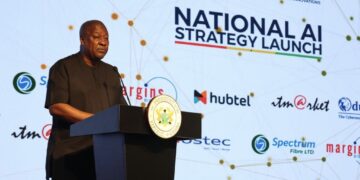
In 2026, Africa’s artificial intelligence (AI) landscape is becoming a reflection of both ambition and innovation. While the global race to build AI ecosystems intensifies, African nations are steadily crafting their own narrative — one that balances research, inclusion, and industrial potential. According to Stanford University’s Human-Centred Artificial Intelligence (HAI) Global AI Vibrancy Tool 2025, which ranks 36 nations by the strength of their AI ecosystems, South Africa remains the continent’s only entrant in the global index, ranking thirty-sixth overall and thirty-first per capita. Yet, beneath this headline, a more complex picture of regional progress is emerging across the continent.
10. Madagascar
Madagascar is positioning itself as a quiet but determined participant in Africa’s AI evolution. The Malagasy Association for Artificial Intelligence aims to establish the country as the hub of French-speaking AI innovation. The island nation has invested in educational collaborations and seeks to build a research ecosystem that connects the Indian Ocean with continental Africa. Its long-term strategy focuses on producing high-quality research over rapid deployment, which could yield exponential results in the next few years.
9. Kenya
Kenya’s National AI Strategy 2025–2030 launched in March 2025 demonstrates a commitment to policy-led innovation. Building on its global recognition for digital finance and mobile technology, Kenya is now extending that momentum to artificial intelligence. The Kenya Private Sector Alliance (KEPSA) and Microsoft’s Kenya Artificial Intelligence Skilling Alliance (KAISA) are key partners in developing technical and policy skills. With a rich base of tech-savvy youth and experience in data labelling for global platforms, Kenya has the potential to become East Africa’s most dynamic AI research hub.



8. Ghana
Ghana’s growing AI ecosystem reflects consistent collaboration between academia and global technology companies. Google’s first African AI research lab, established in Accra in 2019, has since been expanded with the AI Community Centre launched in July 2025. With over $37 million invested in AI initiatives, Ghana continues to cultivate research networks and local startups that apply AI to agriculture, education, and sustainability. Its focus on inclusive innovation underscores Ghana’s place in West Africa’s digital transformation story.

7. Rwanda
Rwanda remains one of Africa’s most policy-driven innovation economies. The Kigali-based AI Scaling Hub, supported by a $17.5 million investment from the Gates Foundation, aims to develop solutions tailored to African social and economic realities. Hosting the Global AI Summit on Africa in 2025, Rwanda has positioned itself as a convening centre for continental dialogue on AI ethics and governance. The nation’s approach to AI is methodical, focused on practical integration into public services rather than headline projects.
6. Angola
Angola’s expanding digital and energy partnerships are transforming its position in the Lusophone AI landscape. With agreements involving Huawei, EY and SLB, Luanda is emerging as a centre for AI applications in the energy sector. Africell’s AfriGPT service, accessible on feature phones without internet, demonstrates a pragmatic approach to consumer AI. Angola’s inclusion in The African Engineering and Technology Network and its forthcoming Huawei Research and Development Centre reflect long-term investment in AI for industrial diversification.
5. Côte d’Ivoire
Côte d’Ivoire’s AI potential is rooted in its strong academic and institutional infrastructure. The African Development Bank, headquartered in Abidjan, continues to promote AI integration across the continent, indirectly benefiting the host nation. The International University of Grand-Bassam and its leadership in the African Mathematical Union highlight the country’s potential for breakthroughs in mathematical models for AI. Côte d’Ivoire is strategically building a bridge between theoretical research and applied innovation, supported by a new network of regional universities.
4. Nigeria
Nigeria is emerging as one of the most active AI environments in Africa. The Nigerian Artificial Intelligence Research Scheme (NAIRS) has supported multiple projects and facilitated the publication of AI research papers across major universities. Google.org’s $2.1 million investment in 2025 and the AI Collective network of over 2,000 professionals reflect a growing ecosystem. Nigeria’s strength lies in the scale of its human capital — a young, inventive population capable of applying AI to sectors such as traffic management, agriculture, and micro-enterprise development. Yet, challenges remain in converting innovation energy into globally competitive products.
3. Egypt
Egypt’s dual identity as both an African and Middle Eastern country gives it a unique position in AI diplomacy and development. The government’s National AI Strategy 2025–2030 is complemented by partnerships with India and the European Union. The country is preparing to host the AI Everything Middle East & Africa 2026 conference in Cairo, which is expected to further anchor Egypt’s role in regional cooperation. With the African Export-Import Bank exploring AI applications for trade, Egypt’s influence extends well beyond its borders.
2. Eswatini
Eswatini has emerged as one of the continent’s most promising AI newcomers. The University of Eswatini’s AI Academy, supported by the national government, represents a rare fusion of education, innovation, and community engagement. By focusing on tactical, scalable projects, Eswatini demonstrates that smaller nations can achieve disproportionate influence in high-technology fields. Its programmes are designed to empower local professionals and policymakers with the skills required for ethical and responsible AI application.
1. South Africa
South Africa remains Africa’s undisputed AI leader. Its Centre for Artificial Intelligence Research (CAIR), a network of 11 research groups across eight universities, continues to define the continental benchmark. The Machine Intelligence and Neural Discovery Institute at Wits University, supported by Google.org funding, exemplifies South Africa’s capacity for interdisciplinary excellence. In 2025, Cassava Technologies deployed 3,000 GPUs and launched the continent’s first GPU-as-a-Service platform, marking a milestone in digital infrastructure. These achievements reflect a decade-long commitment to developing a globally recognised AI ecosystem anchored in science, education, and responsible innovation.
Africa’s AI trajectory shows that leadership is no longer confined to traditional powerhouses. From Eswatini’s educational innovation to Angola’s industrial applications and Ghana’s research collaborations, African nations are demonstrating that AI can be both a tool for economic competitiveness and a vehicle for human-centred progress.
The road to 2030 will require greater continental coordination, deeper investment in theoretical research, and stronger policy frameworks that protect labour and social welfare. Ultimately, Africa’s success in AI will depend not on replication of Western models but on the creation of uniquely African paradigms that reflect the continent’s intellectual and cultural diversity.