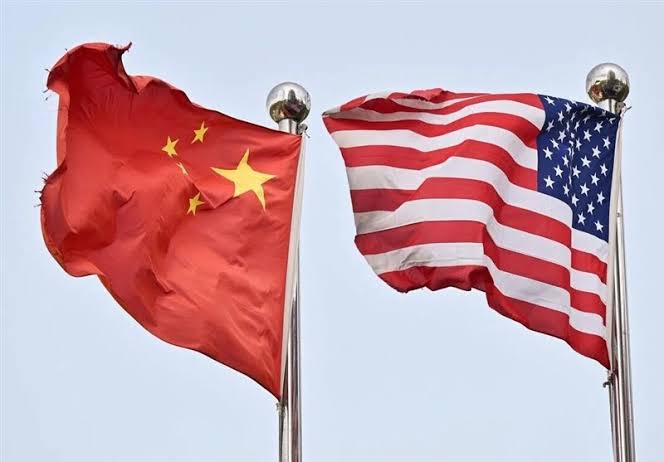
For decades, the United States has relied on economic sanctions as one of its most effective instruments of global power. Through control of dollar based transactions, banking access, and the global financial architecture, Washington has been able to isolate states, corporations, and individuals with remarkable efficiency. The formula has historically been simple: once sanctions are imposed, the world follows.
But events in May 2026 suggest that formula may be changing.
When the United States sanctioned five of China’s largest oil refining companies over alleged purchases of Iranian crude oil, the expectation in Washington appeared straightforward. Banks would cut ties. Insurers would withdraw. Global firms would quietly distance themselves from the sanctioned entities rather than risk secondary penalties from the U.S. Treasury.



Instead, Beijing responded with unusual speed and clarity.
On May 2, China invoked its Anti Foreign Sanctions Law, declaring the American sanctions null and unenforceable within Chinese jurisdiction. The move was not merely symbolic. It represented one of the clearest indications yet that China is now prepared to directly challenge the extraterritorial reach of U.S. financial power.

The implications extend far beyond oil imports or bilateral tensions. What emerged was a deeper question about the future of global economic coercion itself: can traditional sanctions still work against a country as economically central and institutionally prepared as China?
For years, the strength of U.S. sanctions rested not only on American power, but on global dependence. Access to dollar clearing systems, SWIFT networks, and Western capital markets left most governments and corporations with little room to resist. Secondary sanctions amplified this leverage by forcing third parties into compliance, regardless of whether they agreed politically with Washington’s objectives.
China, however, is no longer a peripheral player vulnerable to isolation. It is deeply embedded in global manufacturing, trade, technology, energy markets, and supply chains. That scale changes the calculation.
The legal infrastructure supporting Beijing’s response has also evolved rapidly. Although the Anti Foreign Sanctions Law was introduced in 2021, many initially dismissed it as largely performative. That perception shifted dramatically after March 2025, when new implementation regulations transformed the framework into a more operational and enforceable system.
The revised structure broadened the grounds upon which China could retaliate against foreign measures deemed harmful to its sovereignty, security, or development interests. More importantly, it introduced mechanisms allowing Chinese firms to pursue legal action against companies complying with foreign sanctions.
A notable example emerged in late 2024 when a Chinese marine engineering company successfully pursued compensation after a European client withheld payment following U.S. sanctions. The case culminated in intervention by the Nanjing Maritime Court and later received endorsement from China’s Supreme People’s Court as a persuasive legal precedent.
That moment mattered because it signalled that Beijing was no longer relying solely on political rhetoric. It was institutionalising resistance.
The result is an increasingly difficult environment for multinational corporations operating between the world’s two largest economies. Comply with American sanctions, and firms risk exposure under Chinese law. Ignore Washington, and they face penalties from the United States. This dual pressure is not accidental. It reflects a deliberate attempt by Beijing to raise the commercial cost of enforcing U.S. sanctions within China itself.
The latest confrontation centres around five major refining firms, including Hengli Petrochemical and several large Shandong based operators accused by Washington of facilitating Iranian oil trade. Chinese authorities rejected the allegations, while state media framed the American measures as another example of unlawful “long arm jurisdiction.”
What makes this confrontation particularly significant is timing. It unfolds ahead of an anticipated summit between Chinese and American leadership at a moment when relations are already strained by disputes over trade, technology, Taiwan, semiconductors, and geopolitical influence.
Yet beneath the diplomatic tension lies a larger structural shift.
The effectiveness of sanctions has always depended on the assumption that the target economy could not realistically function outside the dominant Western financial order. That assumption becomes harder to sustain when the target is the world’s second largest economy, a leading trading partner for much of the Global South, and a country actively building alternative systems of finance, trade settlement, and legal protection.
This does not mean U.S. sanctions have become irrelevant. The dollar remains dominant. American financial institutions still wield enormous influence. Many corporations will continue exercising caution to avoid jeopardising access to U.S. markets.
But the era of automatic compliance may be weakening.
China’s response suggests that economic statecraft is entering a more contested phase, one shaped less by unilateral dominance and more by competing systems of power. The issue is no longer whether Washington can impose sanctions. It clearly can. The question is whether those sanctions still produce the same level of global obedience when directed at a country capable of absorbing pressure, retaliating legally, and leveraging its own economic centrality.
In many ways, this marks the emergence of a more multipolar financial order. Sovereignty is no longer defended only through military strength or diplomacy, but increasingly through domestic legal frameworks designed to resist external economic coercion.
For the rest of the world, particularly countries and corporations caught between Washington and Beijing, the consequences are becoming harder to ignore. Strategic neutrality grows more difficult when both sides expect compliance.

The confrontation also exposes a deeper truth about globalisation itself. The same interconnectedness that once strengthened American leverage has also created dependencies that limit how aggressively that leverage can now be used.
China’s rise has reached a stage where isolating it economically no longer resembles sanctioning a regional power or smaller state. It risks destabilising entire sectors of the global economy in the process.
Whether this moment represents a temporary standoff or a permanent turning point remains uncertain. But one conclusion is increasingly difficult to dismiss: China’s scale, integration, and institutional preparation are testing the limits of America’s most powerful economic weapon.
Views expressed herein are those of the author, Admire Maparadza Dube (Ph.D., CFA), who is an independent financial analyst specialising in macroeconomic policy, financial statecraft, and global banking.