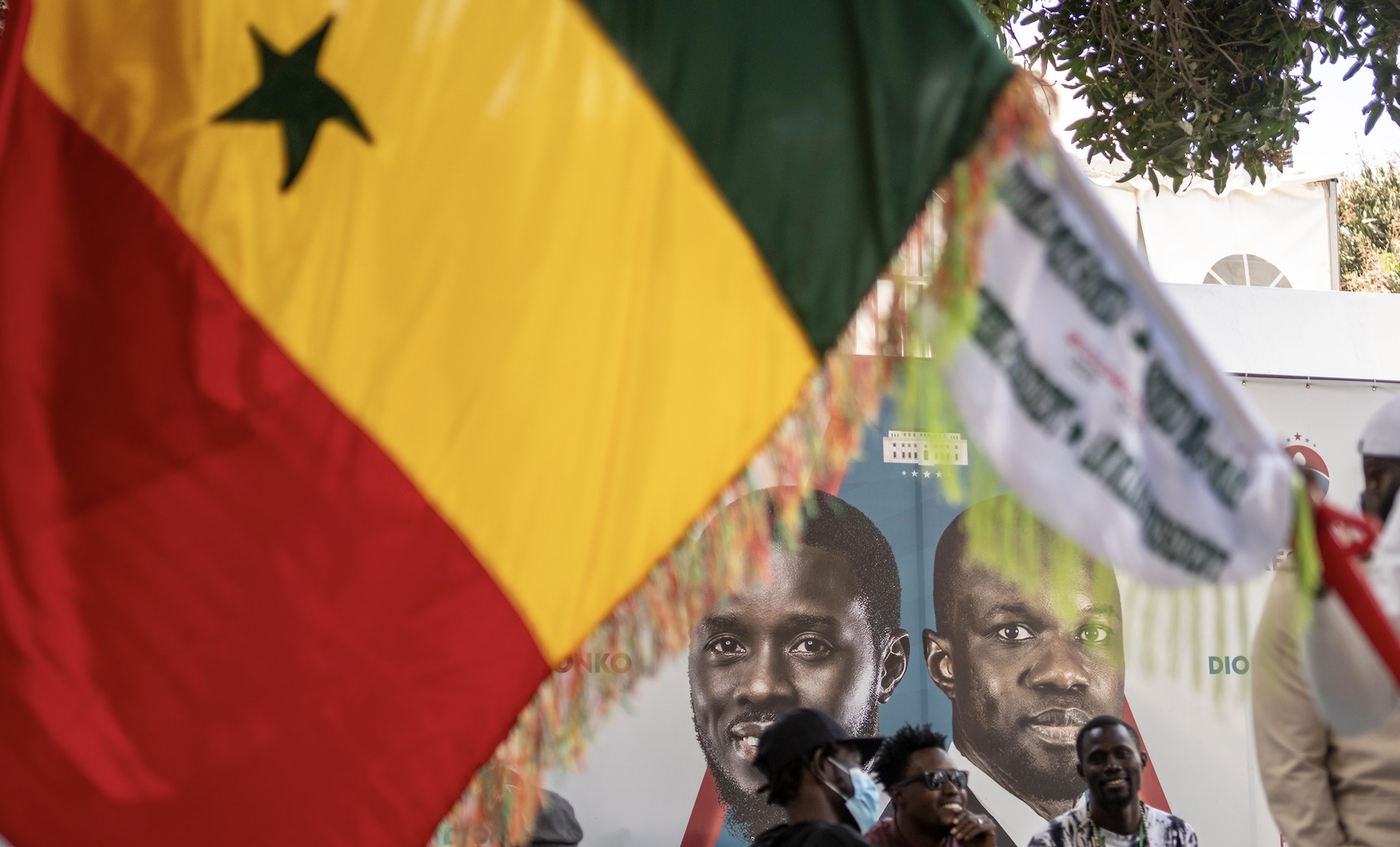
Senegal’s post-election political compact, once heralded as a generational reset, is rapidly evolving into a case study in sovereign risk transmission through fractured executive authority. At the centre of this instability sit Ousmane Sonko and Bassirou Diomaye Faye, whose diverging approaches to debt management and engagement with the International Monetary Fund are reshaping investor perceptions of one of West Africa’s most closely watched frontier markets.
The immediate catalyst for the discord is Senegal’s deteriorating fiscal position, precipitated by the unearthing of over $7 billion in previously undisclosed liabilities accumulated under former president Macky Sall. This revelation has materially altered the country’s debt trajectory, pushing the debt-to-GDP ratio to approximately 132% by end-2025 and effectively freezing access to a $1.8 billion IMF facility. For external investors, this abrupt repricing of sovereign risk has translated into higher yields on Senegalese debt and reduced confidence in fiscal transparency.
Yet the more consequential development lies not in the quantum of debt itself, but in the policy incoherence at the apex of government. Sonko has adopted a resolutely defiant stance, asserting that Senegal can meet its obligations without resorting to restructuring. His position appears rooted in both ideological resistance to IMF conditionality and a broader political calculus aimed at preserving domestic legitimacy. In contrast, Faye and key technocratic allies within the finance ministry have signalled a willingness to entertain restructuring discussions, alongside reforms such as centralising debt management.



This divergence is not merely rhetorical. Markets have already responded to conflicting signals from Dakar: when senior officials issued contradictory statements regarding IMF negotiations in late 2025, borrowing costs spiked sharply. Such volatility underscores a fundamental principle in sovereign finance: credibility is as critical as capacity. Even if Senegal retains the theoretical ability to service its debt, policy ambiguity can trigger liquidity constraints by eroding investor trust.
The situation has since escalated into what can be characterised as a “soft power-sharing” arrangement, as described by Sonko himself. While both leaders emerged from the same political movement, their alliance now appears increasingly transactional. The ruling party’s internal cohesion is under strain, with factions aligning either with Sonko’s more populist, anti-IMF posture or Faye’s pragmatist, market-sensitive approach.
For investors, this bifurcation introduces a layer of political risk that extends beyond standard macroeconomic indicators. The possibility of a cabinet reshuffle or even Sonko’s dismissal is no longer remote, with reports suggesting that alternative candidates for the premiership are being quietly considered. Such a move could restore policy coherence in the short term, but risks triggering political backlash, particularly among Sonko’s support base, which remains influential.
Compounding these political tensions is Senegal’s emerging liquidity crunch. The country has already slipped into what analysts term a “technical default” on certain bilateral obligations, with repayments exceeding grace periods. Approximately $1.3 billion in repayments falling due in the near term intensifies the urgency of securing an IMF-backed programme or alternative financing mechanisms. Without a credible adjustment pathway, Senegal risks entering a cycle of refinancing at punitive rates, further exacerbating debt sustainability concerns.
From a market perspective, the key question is not whether Senegal will eventually engage with the IMF, but under what terms and with what degree of domestic political alignment. IMF programmes, while often criticised, serve as a signalling mechanism to international investors, anchoring expectations around fiscal discipline and structural reform. Delays in reaching an შეთანხმment prolong uncertainty, effectively placing Senegal in a holding pattern that constrains capital inflows and complicates long-term investment planning.
It is instructive to contrast Senegal’s position with that of peers such as Mozambique, where authorities have signalled a clearer, albeit more constrained, willingness to pursue restructuring under IMF guidance. Dakar’s relative economic strength has historically afforded it greater policy latitude, but the current impasse suggests that this margin is narrowing.
However, it would be reductive to frame the situation solely as a binary contest between populism and technocracy. Sonko’s resistance reflects broader concerns about the social and political costs of IMF-backed reforms, including potential austerity measures and their impact on a youthful, politically engaged population. The recent campus unrest, culminating in the death of a student, is a stark reminder that fiscal consolidation carries tangible societal risks.
Equally, Faye’s pragmatism is not without its own constraints. Aligning with IMF prescriptions may stabilise macroeconomic fundamentals, but it could erode political capital if perceived as capitulation to external actors. The balancing act, therefore, is not simply economic but deeply রাজনৈতিক, requiring a synthesis of fiscal realism and domestic legitimacy.
For international investors, Senegal now presents a more complex risk-reward profile. On one hand, the country retains significant structural advantages, including a diversified economy and strategic positioning within the West African Economic and Monetary Union. On the other, governance risk has risen sharply, with policy direction contingent on an increasingly fraught relationship between the presidency and the premiership.

In practical terms, this translates into heightened volatility across Senegalese assets, from sovereign bonds to currency exposures within the CFA franc zone. Investors are likely to demand higher risk premiums until clearer policy alignment emerges, particularly regarding debt restructuring and IMF engagement.
Ultimately, Senegal’s trajectory will hinge on whether its leadership can reconcile competing visions of economic sovereignty and financial pragmatism. The current standoff between Sonko and Faye is not merely a domestic political dispute; it is a critical determinant of the country’s macroeconomic stability and its standing in global capital markets. Until that equilibrium is restored, Senegal will remain a market defined as much by political signalling as by economic fundamentals.