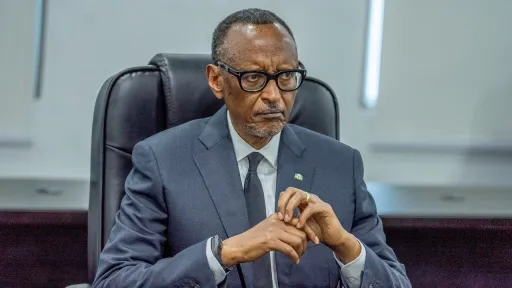
Aroom full of ministers, entrusted with the weight of a nation’s future, sat half attentive as their president spoke. Then came the rupture. “You are sleeping,” Paul Kagame thundered, and in that instant, the quiet rituals of bureaucratic indifference were shattered.
What followed was not merely a reprimand. It was a moment of political clarity. “If you don’t want the job, why don’t you resign?” he demanded, collapsing the comfortable distance between holding office and fulfilling it.
This was not diplomacy. It was diagnosis.



The Discipline of Attention
Leadership, in its most serious conception, is an act of sustained attention. It requires not only presence but vigilance, not only authority but intellectual and moral wakefulness. What Kagame confronted in that room was not simply discourtesy. It was the quiet normalisation of disengagement.
“Am I speaking to people who are sleeping or what?” he asked, his frustration cutting through the formalities of statecraft.
The question lingers because it extends beyond that room. Across much of the continent, governance is too often marked by a curious detachment. Meetings are held, policies announced, communiqués issued, yet the underlying machinery of the state remains sluggish, unresponsive, at times inert. The problem is not always a lack of ideas. It is a deficit of attention.
Kagame’s insistence that “leadership is a serious responsibility” is therefore not rhetorical flourish. It is a philosophical position. It asserts that public office is not symbolic but functional, not a title to be worn but a duty to be discharged. In this framing, inattentiveness becomes a form of failure.
Scholarly analyses of Rwanda’s governance model often return to this theme. They describe a system in which performance is monitored, follow up is expected, and outcomes are measured with unusual rigour. The state, in other words, pays attention to itself. Kagame’s outburst can be read as an enforcement of that ethic, a refusal to allow complacency to pass unchallenged.
Merit and the Politics of Consequence
“Deliver or resign.” With this stark formulation, Kagame strips leadership of its usual ambiguities. There is no room here for procedural delay or rhetorical evasion. Performance is not aspirational. It is obligatory.
This is where the question of merit becomes unavoidable. In many African political systems, advancement is mediated through networks of loyalty rather than demonstrations of competence. The result is a structure in which failure carries little cost and success is unevenly rewarded. Responsibility dissolves into hierarchy.
Kagame’s intervention disrupts that logic. “What exactly do you do in those positions?” he asks, forcing a confrontation with the substance of office rather than its status.
The implication is clear. Position without performance is illegitimate.
There is, admittedly, an austere edge to this approach. Public reprimand, particularly at such a level, carries the risk of substituting fear for motivation. A system that demands results with relentless intensity must guard against the erosion of openness and dissent. The line between discipline and overreach is neither fixed nor easily discerned.
Yet one must also reckon with the alternative. Kagame speaks of officials who “repeat the exact same mistakes over and over without a single lesson learned,” and of leaders who ignore citizen complaints as though they were mere background noise. In such contexts, the absence of consequence is not neutral. It is corrosive.

Roads remain unfinished not because they cannot be built, but because no one is held accountable for their absence. Hospitals falter not for lack of policy, but for lack of execution. The cost of inertia is borne, invariably, by those with the least capacity to absorb it.
Meritocracy, in this sense, is not an abstract ideal. It is a mechanism of justice.
Pragmatism and the Refusal of Excuses
Running through Kagame’s remarks is a palpable impatience with evasion. He speaks of arrogance without achievement, of officials who treat public office as private entitlement, of a culture in which urgency is conspicuously absent.
This is not merely a critique of individuals. It is a rejection of a broader habit within political discourse, the tendency to explain failure rather than resolve it.
For decades, African governance challenges have been narrated through external frameworks. Colonial legacies, global inequalities, structural dependencies. These explanations are not without merit, but they have too often become a vocabulary of deflection.
Kagame’s posture is different. It is insistently internal. The problem is here, in the room, in the conduct of those entrusted with power. The solution, therefore, must also begin here.
This is pragmatism in its most disciplined form. It is not concerned with ideological purity or rhetorical positioning. It is concerned with outcomes. What works, what does not, and who is responsible.
Observers of Rwanda’s developmental trajectory frequently point to this orientation as a defining feature. Policies are judged not by their elegance but by their effectiveness. Progress is measured not in declarations but in delivery. Kagame’s rebuke is thus not an aberration but an expression of a governing logic that prioritises action over explanation.
Across the continent, the resonance of this moment is unmistakable. From Abuja to Nairobi, from Johannesburg to Kinshasa, the scene feels uncomfortably familiar. Rooms filled with authority, yet starved of urgency. Plans articulated, yet seldom realised. A politics that performs engagement without fully inhabiting it.
The imagery of sleep captures this malaise with unsettling precision. To say that leaders are sleeping is to say that they are absent even when present, detached even when in power. It is an indictment not only of individuals but of systems that permit such detachment to persist.
Conversely, the command to stand becomes something more than instruction. It is a metaphor for awakening. Stand up, pay attention, take responsibility.

There is, undeniably, a disquieting edge to this model of leadership. Power that disciplines can also concentrate. A system that demands performance can, if unchecked, constrain dissent. History offers ample caution on this front, and it would be intellectually careless to ignore it.
Yet the greater and more persistent danger across much of Africa has not been an excess of discipline, but its absence. Not too much accountability, but too little. Not overperformance, but chronic underperformance.
Kagame’s intervention forces a recalibration of emphasis. It suggests that engagement must be active rather than performative, that merit must be enforced rather than assumed, and that pragmatism must prevail over excuse making.
In the end, what unfolded in that room was more than a presidential reprimand. It was a moment in which the contradictions of African leadership were laid bare.
“You are sleeping,” Kagame said. It sounded like a rebuke. It may yet prove to be a continental diagnosis.