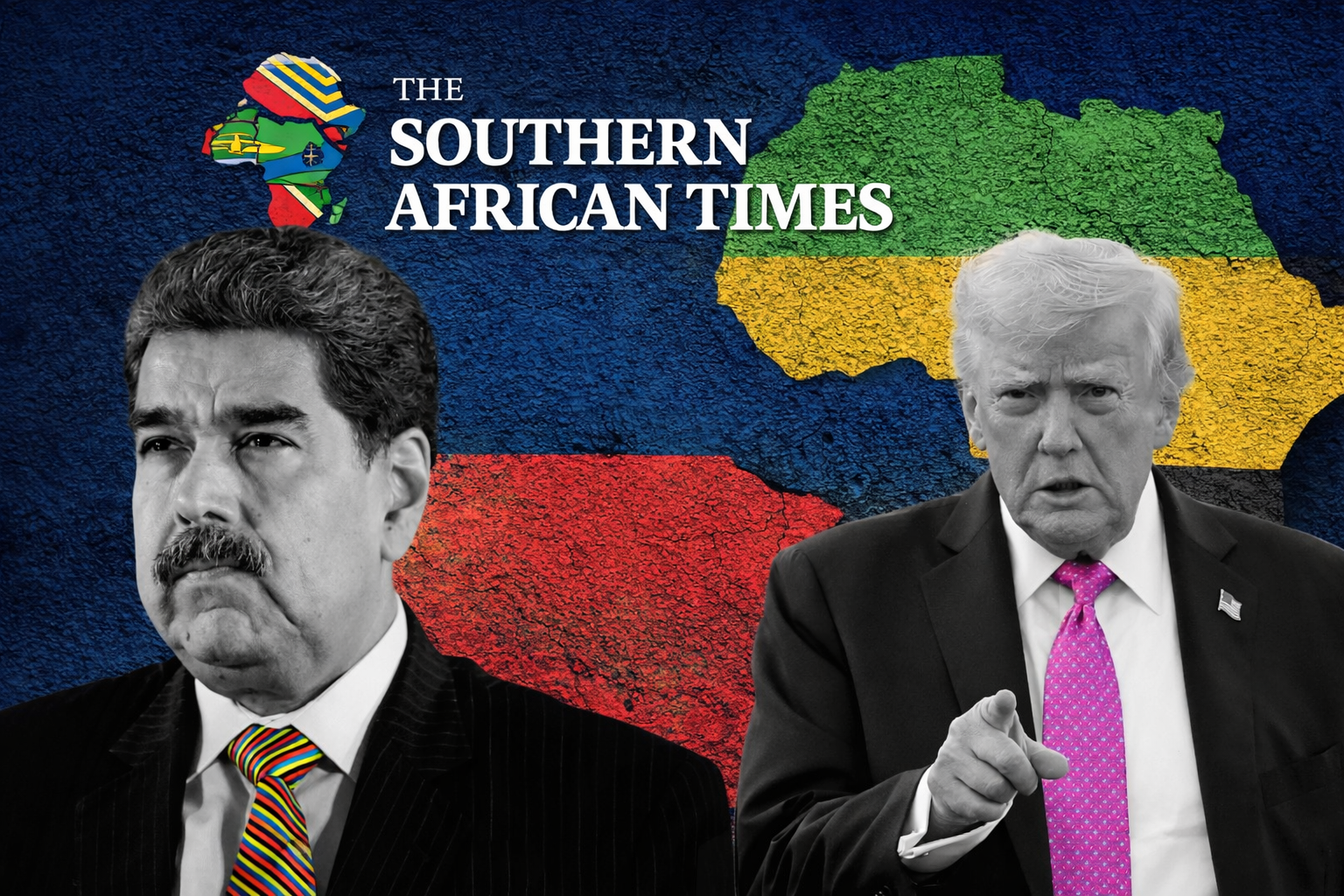
The world awoke to the stunning news that the United States had launched a full-scale military operation against Venezuela and captured its president, Nicolás Maduro. What President Donald Trump described as a decisive triumph of justice is in fact an egregious violation of international law and a moral collapse of global proportions. It is not merely Venezuela’s sovereignty that has been violated, but the very principles upon which the post-war international order was built.
Since 1945, the United Nations Charter has stood as a solemn covenant among nations, asserting that the use of force is permissible only in self-defence or with the authorisation of the Security Council. Article 2(4) explicitly prohibits the “threat or use of force against the territorial integrity or political independence of any state.” It is a clause that represents the collective resolve of humanity to ensure that law, not power, governs relations between nations. The strikes on Caracas and the abduction of a sitting president are an unambiguous repudiation of that commitment.
President Trump’s justification, that Maduro was indicted years ago by a U.S. court on narcotics charges, is legally and morally indefensible. Domestic law cannot override international law. No court in one country can claim jurisdiction over the head of state of another without the consent of the international community. The capture of a foreign leader by force, conducted without UN authorisation and without congressional approval under the U.S. War Powers Resolution, amounts to an act of aggression under both the United Nations Charter and the Rome Statute of the International Criminal Court. As Professor Christine Gray has written in International Law and the Use of Force, such unilateral actions “subvert the collective security framework and restore the anarchy the Charter was designed to prevent.”



The operation also violates the United States’ own constitutional safeguards. The War Powers Resolution of 1973 mandates that the President may not engage in hostilities without congressional consent unless the nation is under attack. No such authorisation was granted. To describe the deployment of Delta Force, the seizure of naval targets, and the bombardment of Venezuelan military bases as a mere “law enforcement operation” is a cynical distortion of both fact and law. It represents a dangerous centralisation of war-making power in the executive, precisely what the U.S. Constitution was designed to prevent.

But the illegality of this act is only the beginning of its peril. The greater danger lies in its implications for global order. When the United States, the world’s most powerful nation, disregards the rules it helped to write, the entire edifice of international stability begins to tremble. If Washington can unilaterally abduct a head of state under the guise of justice, who is to deny Beijing the same right over Taipei? What argument could be made against Moscow were it to seize Ukraine’s president, citing its own domestic indictments? When law becomes the servant of convenience, it ceases to be law at all.
This action corrodes the moral authority the United States has long claimed as the guardian of liberal democracy. It exposes the contradictions between its rhetoric and its conduct, between the ideal of a rules-based order and the practice of might-based intervention. For decades, Washington has invoked international law to criticise others while reserving for itself the privilege of selective obedience. From Iraq to Libya, from drone strikes in Yemen to the extraterritorial abduction of suspects, the U.S. has often treated legality as optional and morality as relative. Now that posture reaches its logical conclusion: the physical capture of a foreign head of state under the banner of justice.
The implications for the developing world are profound. Africa, Asia, and Latin America have long endured interventions clothed in the language of liberation. The colonial justification of “civilising missions” has been replaced by the moral vocabulary of “democracy promotion” and “counter-narcotics operations.” Yet the pattern remains unchanged: unilateral intervention, followed by instability, displacement, and disillusionment. From the Congo to Libya, the Global South has learned that foreign interventions, even when dressed in moral purpose, rarely bring peace. They bring fragmentation.
The attack on Venezuela, therefore, is not only an assault on sovereignty but also a direct threat to the principle of equality among nations. As the UN General Assembly’s Resolution 2625 (1970) declared, “No state or group of states has the right to intervene, directly or indirectly, for any reason whatever, in the internal or external affairs of another state.” This act dismantles that guarantee. It tells the world that international law applies only to the powerless.
Even those who oppose Maduro’s governance must recognise the peril of his method of removal. The forced capture of a president under foreign arms does not herald democracy; it invites chaos. Regime change achieved through violence, without domestic legitimacy or international sanction, cannot yield stability. It perpetuates a cycle of dependency and division. The Venezuelan people deserve freedom, but it must be their own achievement, not one imposed from abroad at the point of an American gun.
There is also an undeniable moral hypocrisy at play. For decades, the United States has invoked restraint when asked to support justice for the Palestinian people, claiming the need for diplomacy and dialogue. Yet it now asserts the right to enforce international justice unilaterally, by force of arms, when convenient. Such double standards erode global trust and embolden those who argue that international law is nothing more than a mask for Western power. A world where legality is selective will not be a stable one.
If global order is to mean anything, it must be based on consistency. The same principles that protect the United States from foreign aggression must protect Venezuela from American aggression. The same moral outrage expressed at Russia’s invasion of Ukraine must be directed at this reckless American act. The law cannot belong to one civilisation; it belongs to humanity.
Judge Rosalyn Higgins, writing in The British Yearbook of International Law in 1961, observed that “the essence of international law lies not in the denial of power, but in its restraint.” What we have witnessed is not restraint, but unbridled hubris. It is the arrogance of a state convinced that legality is an instrument of convenience, not a covenant of conscience.
The Southern African Times condemns unequivocally the U.S. attack on Venezuela and the abduction of President Maduro. This is not a defence of his policies but a defence of the international system itself. If this precedent is allowed to stand, no leader, no state, and no region will be safe from similar violations. The United Nations Security Council must act to reaffirm the Charter’s authority and to ensure that the rule of law, not the rule of power, prevails.
For if the world accepts this act as legitimate, we will have crossed a dangerous threshold. From Caracas to Taipei, from Gaza to Kyiv, any state could justify invasion in the name of justice. When the guardian of international order becomes its violator, the world stands at the edge of moral collapse. We must step back — or risk watching the lights of law, diplomacy, and restraint go out across the world.
By The Southern African Times Editorial Board