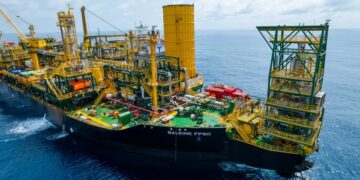
Equatorial Guinea has announced that it will launch its first oil and gas licensing round since 2019 in April 2026, offering 24 blocks in an effort to stimulate fresh exploration and reverse a long-term decline in production.
Antonio Oburu Ondo, the country’s Minister of Hydrocarbons and Mining Development, confirmed at the African Energy Week conference in Cape Town that the licensing round would run from April until November 2026, with details on procedures and timelines expected early in the year. Of the 24 blocks on offer, two are onshore and the remainder offshore.
The Central African nation, a member of the Organization of the Petroleum Exporting Countries (OPEC), has long relied on hydrocarbons as the backbone of its economy. According to OPEC’s 2024 Statistical Review, Equatorial Guinea reached peak oil production in 2010 at approximately 241,000 barrels per day. However, by 2023 output had fallen to 55,000 barrels per day, underscoring the urgency of attracting new investment.



The International Monetary Fund observed in an August 2025 report that the country’s economic growth is projected to average just 0.9 per cent annually over 2025–2030, largely due to declining oil and gas output. This trajectory illustrates the challenges Equatorial Guinea faces as it seeks to balance energy sector dependence with the wider goal of economic diversification.

On the commercial front, global energy companies maintain a significant presence in Equatorial Guinea. Firms such as Chevron, Trident Energy and ConocoPhillips continue to operate producing fields in partnership with state-owned GEPetrol. Earlier this week, Chevron announced that its Noble Energy subsidiary had reached terms with Malabo on developing the Aseng gas project, situated in Block I of the Douala Basin. With an initial investment of approximately $690 million, the project is expected to support long-term liquefied natural gas (LNG) supply and contribute to the country’s aspiration of becoming a regional processing hub.
These ambitions are further reflected in recent cross-border initiatives. Equatorial Guinea has partnered with Nigeria on the Gulf of Guinea Gas Pipeline, aimed at strengthening regional energy security and integration. In addition, the government is advancing plans for the EG-27 LNG project, which centres on the Ebano field and carries an estimated development cost of $4.5 billion. Backed by the Afreximbank, the project is expected to generate 2.4 million metric tonnes of LNG annually over a 20-year period.
While the licensing round marks a pivotal moment for the country, the context is wider than Equatorial Guinea alone. Across Africa, states rich in hydrocarbons are confronting the realities of shifting global energy markets, fluctuating demand, and the urgency of energy transition imperatives. The balance between harnessing natural resources for development and ensuring longer-term sustainability continues to frame policy and investment debates across the continent.
Equatorial Guinea’s decision to reopen licensing reflects not only a national imperative but also an evolving continental narrative in which energy resources remain central to aspirations of industrialisation, economic growth and regional cooperation.