How the struggle to determine policy within the current government unfolds will turn on the relationship between the ANC and the Democratic Alliance, DA, the country’s long-standing center-right opposition party that finished in second place in May with 22 percent of the vote. With their combined share of the vote, the erstwhile bitter enemies now dominate the new power-sharing government. So far, their policy differences have largely focused on domestic issues such as education and health policy, but the fault lines between the ANC and DA on foreign policy are becoming more visible.
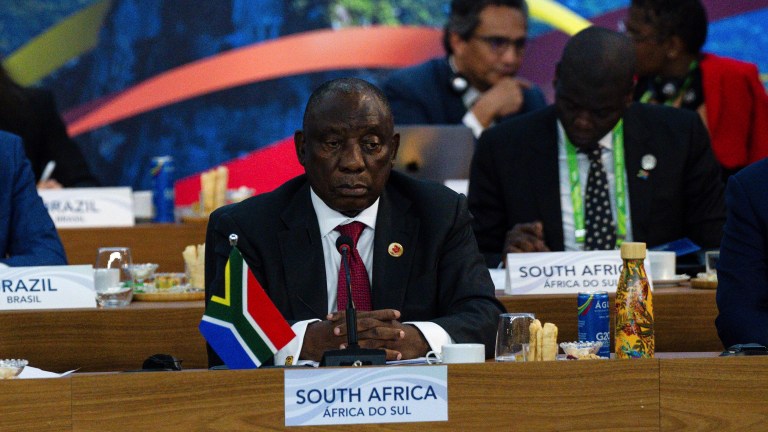
The ANC’s foreign policy trajectory since former President Nelson Mandela left office in 1999—whether under former Presidents Thabo Mbeki from 1999 to 2008 and Jacob Zuma from 2009 to 2018, or President Cyril Ramaphosa from 2018 to now—has had three distinctive features. First, solidarity with African countries and, more broadly, those of the Global South, with a commitment to the democratization of the institutions of global governance taking precedence over any support for the internal democratization of states. Pretoria’s muted responses to the proliferation of coups in Africa since 2020 and to the malpractice accompanying many African elections are illustrative examples. Second, a commitment to non-interference in the internal affairs of states replaced Mandela’s view that sovereignty should not be used as a shield to deflect criticism of a state’s human rights violations. Third, the promotion of multilateralism as the route to a more equitable world order and closer alignment with states seeking the same goals, whether in the Southern African Development Community, the African Union or the expanded BRICS forum. Underpinning each of those objectives has been a hostility toward the West in general and U.S. hegemony in particular.
There is some common ground between the ANC and the DA here. The DA supports South Africa’s promotion of its African neighbors’ interests, given that the country’s wellbeing is intrinsically linked to that of the continent. Nor does it have an issue with multilateralism per se, as it recognizes South Africa’s need to pursue its interests in as many diverse forums as possible. However, the DA favors a less expansive, more pragmatic foreign policy that would place stronger emphasis on democracy in Africa while favoring a more restrained role in the wider Global South, particularly in the Middle East where it feels South Africa is too partisan and lacks the weight to make a difference. It would seek to shore up South Africa’s traditional trade and investment links with the West as well as consolidating and expanding trade relations with China and emerging powers such as India and Brazil.
The DA regards the ANC’s animosity toward the West and its supportive posture toward Russia—and to a lesser extent Iran and Hamas in Gaza—as a self-harming foreign policy, given South Africa’s own democratic values, as well as the meager economic benefits flowing from those relationships compared to the role played by Western trade and investment. It is also aware that the ANC’s foreign policy and South Africa’s alleged hostility to U.S. global interests has prompted calls in the U.S. Congress for a review of the bilateral relationship and of South Africa’s place in the U.S. African Growth and Opportunity Act, or AGOA, which allows thousands of its goods duty-free access to the U.S. market and is due for renewal in 2025.
This growing antagonism in Washington toward Pretoria is likely to deepen further under President-elect Donald Trump’s second administration and a fully Republican-controlled Congress, with the relationship set for a period of even greater turbulence on geopolitical and trade issues. The diplomatic skills of Ebrahim Rasool, South Africa’s new ambassador to Washington, are likely to get a strenuous workout over the next four years.
The DA’s failure to challenge the ANC’s monopolization of the foreign policy machinery in the negotiations over governmental positions means its influence is restricted to the National Assembly’s committee on international relations.
Essentially the ANC and the DA embrace two distinct models of non-alignment. The ANC’s has a pronounced tilt toward Russia, China and more recently Iran, while the DA’s is markedly tilted toward the West. One way to bridge this foreign policy divide is for the coalition government to assume a genuinely non-aligned posture in which South Africa avoids being drawn into ideological camps. Instead, it would seek to extract maximum benefits from its diverse relationships, whether in the expanded BRICS, AGOA or the G20, which South Africa will chair in 2025.
This would recognize that the central purpose of a state’s foreign policy is to enhance its global standing and to generate as many economic benefits as possible. The value of such a posture to South Africa should be obvious given the scale of its domestic challenges of low growth, poverty and catastrophically high unemployment. That would still allow Pretoria to express differences with its partners, while avoiding the partisanship that is disfiguring its current foreign policy and antagonizing important power blocs.
It might even allow South Africa to reprise the golden age of its international relations from the mid- to late 1990s, when it played the role of bridge-builder and model international citizen. This allowed it to break deadlocks and resolve disputes on issues such as the extension of the Nuclear Non-Proliferation Treaty in 1995 and the Lockerbie stand-off in 1999 between Libya under Moammar Gadhafi on one side and the U.S. and Britain on the other. The current coalition government would provide Ramaphosa with the political cover to make this change if he chose to, as he can legitimately argue that the ANC has lost the power to decide policy alone.
That appears an unlikely outcome, however, for reasons rooted in the thinking of both main parties. Although welcomed internationally, the coalition government is a fragile construction domestically, and there is strong opposition to it among sections of the ANC as well as its ally the South African Communist Party, which Ramaphosa cannot completely ignore. The internal critics are the same factions that embrace a militant, ideologically driven foreign policy rooted in hostility to “Western imperialism,” so they would in all likelihood resist any change of foreign policy direction. Ramaphosa is also conscious of the fact that a radical foreign policy invoking the old themes of struggle and solidarity provides some consolation for the party’s rank and file as well as for malcontents among the leadership, in an era otherwise defined by a series of ANC retreats.
In any case, from the outset of the coalition government, the ANC signaled its commitment to continuity and its determination to maintain a tight grip on foreign policy. This has been achieved through its control of both the presidency—South Africa has a long tradition of executive leadership in foreign policy—and the Department of International Relations and Cooperation, or DIRCO, through Foreign Minister Ronald Lamola and his two deputies, Alvin Botes and Thandi Moraka, all three of whom are from the ANC. The DA’s failure to challenge the ANC’s monopolization of the foreign policy machinery in the negotiations over governmental positions means it now has no presence at DIRCO, and its influence is restricted to the National Assembly’s committee on international relations.
The party’s disinterest in these top-level appointments during the coalition negotiations sent a clear signal that it does not view foreign policy as a priority. Indeed, in September, DA party leader John Steenhuisen identified the DA’s two red lines that, if crossed, would trigger its withdrawal from the coalition government: any ANC actions threatening the economy and any ANC assaults on the Constitution. Everything else would be subject to internal debates or “constructive conflict,” an implicit admission that the DA will not collapse the coalition government on account of foreign policy differences.
That candor was perhaps unwise, as the DA might have gained more leverage by keeping the ANC guessing as to its red lines. Instead, the ANC is likely convinced that any DA opposition to its foreign policy will be performative and without substance. For example, it was notable how casually the president’s office dismissed Steenhuisen’s complaint that Ramaphosa’s description of Russia as a “valuable ally and friend” at the BRICS Summit in Kazan, Russia, in October had not been cleared by his coalition partners.
A more positive sign is that Lamola appears to be striking a less ideologically dogmatic and partisan tone than his predecessor, former Foreign Minister Naledi Pandor. He seems more conscious of the need to placate Western opinion and to avoid the rhetorical grandstanding that characterized Pandor’s tenure at DIRCO, although that will still fall well short of a fundamental reset of foreign policy. It does indicate, however, that any modifications to policy will be driven by external forces and the weight of economic pressures brought to bear on South Africa—or the threat of them—rather than through any traction the DA has in the coalition government.
James Hamill has been a lecturer in the Department of Politics and International Relations at the University of Leicester since 1991. He has a long-standing research interest in South African politics, particularly in the country’s post-apartheid development, and is a frequent visitor to the country. He has published articles on South Africa in International Relations, Diplomacy & Statecraft, The World Today, Politikon: The South African Journal of Political Studies and The Round Table: The Commonwealth Journal of International Affairs.