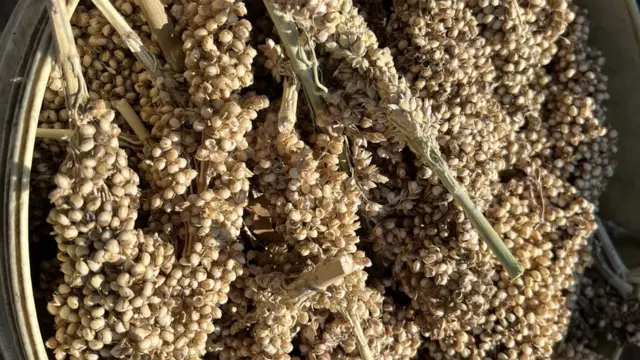
As Zimbabwe grapples with a severe drought declared a national disaster, traditional grains such as sorghum and millet are emerging as a sustainable solution to the country’s food insecurity. These resilient crops, once sidelined by colonial agricultural practices in favour of maize, are being revived for their ability to thrive in arid conditions, offering a lifeline to farmers struggling with the effects of climate change.
Unlike maize, which requires substantial water to grow, sorghum and millet are better suited to Zimbabwe’s increasingly erratic rainfall patterns. “They just grow like grass,” said Diana Sedze, a small-scale farmer from Nyanga District in Manicaland Province. Sedze, like many other smallholder farmers, has turned to these grains in a bid to safeguard her harvests in the face of persistent drought. “If you grow traditional grains, you are guaranteed a harvest,” she remarked.
The shift towards traditional grains is more than just an agronomic adaptation; it is a reclamation of food sovereignty. Sedze, a member of the Zimbabwe Smallholder Organic Farmers Forum (ZIMSOFF), believes that growing and consuming traditional grains allows communities to exercise control over their food systems. Food sovereignty, a principle that emphasizes local autonomy in the production and consumption of food, is gaining traction among Zimbabwe’s smallholder farmers. “It’s about having control over our food, how it’s grown, and its distribution using locally available resources,” said Elizabeth Mpofu, another farmer from Masvingo Province and a fellow ZIMSOFF member.



This sentiment was echoed at a recent event marking World Food Day, organised by ZIMSOFF at the Shashe Agroecology School in Masvingo. The school serves as a hub for farmers to exchange knowledge on agroecological farming methods, which promote sustainable practices that align with the region’s natural resources. Farmers like Sedze and Mpofu are keen advocates of these methods, which include the use of organic manure instead of chemical fertilisers. “Traditional grains are cheap to produce,” Sedze noted. “They don’t require supplementary fertilisers. We just cultivate them using manure, so it’s cost-effective.”
Traditional grains, which had been grown in Zimbabwe for generations, were largely displaced by maize during the colonial period. Maize, however, is ill-suited to Zimbabwe’s increasingly unpredictable rainfall, with recent seasons proving disastrous. The bulk of the 2023/2024 rain-fed maize crop was declared a complete loss due to an El Nino-induced drought, leaving more than 60% of Zimbabwe’s population facing food insecurity. In contrast, sorghum and millet, with their drought-resistant characteristics, offer a more reliable alternative.
Despite their advantages, traditional grains have long been undervalued, both by farmers and policymakers. Most farmers allocate only a small portion of their land to these crops, with maize occupying the majority of agricultural space. However, this trend is starting to change. Statistics from the 2023/2024 season show that the area planted with sorghum increased by 27% compared to the previous season, while the hectarage under pearl millet rose by 7.5%.

Farmers like Janet Simbini from Checheche in Manicaland Province are seeing the benefits of this shift. “They take less time to mature, which shields us from vulnerabilities,” Simbini explained. “A lot of people are now coming to inquire about traditional grains because they are witnessing their resilience.” Simbini employs agroecological practices, focusing on the sustainable use of farm resources such as manure, which enhances the environmental sustainability of her farming methods.
Health professionals are also advocating for the consumption of traditional grains, citing their superior nutritional value. Sedze, a cancer survivor, has been advised by her doctors to consume traditional grains due to their higher nutritional content compared to maize. “I was recommended to eat traditional grains because they are more nutritious,” she said. These grains are rich in essential nutrients and are often used to make Sadza, a staple porridge in Zimbabwean cuisine. Sadza, made from ground sorghum or millet flour, holds cultural significance and is typically served with meat and green vegetables.
The Zimbabwean government is increasingly supportive of traditional grains, recognising their role in achieving food and nutrition security, particularly in regions with below-average rainfall. Farmers are being encouraged to cultivate these crops as part of a broader national effort to revive traditional food systems. “As a nation, we have an identity,” said Masvingo District Development Coordinator Kenneth Madziva. “We have the food that defines us as a people of Zimbabwe. We need our locally produced food.”
The resurgence of traditional grains represents not only a practical solution to Zimbabwe’s food insecurity but also a cultural revival. By embracing crops that are both ecologically and nutritionally superior to maize, Zimbabwean farmers are reclaiming control over their agricultural heritage while ensuring that their communities can withstand the challenges of climate change.