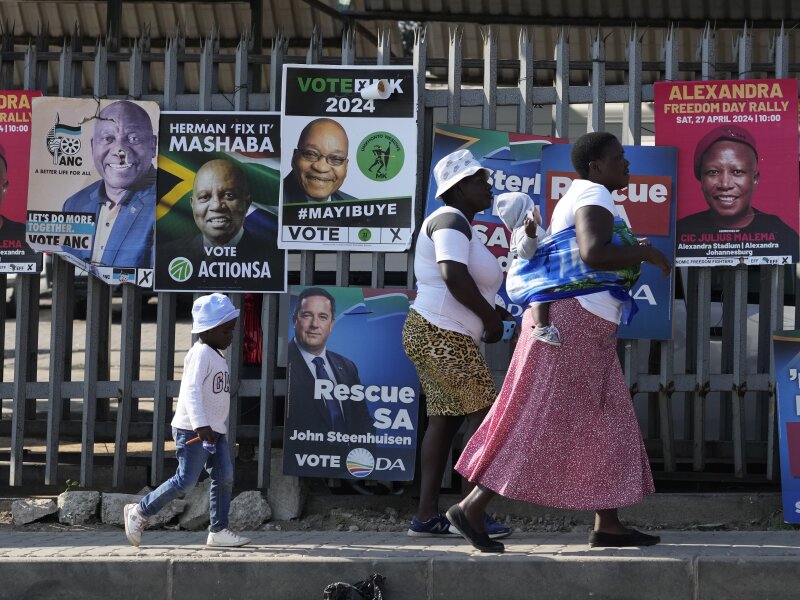
The ruling African National Congress (ANC) of South Africa has commenced discussions with major political parties in a bid to form a national unity government after failing to secure an outright majority in the National Assembly following the recently concluded general elections.
In a statement released after its National Working Committee Meeting, the ANC disclosed its active engagements with other parties to foster national unity and stability. “We have been meeting with all parties that are keen to contribute ideas on how we can collectively move our country forward to form a government that ensures national unity and stability,” the statement read.
The ANC emerged from the elections with 159 out of the 400 seats in the National Assembly. The Democratic Alliance (DA) came in second with 87 seats, followed by the uMkhonto weSizwe (MK) Party with 58 seats, and the Economic Freedom Fighters (EFF) securing 39 seats.



“The results of the 2024 national and provincial elections indicate that the South Africans want all parties to work together, because no party received an absolute majority to form a government alone at the national level,” the ANC acknowledged. It further stated that meetings have been held with political parties including the DA and the EFF.

However, the ANC’s attempts to engage with the MK Party have so far been unsuccessful. “The ANC has repeatedly reached out to the MK Party for an engagement meeting, with no positive response,” the statement noted. Despite this, the ANC reiterated its openness to discussions with all parties willing to contribute positively to the nation’s progress.
Following the official announcement of the election results on 2 June, the newly elected National Assembly has a 14-day window to convene its first session. During this session, members will elect the president of South Africa for the next five years through a simple majority vote.
As the ANC navigates the complexities of coalition politics, the focus remains on achieving a collaborative governance model that reflects the electorate’s desire for unity and collective progress. The formation of a coalition government marks a significant shift in South African politics, underscoring the necessity for cooperative governance in a diverse and dynamic political landscape.