Tuesday, June 2, 2026
  • Login
The Southern African Times
  • Home
  • Southern Africa
  • Business
    • African Start ups
    • African Continental Free Trade Area
  • Technology
    • Lifestyle
      • Health
      • Culture
      • Food and Drink
      • Entertainment
  • Opinion
  • Sports
  • SAT Jobs
    • Events
  • About Us
    • Advertise with Us
    • Contact Us
No Result
View All Result
  • Home
  • Southern Africa
  • Business
    • African Start ups
    • African Continental Free Trade Area
  • Technology
    • Lifestyle
      • Health
      • Culture
      • Food and Drink
      • Entertainment
  • Opinion
  • Sports
  • SAT Jobs
    • Events
  • About Us
    • Advertise with Us
    • Contact Us
No Result
View All Result
The Southern African Times
No Result
View All Result
Home Opinion

China-U.S. high level talks: Looking for common ground on climate change

by SAT Reporter
July 21, 2023
in Opinion
0
China-U.S. high level talks: Looking for common ground on climate change

It is not lost to observers that the United States has made three high-level official visits to China in about a month. The diplomatic forays are a gradual way to seek rapprochement between the two socioeconomic, cultural and political adversaries. Indeed, such heightened diplomatic activities could be a build-up to something bigger, say, like a meeting between the presidents of the two countries in the nearest future.

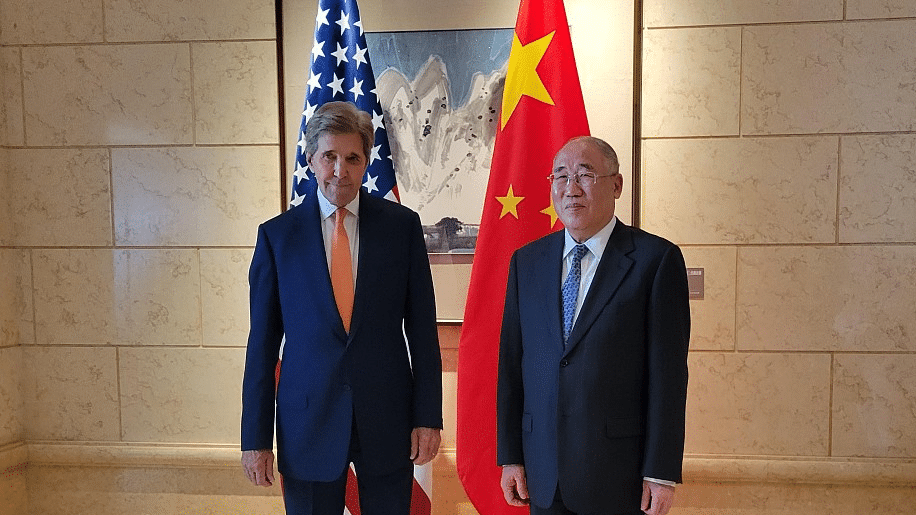
Three top U.S. officials have visited Beijing in recent weeks. These included visits by U.S. Secretary of State Antony Blinken, then by U.S. Treasury Secretary Janet Yellen, and a few days ago, by U.S. Special Presidential Envoy for Climate John Kerry, who landed in Beijing on July 16 to restart bilateral talks on curbing climate change. Each meeting is adding to the ground covered so far in the two countries’ relations.

The superpower is taking advantage of Beijing’s open door policy, even when the former pushes its partner against the wall. If China kept grudges or took the moral high ground on contentious issues, it would have stood its ground or put conditions on high-level negotiations. But the largest developing country understands that it has a global leadership role to play, and needs the cooperation of other major countries.


ADVERTISEMENT

During his meeting with Chinese Premier Li Qiang, Kerry acknowledged the role played by Chinese President Xi Jinping and U.S. President Joe Biden in the progress made so far towards the normalization of relations. Symbolically, the two countries need to reduce the heat of their current tensions to levels that do not hinder progress both bilaterally and multilaterally. The world is watching how the outcomes of Kerry’s visit will impact COP 28 to be held in the United Arab Emirates (UAE) in December. By default — the two countries are the largest economies in the world — the duo releases the most carbon emissions.

“It is incumbent upon China, the United States, and indeed all countries in the world to strengthen coordination with consensus and speed of actions,” Li noted. Extreme weather has now become a sad reality in many parts of the world. Parts of Europe, Asia and North America are under heat red alerts and bracing for record heat with health warnings and evacuations. But each major polluter must take responsibility for its contribution.

For instance, while China’s capital city, Beijing, has just recently experienced three consecutive days with temperature exceeding 40-degrees Celsius (104 degrees Fahrenheit) threshold last recorded in 1951, temperatures in the U.S. Southwest have risen to almost 49 degrees Celsius (120 degrees Fahrenheit). The hottest day on earth was recorded earlier this July. Temperatures in Mexico and parts of Europe are almost hitting 50 degrees Celsius. Medically, heat in a human body should not go beyond 38 degrees Celsius.

While the U.S. has been non-committal, China is proactively striving to meet its side of the bargain. In a statement before the UN General Assembly in September 2020, Chinese President Xi Jinping first announced his commitment to achieving “carbon emissions peak before 2030 and achieve carbon neutrality before 2060.” Subsequently, the country formally submitted China’s Mid-Century Long-Term Low Greenhouse Gas Emission Development Strategy to the United Nations Framework Convention on Climate Change in October 2021.
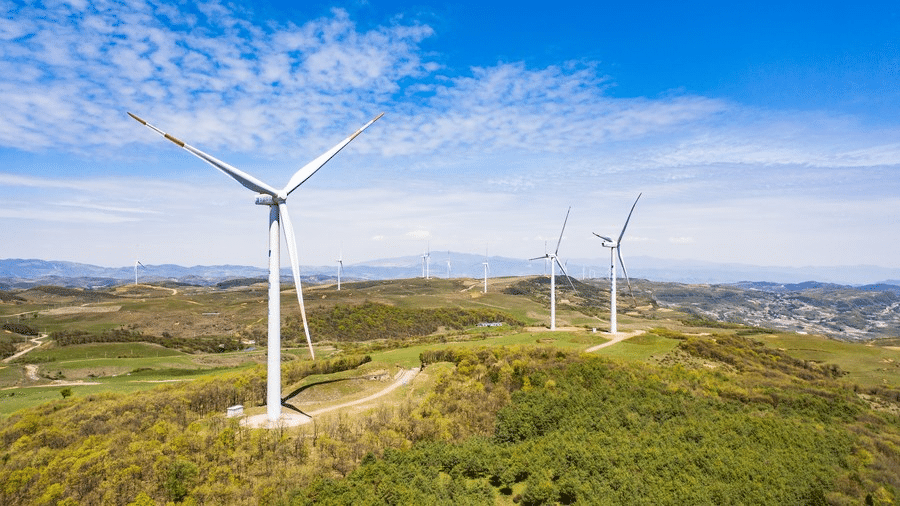
Wind turbines in Weining County, southwest China’s Guizhou Province, April 27, 2022.

Fortunately, although Former U.S. President Donald Trump abandoned the Paris Agreement, Biden has shown goodwill in tackling this existential threat to mankind. In February 2021, just hours after taking the oath of office, he signed an executive order that began a 30-day process to rejoin the Paris Agreement, the international pact on climate change.

Climate diplomacy is one of the major foreign policy planks of the Biden administration. Sending Kerry to Beijing in the scorching summer is aimed at striking the iron while it is still hot. The heat waves and flooding in the U.S., and the current heat waves in China, create an ideal environment for tackling such a grave issue of mutual concern.

If the two countries manage to break the current stalemate on their climate obligations and agree on a strategic plan to reduce carbon emissions, this milestone will send a positive sign that they are back to normalization. However, it is the U.S. that must show its commitment, particularly after former U.S. President Donald Trump’s withdrawal from the Paris Agreement put the United States at odds with the international community. It’s worth noting that the U.S. has emitted more carbon dioxide into the atmosphere than any other country since the beginning of the industrial age in the mid-1800s.

Lack of a concrete agreement by Kerry and his Chinese counterpart may send negative vibes both bilaterally and internationally. It will send the wrong signals that the recent visits by the U.S. top officials are duplicitous. Inaction or controversy will also claw back on the diplomatic baby steps made so far towards a decent rapprochement, and revert to high tensions.

China has been the world’s largest and fastest growing renewable energy producer for more than a decade, which is enough evidence of its commitment to mitigating climate change. But its actions need support from its counterpart in order to have the large scale impact envisioned by scientists, environmentalists and industrialists.


Stephen Ndegwa, a special commentator on current affairs for CGTN, is the Executive Director of South-South Dialogues, a Nairobi-based communications development think tank. The article reflects the author’s opinions and not necessarily the views of The Southern African Times. 

Previous Post

President Vladimir Putin to Skip BRICS Summit in South Africa

Next Post

IMF and Zimbabwe Initiate Dialogue for New Staff Monitored Program

SAT Reporter

Related Posts

Education and the Making of Responsible Citizens
Opinion

Education and the Making of Responsible Citizens

by Brendan Amadi
June 2, 2026
LONG READ | Zimbabwe Is Open for Business. But at What Price?
Opinion

LONG READ | Zimbabwe Is Open for Business. But at What Price?

by SAT Reporter
June 2, 2026
As Cuba Suffocates Under Siege, Why Is Africa Silent?
Opinion

As Cuba Suffocates Under Siege, Why Is Africa Silent?

by The Editorial Board
June 1, 2026
AI Needs Oversight, Not Faith: Lessons from South Africa’s Policy Reversal
Opinion

AI Needs Oversight, Not Faith: Lessons from South Africa’s Policy Reversal

by Sonny Iroche
May 27, 2026
Africa Day 2026 | The Century Is Quietly Turning Towards Africa
The Editorial Board

Africa Day 2026 | The Century Is Quietly Turning Towards Africa

by The Editorial Board
May 25, 2026
Next Post
IMF and Zimbabwe Initiate Dialogue for New Staff Monitored Program

IMF and Zimbabwe Initiate Dialogue for New Staff Monitored Program

Browse by Category

  • Africa AI
  • African Continental Free Trade Area
  • African Debt
  • African Start ups
  • Agriculture
  • AI Africa
  • Algeria
  • All News
  • Analysis
  • Angola
  • Arts / Culture
  • Asia
  • Botswana
  • BOTSWANA
  • BREAKING NEWS
  • BRICS
  • Burkina Faso
  • Burundi
  • Business
  • Business
  • Business Wire
  • Cameroon
  • Central Africa
  • Chad
  • China
  • Climate Change
  • Climate Changev
  • Community
  • Congo Republic
  • Conservation
  • Côte d’Ivoire
  • COVID 19
  • CRYPTOCURRENCY
  • Culture
  • Democratic Republic of Congo
  • Diplomacy
  • Eastern Africa
  • Economic Development
  • Economy
  • Education
  • Egypt
  • Elections 2024
  • Energy
  • Entertainment
  • Environment
  • Eritrea
  • Ethiopia
  • Europe
  • Fashion
  • Feature
  • Finance
  • Financial Inclusion
  • Food
  • Food and Drink
  • Foods
  • GABON
  • Ghana
  • Global
  • Global Africa
  • Guinea
  • Health
  • Humanitarian Aid
  • Immigration
  • in Southern Africa
  • International news
  • International Relations
  • Investment
  • Ivory Coast
  • Just In
  • Kenya
  • Lesotho
  • Libya
  • Life Style
  • Lifestyle
  • Literature
  • Malawi
  • Malawi
  • Mali
  • Markets
  • Mauritius
  • Middle East
  • Mining in Africa
  • Morocco
  • Mozambique
  • Namibia
  • niger
  • Niger
  • Nigeria
  • North Africa
  • North-Eastern Africa
  • Obituaries
  • Obituary
  • Opinion
  • PARTNER CONTENT
  • Politics
  • Property
  • Racism
  • Rwanda
  • Rwanda
  • SADC
  • SAT Interviews
  • SAT Investigation
  • SAT Jobs
  • Saudi Arabia
  • Senegal
  • Seychelles
  • Somaliland
  • South Africa
  • South Sudan
  • Sports
  • Startup Africa
  • STOCK EXCHANGE
  • Sudan
  • Sustainability
  • Sustainablity
  • Tanzania
  • Technology
  • Telecommunications
  • The Editorial Board
  • The Power Of She
  • Togo
  • Trade
  • Travel
  • Travel
  • Tunisia
  • Uganda
  • Uncategorized
  • Wealth
  • West Africa
  • World
  • World
  • ZAMBIA
  • Zambia
  • ZIMBABWE
  • Zimbabwe

Browse by Tags

#NewsUpdate #SouthAfrica #SouthernAfricanTimes #TheSouthernAfricanTimes AfCFTA africa African Continental Free Trade Area African development African Development Bank African economies African economy African Union Agriculture Angola Botswana China Climate change Cyril Ramaphosa Economic Development economic growth energy transition governance IMF industrialisation Inflation Infrastructure Infrastructure Development International relations Investment Kenya Mozambique Namibia news Nigeria Regional Integration renewable energy Rwanda SADC South Africa Southern Africa sustainable development Tanzania United States Zambia Zimbabwe
ADVERTISEMENT

WHO WE ARE

The Southern African Times is a regional bloc digital newspaper that covers Southern African and world news. The paper also gives a nuanced analysis on news and covers a wide range of reporting which include sports, entertainment, foreign affairs, arts and culture.

Welcome Back!

Login to your account below

Forgotten Password?

Retrieve your password

Please enter your username or email address to reset your password.

Log In
  • Home
  • Southern Africa
  • Business
    • African Start ups
    • African Continental Free Trade Area
  • Technology
    • Lifestyle
      • Health
      • Culture
      • Food and Drink
      • Entertainment
  • Opinion
  • Sports
  • SAT Jobs
    • Events
  • About Us
    • Advertise with Us
    • Contact Us
Not enough quota to unlock this post
Unlock left : 0
Are you sure want to cancel subscription?