The 38th Ordinary Session of the African Union (AU) Assembly of Heads of State and Government opened on 15 February 2025 at the AU headquarters in Addis Ababa, Ethiopia, marking a pivotal moment for continental dialogue on justice, governance, and collective progress. Under the theme “Justice for Africans and People of African Descent Through Reparations”, the two-day summit has drawn leaders from across the AU’s 55 member states to deliberate on pressing issues, ranging from structural inequities to institutional reforms, while concurrently electing new leadership to steer the AU Commission.
The choice of theme reflects a growing continental and diasporic reckoning with historical injustices, particularly the transatlantic slave trade, colonialism, and their enduring socio-economic legacies. This agenda builds on prior initiatives, such as the 2001 Durban Declaration, and aligns with broader global movements advocating for reparative justice, as seen in [CARICOM’s ten-point plan] and recent debates within the United Nations. The summit’s emphasis on reparations underscores a strategic shift towards addressing systemic disparities through multilateral frameworks, with discussions likely to explore mechanisms for financial restitution, cultural restoration, and institutional accountability.




Central to the summit’s agenda is the election of senior officials to the AU Commission, including the chairperson, deputy chairperson, and six commissioners. These elections, held every four years, are critical in shaping the continent’s trajectory, particularly as the AU seeks to enhance its operational efficacy amid evolving challenges. The outgoing chairperson, Moussa Faki Mahamat, whose tenure since 2017 has been marked by efforts to [, leaves a legacy of incremental institutional reforms. Speculation abounds regarding potential successors, with candidates likely to be evaluated on their ability to navigate complex geopolitical dynamics and accelerate the implementation of Agenda 2063—Africa’s blueprint for inclusive development.

Beyond leadership renewal, the assembly is expected to address continental peace and security challenges, with particular attention to regions grappling with instability. While progress has been made in mitigating conflicts such as the Tigray crisis in Ethiopia, persistent tensions in the Sahel, Mozambique’s Cabo Delgado province, and the Democratic Republic of the Congo remain high on the agenda. The summit presents an opportunity to reassess the efficacy of existing peacekeeping frameworks, including the African Peace and Security Architecture (APSA), and to bolster collaborative mechanisms with international partners.
Economic development also features prominently, with discussions likely to centre on the African Continental Free Trade Area (AfCFTA). Since its operationalisation in 2021, the AfCFTA has faced both acclaim and criticism, with proponents highlighting its potential to boost intra-African trade by 52% by 2030, while critics point to infrastructural deficits and non-tariff barriers. The summit may explore strategies to harmonise trade policies, accelerate digital transformation, and leverage partnerships such as the G20’s inclusion of the AU in 2023, which has amplified Africa’s voice in global economic governance.
Concomitantly, institutional reforms initiated under the 2016 Kagame Report remain a priority. Proposed measures—including financial autonomy through the implementation of a 0.2% levy on eligible imports and the reduction of redundant committees—aim to transform the AU into a more agile and self-reliant body. These reforms are seen as essential for advancing the continent’s developmental aspirations and ensuring that the AU can respond dynamically to emergent challenges such as climate change and public health crises.
Africa’s evolving role on the global stage is another critical discourse point. The continent’s unified stance on climate justice, exemplified by its negotiations at COP28, and its advocacy for permanent representation on the United Nations Security Council (UNSC), signal a strategic push to reshape international governance architectures. The summit may also deliberate on strengthening South-South cooperation, particularly with emerging powers in the Global South, to counterbalance traditional Western influence.

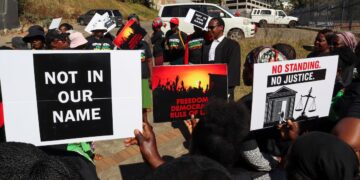
The proceedings in Addis Ababa are being closely watched by civil society organisations, which have called for greater transparency in the AU’s decision-making processes and more robust engagement with grassroots movements. The reparations debate, in particular, has galvanised diaspora communities, with many urging the AU to adopt a cohesive strategy that transcends symbolic gestures and delivers tangible redress.
As the summit concludes on 16 February, the outcomes—ranging from leadership appointments to policy directives—will undoubtedly shape Africa’s socio-political landscape in the coming years. The emphasis on justice and institutional renewal offers a moment of introspection and potential transformation, reinforcing the AU’s mandate to foster “an integrated, prosperous, and peaceful Africa, driven by its own citizens.”