Tuesday, June 30, 2026
  • Login
The Southern African Times
  • Home
  • Southern Africa
  • Business
    • African Start ups
    • African Continental Free Trade Area
  • Technology
    • Lifestyle
      • Health
      • Culture
      • Food and Drink
      • Entertainment
  • Opinion
  • Sports
  • SAT Jobs
    • Events
  • About Us
    • Advertise with Us
    • Contact Us
No Result
View All Result
  • Home
  • Southern Africa
  • Business
    • African Start ups
    • African Continental Free Trade Area
  • Technology
    • Lifestyle
      • Health
      • Culture
      • Food and Drink
      • Entertainment
  • Opinion
  • Sports
  • SAT Jobs
    • Events
  • About Us
    • Advertise with Us
    • Contact Us
No Result
View All Result
The Southern African Times
No Result
View All Result
Home Environment

Zimbabwe’s elephants becoming a danger unto themselves, parks official says

by SAT Reporter
November 11, 2021
in Environment, Just In
0
Zimbabwe’s elephants becoming a danger unto themselves, parks official says

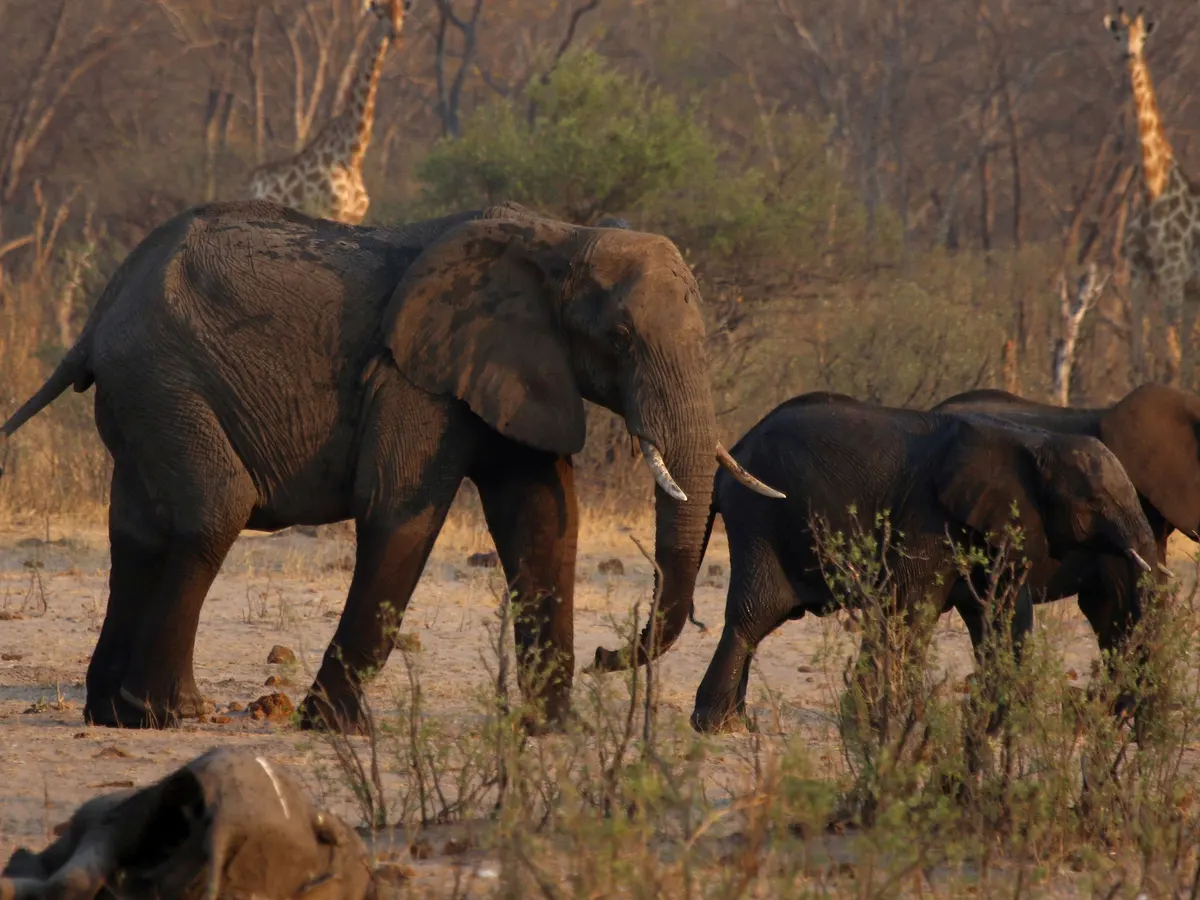
HARARE, (The Southern African Times) – Zimbabwe’s elephants are slowly becoming a danger unto themselves as they continue to destroy their own habitat as well as that of other wild animals, a wildlife official has said.

Zimbabwe Parks and Wildlife Management Authority (ZIMPARKS) spokesman Tinashe Farawo said the situation was becoming untenable in areas such as Hwange in western Zimbabwe where huge swathes of vegetation were being lost to the growing elephant population.

Zimbabwe’s elephant population is estimated to be more than 100,000, more than double its ecological carrying capacity of about 45,000, according to conservationists.


ADVERTISEMENT

It boasts of about a quarter of the continent’s elephant population and the second-highest in the world after Botswana.

This is due to the country’s robust conservation measures which have protected the critically endangered species.

But such measures are now literally coming back to haunt the authorities as the habitats can no longer sustain the growing numbers.

“The elephants are slowly becoming a danger unto themselves. They are destroying their habitat and that of other animals. Go to Hwange National Park and you will think that someone has been deliberately razing down the trees,” he told Xinhua.

Environment, Climate, Tourism and Hospitality Minister Mangaliso Ndlovu said in May 2021 that the government was considering culling the elephants to save the habitat.

However, some international conservationists have frowned upon the idea.

Farawo said these conservationists should leave their offices abroad and come to Zimbabwe to see what is prevailing on the ground.

To sustain its conservation efforts, Zimbabwe also wants to raise funds through the sale of ivory, but the conservationists fear that this will open floodgates for poaching.

“We’re battling an ever-increasing population of animals. They can come and see for themselves how our people are coping. We must be allowed to benefit from our resources. These are the issues we have to deal with,” he said.

The country last culled elephants in 1988 and continues to have stockpiles of ivory which it cannot sell because of restrictions from the Convention on International Trade in Endangers Species (CITES).

President Emmerson Mnangagwa in 2019 implored CITES to allow it to sell its 600 million U.S. dollars worth ivory stockpile, but the plea fell on deaf ears, prompting the country to consider pulling out of the convention.

Another option to deal with over-population would be to translocate some of the elephants from densely populated parks to those which can sustain higher populations.

However, the exercise is costly and given that there are other conflicting social needs in society, funding for such an exercise would be difficult to find, Farawo said.

“The last time we carried out such a translocation of 100 elephants it cost us about half a million U.S. dollars,” he said.

Apart from the destruction of habitat, elephants are also leading in incidences of human and wildlife conflict.

Farawo said almost 60 people had died from such conflicts since the beginning of 2021, with elephants and crocodiles accounting for more than 90 percent of the cases.

He warned that the situation could get worst at this time of the year because the elephants would move out of their natural habitat in search of water and food.

“We are at the peak of the dry season and elephants stray into nearby communities. Interaction with them in such cases can be fatal,” he said

Previous Post

World Bank announces new grant of 1.5 bln USD to Angola

Next Post

Zimbabwe electoral body announces draft roadmap for by-elections

SAT Reporter

Related Posts

Waste Colonialism and the Burden of Electronic Waste in Africa
Environment

Waste Colonialism and the Burden of Electronic Waste in Africa

by SAT Reporter
April 10, 2026
South Africa Reports 16 Percent Decrease in Rhino Poaching in 2025
Environment

South Africa Reports 16 Percent Decrease in Rhino Poaching in 2025

by SAT Reporter
February 11, 2026
One in Five Mammal Species Face Extinction in Southern Africa, Regional Report Warns
Environment

One in Five Mammal Species Face Extinction in Southern Africa, Regional Report Warns

by SAT Reporter
January 22, 2026
Investing in Nature Could Unlock Trillions for the Global Economy, Says UN Report
Environment

Investing in Nature Could Unlock Trillions for the Global Economy, Says UN Report

by SAT Reporter
December 10, 2025
Mont-aux-Sources Weather Station Boosts Climate and Water Monitoring
Environment

Mont-aux-Sources Weather Station Boosts Climate and Water Monitoring

by SAT Reporter
December 2, 2025
Next Post
Zimbabwe electoral body announces draft roadmap for by-elections

Zimbabwe electoral body announces draft roadmap for by-elections

Browse by Category

  • Africa AI
  • African Continental Free Trade Area
  • African Debt
  • African Start ups
  • Agriculture
  • AI Africa
  • Algeria
  • All News
  • Analysis
  • Angola
  • Arts / Culture
  • Asia
  • Botswana
  • BOTSWANA
  • BREAKING NEWS
  • BRICS
  • Burkina Faso
  • Burundi
  • Business
  • Business
  • Business Wire
  • Cameroon
  • Central Africa
  • Chad
  • China
  • Climate Change
  • Climate Changev
  • Community
  • Congo Republic
  • Conservation
  • Côte d’Ivoire
  • COVID 19
  • CRYPTOCURRENCY
  • Culture
  • Democratic Republic of Congo
  • Diplomacy
  • Eastern Africa
  • Economic Development
  • Economy
  • Education
  • Egypt
  • Elections 2024
  • Energy
  • Entertainment
  • Environment
  • Eritrea
  • Ethiopia
  • Europe
  • Fashion
  • Feature
  • Finance
  • Financial Inclusion
  • Food
  • Food and Drink
  • Foods
  • GABON
  • Ghana
  • Global
  • Global Africa
  • Guinea
  • Health
  • Humanitarian Aid
  • Immigration
  • in Southern Africa
  • International news
  • International Relations
  • Investment
  • Ivory Coast
  • Just In
  • Kenya
  • Lesotho
  • Libya
  • Life Style
  • Lifestyle
  • Literature
  • Malawi
  • Malawi
  • Mali
  • Markets
  • Mauritius
  • Middle East
  • Mining in Africa
  • Morocco
  • Mozambique
  • Namibia
  • niger
  • Niger
  • Nigeria
  • North Africa
  • North-Eastern Africa
  • Obituaries
  • Obituary
  • Opinion
  • PARTNER CONTENT
  • Politics
  • Property
  • Racism
  • Rwanda
  • Rwanda
  • SADC
  • SAT Interviews
  • SAT Investigation
  • SAT Jobs
  • Saudi Arabia
  • Senegal
  • Seychelles
  • Somaliland
  • South Africa
  • South Sudan
  • Sports
  • Startup Africa
  • STOCK EXCHANGE
  • Sudan
  • Sustainability
  • Sustainablity
  • Tanzania
  • Technology
  • Telecommunications
  • The Editorial Board
  • The Power Of She
  • Togo
  • Trade
  • Travel
  • Travel
  • Tunisia
  • Uganda
  • Uncategorized
  • Wealth
  • West Africa
  • World
  • World
  • ZAMBIA
  • Zambia
  • ZIMBABWE
  • Zimbabwe

Browse by Tags

#NewsUpdate #SouthAfrica #SouthernAfricanTimes #TheSouthernAfricanTimes AfCFTA africa African Continental Free Trade Area African development African Development Bank African economies African economy African Union Agriculture Angola Botswana China Climate change critical minerals Cyril Ramaphosa Economic Development economic growth energy transition governance industrialisation Inflation Infrastructure Infrastructure Development International relations Investment Kenya Mozambique Namibia news Nigeria Regional Integration renewable energy Rwanda SADC South Africa Southern Africa sustainable development Tanzania United States Zambia Zimbabwe
ADVERTISEMENT

WHO WE ARE

The Southern African Times is a regional bloc digital newspaper that covers Southern African and world news. The paper also gives a nuanced analysis on news and covers a wide range of reporting which include sports, entertainment, foreign affairs, arts and culture.

Welcome Back!

Login to your account below

Forgotten Password?

Retrieve your password

Please enter your username or email address to reset your password.

Log In
  • Home
  • Southern Africa
  • Business
    • African Start ups
    • African Continental Free Trade Area
  • Technology
    • Lifestyle
      • Health
      • Culture
      • Food and Drink
      • Entertainment
  • Opinion
  • Sports
  • SAT Jobs
    • Events
  • About Us
    • Advertise with Us
    • Contact Us
Not enough quota to unlock this post
Unlock left : 0
Are you sure want to cancel subscription?