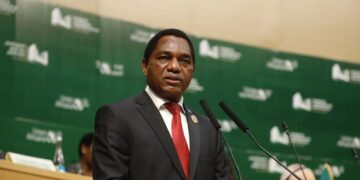
Zambia has renewed its call for a harmonised African policy on water resource governance, emphasising the need for coordinated continental efforts to manage this vital resource. Speaking after the 48th Ordinary Session of the Executive Council of the African Union held in Addis Ababa, Ethiopia, Zambia’s Minister of Foreign Affairs and International Cooperation, Mulambo Haimbe, reiterated the importance of adopting a guiding continental framework for water management.
The session, which convenes under the African Union’s theme Assuring Sustainable Water Availability and Safe Sanitation Systems to Achieve the Goals of Agenda 2063, has brought together African leaders and policymakers to deliberate on long term solutions to water and sanitation challenges. Haimbe stated that while individual nations face distinct environmental and developmental challenges, a unified African approach is essential to ensure sustainability, cross-border coordination and collective progress.
Haimbe’s intervention reflects an evolving consensus across the continent that water is no longer merely a development issue but also one of strategic significance. He underscored water’s pivotal role in realising the African Union’s Agenda 2063, which outlines a vision for inclusive growth, sustainable development and regional integration. Water security, he noted, intersects with a wide array of continental priorities including public health, food systems, energy supply, and human wellbeing.



Zambia’s recent experience with prolonged drought during the 2023 and 2024 rainy seasons has further reinforced the urgency of this matter. The drought severely impacted agricultural production and hydroelectric output, highlighting the vulnerabilities that climate variability imposes on both rural livelihoods and national economies. In this context, Haimbe warned that water scarcity must be recognised not only as an ecological and economic risk, but as a factor of strategic and human security.
The Minister called upon AU Member States to adopt the proposed Continental Water Policy and commit to fostering intergovernmental collaboration on water governance. He stressed that the success of any sustainable development agenda hinges on strengthening resilience to climate-induced shocks and safeguarding the availability of water across regions and generations.
The position advocated by Zambia reflects a broader shift toward a pan African development logic that moves beyond siloed national planning. In advocating for water as a shared continental asset, this approach contests the dominant global policy paradigms which often frame African water challenges through external deficit lenses rather than endogenous capacity building. The call for harmonisation does not ignore national specificities but instead acknowledges them within a continental framework of solidarity, knowledge exchange and mutual accountability.

Africa’s rivers, lakes and underground aquifers cross political boundaries and ecological zones. Managing them effectively requires not only scientific and infrastructural innovation, but also strong institutional cooperation and a shared ethical responsibility to future generations. As the continent contends with the multifaceted implications of climate change, population growth and urbanisation, coherent and inclusive water governance will remain central to its development trajectory.
Zambia’s engagement at the Executive Council reflects a commitment to building collaborative mechanisms that reinforce African agency in policy-making, and promote locally rooted, context-responsive solutions. It also signals a broader commitment to rethinking the governance of natural resources in a way that centres African voices, human dignity and the long term public good.