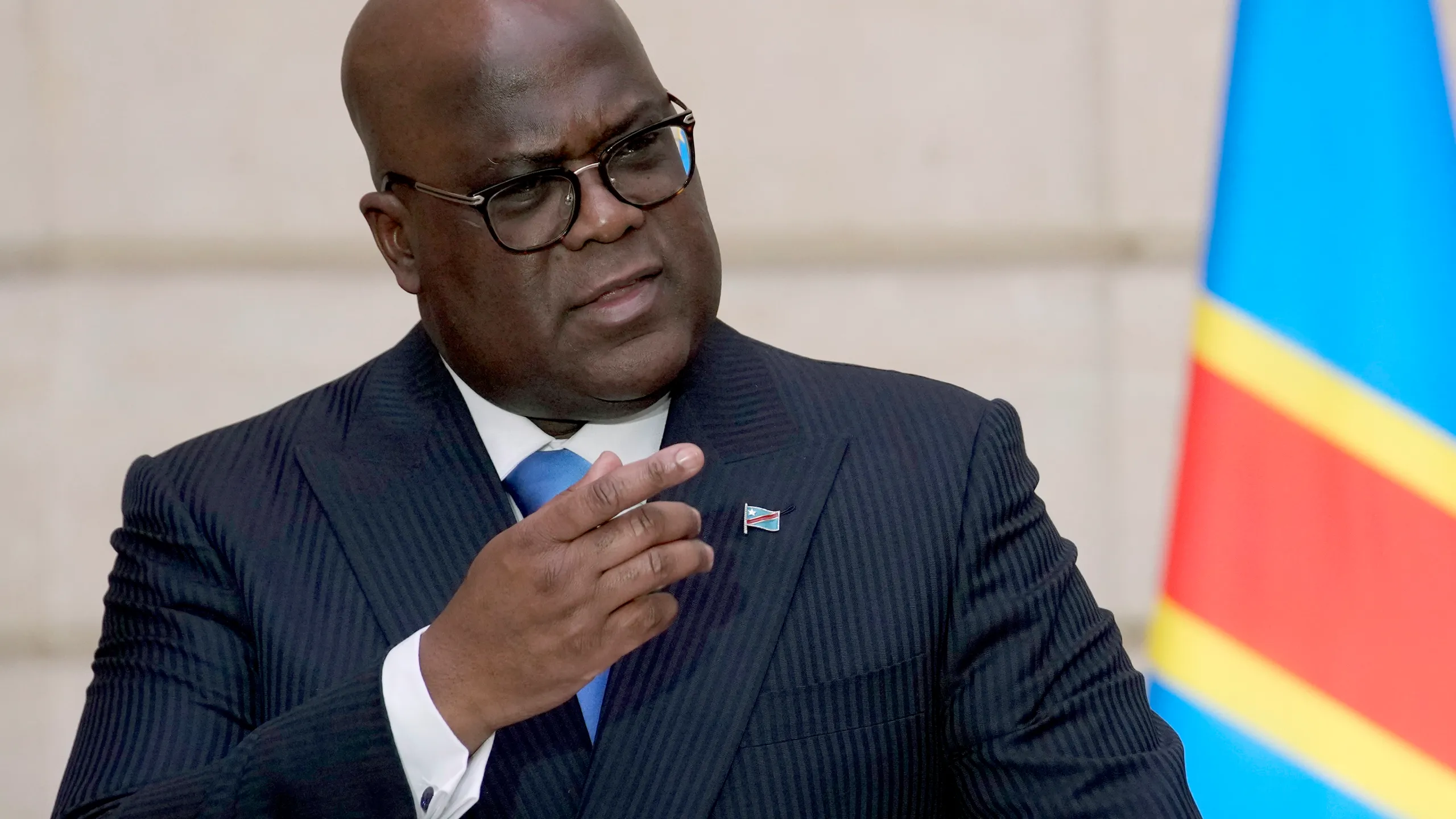
The President of the Democratic Republic of the Congo (DRC), Felix Tshisekedi, has announced significant political and military changes, including the formation of a government of national unity, in a bid to prevent the security crisis in the country’s east from evolving into a broader regional conflict. This decision comes as the armed March 23 Movement (M23) rebels continue their offensive, capturing key cities such as Goma and Bukavu, capitals of North Kivu and South Kivu provinces, respectively.
The announcement was made following a high-level meeting between Tshisekedi and members of the Sacred Union, the ruling parliamentary coalition composed of his Union for Democracy and Social Progress (UDPS) party and allied factions. The focus of the meeting was the deteriorating security situation, which the President described as necessitating a “complete overhaul” of both political and military structures. Tshisekedi also emphasised the urgent need to address internal betrayals within the Congolese armed forces.
Rejecting any possibility of direct negotiations with the M23 rebels, the Congolese leader stressed that the battle against the insurgents would be a prolonged one. His remarks come in the wake of a United Nations Security Council resolution urging the M23 to halt its offensive and calling on Rwandan forces to withdraw from Congolese territory.
The DRC has long accused Rwanda of backing the M23, an allegation Kigali denies, instead asserting that the Congolese government has aligned itself with the Democratic Forces for the Liberation of Rwanda (FDLR), a rebel group linked to the 1994 Rwandan Genocide. This longstanding dispute has further complicated diplomatic efforts aimed at restoring peace in the Great Lakes region.
At the 38th African Union (AU) Summit, held in Addis Ababa, regional leaders reinforced calls for an immediate ceasefire and the withdrawal of M23 fighters. However, despite these diplomatic pressures, previous AU-led peace talks, such as the Luanda Process, have repeatedly failed to bring Tshisekedi and Rwandan President Paul Kagame to the negotiating table.
The potential for a wider regional escalation remains a growing concern. Jean-Pierre Lacroix, the UN Under-Secretary-General for Peace Operations, warned that the ongoing violence could spill over into neighbouring countries, a sentiment echoed by UN Secretary-General António Guterres, who underscored that “there is no military solution” and urged dialogue as the only path forward.
The crisis in eastern DRC is exacerbated by competition for control over strategic mineral resources, including coltan, tin, tantalum, and gold. These minerals, critical for global supply chains, have fuelled conflicts as armed groups vie for territorial dominance.
The humanitarian impact of the conflict has been devastating. Since February, more than 400,000 Congolese refugees—primarily women and children—have fled to Burundi seeking protection, according to the UN High Commissioner for Refugees (UNHCR). In North Kivu alone, over 500,000 civilians were displaced in January, adding to the mounting humanitarian crisis.
As Tshisekedi’s government seeks to consolidate national unity and implement military reforms, the question remains whether these measures will be sufficient to stabilise the country or if further international intervention will be required to prevent an escalation into a full-scale regional war.