

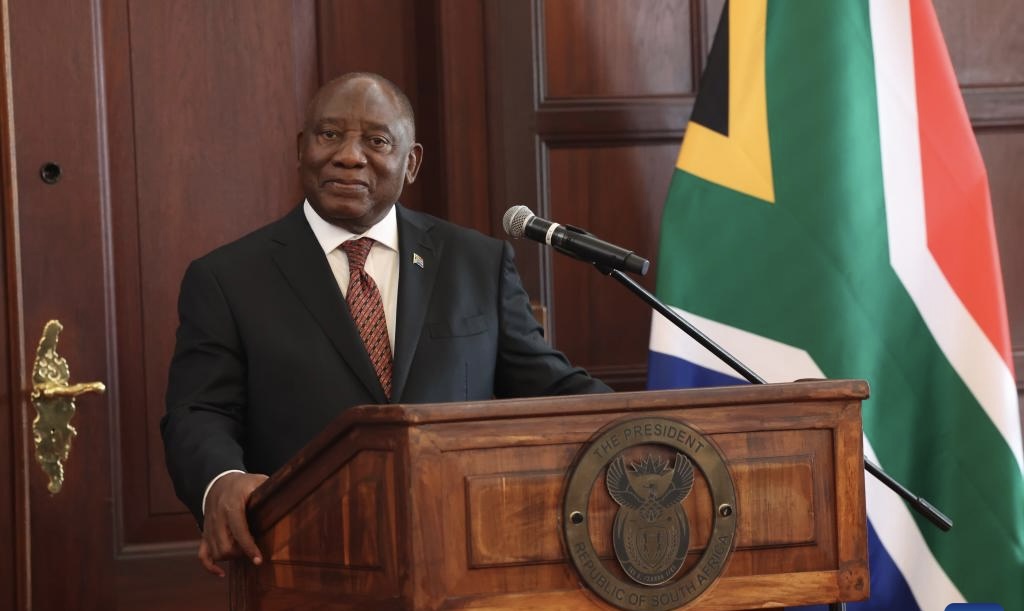
South Africa has welcomed the announcement of a temporary ceasefire in the recent escalation involving Iran, the United States and Israel, describing the development as an important step towards reducing tensions in a region with far reaching global implications.
Speaking in Pretoria on Wednesday, President Cyril Ramaphosa said the ceasefire offered a foundation upon which a more durable political resolution might be constructed. His remarks were delivered during a diplomatic engagement with newly accredited heads of mission, situating South Africa’s response within its broader foreign policy emphasis on multilateralism and negotiated peace.
According to reporting by Xinhua and corroborated by regional coverage from Business Day, the current phase of hostilities began on 28 February, when joint United States and Israeli airstrikes targeted Iranian infrastructure and senior leadership. Iran subsequently launched retaliatory missile and drone operations and imposed restrictions affecting maritime passage through the Strait of Hormuz, a critical artery for global energy supply, as widely noted in international reporting including Euronews.



Diplomatic mediation led by several states, including Pakistan, resulted in the announcement of a two week cessation of hostilities. While limited in duration, the agreement has been interpreted by multiple actors as an opportunity to re open channels for sustained dialogue.

Ramaphosa emphasised that South Africa supports initiatives aimed at achieving a comprehensive and lasting settlement. He reiterated a longstanding position within South African diplomacy that prioritises negotiation over military engagement, calling for adherence to international law and respect for sovereignty and territorial integrity.
This position reflects a broader African diplomatic tradition that has frequently underscored the importance of inclusive dialogue and collective security frameworks. Across the continent, historical experiences of conflict and external intervention have shaped a cautious approach to militarised solutions, with many states advocating instead for mediation led by regional and Global South actors.
In this context, South Africa’s response can be understood not only as a reaction to a specific geopolitical crisis but also as part of an evolving African voice in global governance debates. By foregrounding dialogue, legal norms and the protection of civilian life, Pretoria aligns itself with a wider continental emphasis on human centred security and the reform of international systems perceived to be uneven in their application.
At the same time, the ceasefire remains fragile. Analysts have noted that unresolved strategic tensions, as well as the economic and security implications of disruptions in key maritime routes, continue to pose risks to stability. The Strait of Hormuz in particular remains central to global trade flows, and any sustained disruption carries consequences that extend well beyond the immediate region.
South Africa’s call for restraint and renewed negotiation therefore reflects both principled and pragmatic considerations. It signals concern for the humanitarian consequences of continued conflict, while also recognising the interconnected nature of global security and economic systems.
As diplomatic efforts continue, the extent to which this ceasefire can be transformed into a longer term settlement remains uncertain. What is clearer is that African states, including South Africa, are seeking to assert a more visible and balanced role in international peace efforts, grounded in dialogue, equity and respect for sovereignty.


