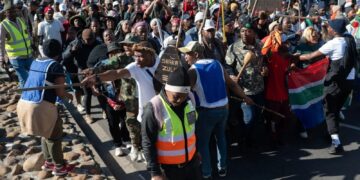
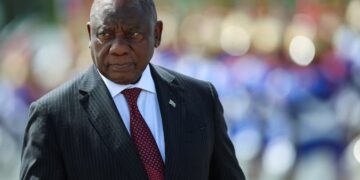
President Cyril Ramaphosa announced last night that members of the South African National Defence Force will be deployed in the coming days to support policing operations in parts of the Western Cape affected by gang violence and in Gauteng where illegal mining continues to present security and economic risks. The announcement was made during the 2026 State of the Nation Address delivered at Cape Town City Hall.
The President stated that he had instructed the Minister of Police together with defence authorities to finalise a technical deployment plan and that Parliament would be formally informed of the decision and its financial implications. In terms of section 201 of the Constitution of the Republic of South Africa, 1996, the President is empowered to authorise the employment of the defence force in cooperation with the South African Police Service, subject to parliamentary notification and oversight. Similar deployments have occurred in previous years in response to civil unrest and sustained violent crime.
Framing the intervention within a broader strategy against organised crime and corruption, Ramaphosa said government would consolidate intelligence structures at national level, identify priority syndicates and deploy multidisciplinary teams to dismantle criminal networks. These measures align with existing policy frameworks including the Integrated Crime and Violence Prevention Strategy and ongoing security cluster reforms.



The President also announced plans to streamline legislation governing the licensing, possession and trade of firearms and ammunition, citing the need to strengthen enforcement of existing gun control measures. According to crime statistics released by the South African Police Service, firearms remain a significant contributor to violent crime in several provinces.

In addition to the military support, Ramaphosa confirmed the recruitment of 5,500 new police officers. This builds on the phased intake of 20,000 officers announced in previous State of the Nation Addresses. Annual reporting by the South African Police Service has consistently identified resource constraints, particularly within detective services and specialised investigative units.
Addressing the economic dimensions of criminality, the President announced the establishment of a National Illicit Economy Disruption Programme that will bring together state agencies and private sector stakeholders. The initiative will focus on sectors vulnerable to illicit trade, including tobacco, fuel and alcohol. National Treasury and the South African Revenue Service have previously indicated that illicit trade undermines fiscal revenue and formal sector employment.
Ramaphosa also referred to findings arising from the Madlanga Commission of Inquiry and subsequent parliamentary processes examining allegations of corruption within law enforcement structures. He said investigations flowing from those findings would be expedited by a newly appointed task team and confirmed that the State Security Agency would conduct renewed vetting and lifestyle audits of senior police and metropolitan officers. Oversight of these processes falls within established accountability frameworks including parliamentary committees and the Independent Police Investigative Directorate.
Municipal authorities in Cape Town have welcomed the proposed deployment while indicating that military support should remain a temporary stabilisation measure. They have called for further consideration of metropolitan policing competencies within the framework of cooperative governance.
Gang violence on the Cape Flats and illegal mining operations in parts of Gauteng reflect complex socio economic conditions shaped by inequality, unemployment, organised criminal networks and spatial marginalisation. Research from Statistics South Africa and the Institute for Security Studies suggests that enforcement interventions alone are unlikely to secure lasting reductions in violence without sustained investment in community development, youth employment and justice system reform.
Within a broader African context, South Africa’s approach mirrors challenges faced by other states confronting entrenched criminal economies that intersect with global supply chains. The balance between enforcement, constitutional safeguards and structural reform remains central to democratic governance across the continent.
Parliament is expected to debate the address in the coming days, including the legal and financial parameters of the proposed deployment.