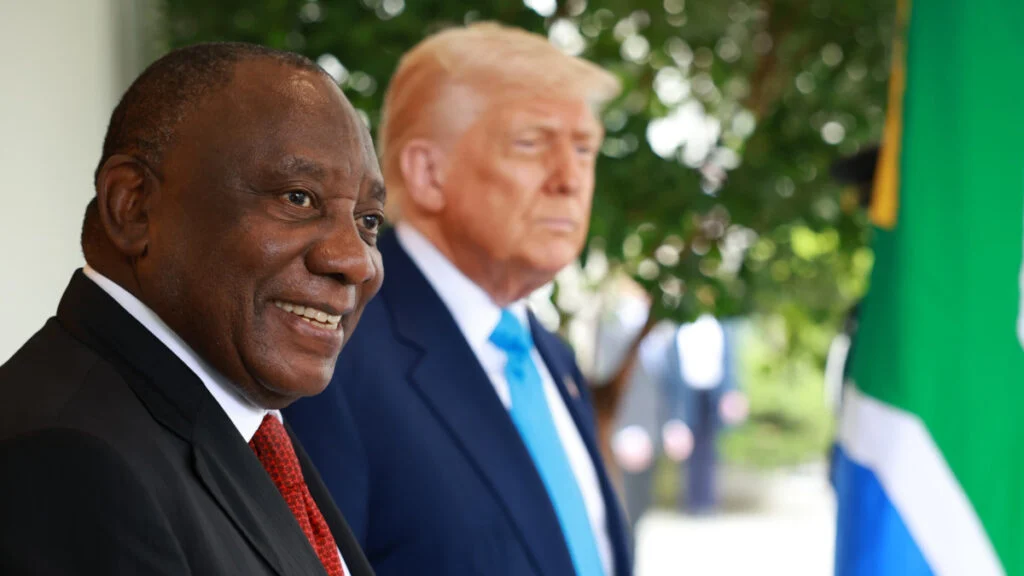
The United States House Committee on Ways and Means has approved a bill to renew the African Growth and Opportunity Act (AGOA), signalling a possible continuation of duty free trade access for Sub Saharan African economies. The decision has generated cautious optimism in South Africa where concerns have been mounting that the country could be excluded from the agreement amid strained diplomatic relations with Washington.
AGOA, first enacted in 2000, has served as a cornerstone of economic engagement between the United States and Sub Saharan Africa. The programme, which expired in September, allows eligible African nations to export thousands of products to the US market free of tariffs. According to estimates by the Brookings Institution and the African Development Bank, the framework supports hundreds of thousands of African jobs across manufacturing, agriculture and textiles.
The committee approved the AGOA Extension Act by a vote of 37 to 3, describing the initiative as “the cornerstone of economic relations between the US and Sub Saharan African nations.” The statement also noted that “an extended lapse in AGOA would create a void that malign actors like China and Russia will seek to fill.” The bill now proceeds to the full House of Representatives, though it remains uncertain when it will be debated.



While the latest legislative development makes no mention of excluding South Africa, the country remains under scrutiny. US Trade Representative Jamieson Greer recently characterised South Africa as a “unique problem,” citing the nation’s tariffs on American imports and its growing alignment with countries such as China and Russia. In August, Washington imposed a 30 per cent tariff on South African goods following disputes over market access, a move Pretoria said was based on “an inaccurate view” of the bilateral trade relationship.
South Africa’s Department of Trade, Industry and Competition has maintained that it continues to engage constructively with US counterparts. A spokesperson confirmed that the ministry is “tracking the progress of the AGOA Extension Act closely” and reaffirmed that “South Africa remains committed to a rules based international trading system.”

However, not all developments have favoured Pretoria. In September, Senator John Kennedy introduced the AGOA Extension and Bilateral Engagement Act, also referred to as “AGOA 2.0,” which explicitly seeks to exclude South Africa from the programme. The bill would extend AGOA for two years but limit participation to nations that “support US interests.” It also proposes a review of the US South Africa bilateral relationship and calls for the US president to certify whether South Africa undermines national security interests.
The proposed legislation further requests a classified list of South African government officials who could be subject to sanctions under the Global Magnitsky Act. If enacted, it would end South Africa’s eligibility to benefit from AGOA entirely.
This contrasts with the broader House bill that seeks to renew AGOA without specifying exclusions. Analysts argue that the divergence between the House and Senate versions illustrates growing political tension within Washington over how to engage with African states seen as diverging from US foreign policy positions.
For South Africa, exclusion from AGOA could have wide ranging economic implications. The country exports over 200 products under the scheme, ranging from automotive components to citrus fruits. According to the South African Reserve Bank, AGOA related exports were valued at more than US$3 billion in 2023, supporting significant employment within manufacturing and agriculture.
Economists note that while South Africa has expanded trade ties with emerging economies, particularly China and India, the United States remains a vital export destination. A lapse in AGOA or South Africa’s removal from the framework could lead to job losses and increased pressure on the domestic economy already burdened by energy shortages, high unemployment and declining industrial output.
Pan African trade experts have called for the moment to be used as an opportunity for reflection. Many argue that Africa’s trade frameworks must evolve beyond dependency on external preferences and towards deeper intra African trade, particularly under the African Continental Free Trade Area (AfCFTA). They suggest that while AGOA has provided short term benefits, the continent’s long term prosperity will depend on value addition and regional integration rather than preferential market access alone.
As the US House prepares to deliberate on the AGOA Extension Act, South Africa finds itself navigating a complex intersection of diplomacy and economics. The decision will not only determine the immediate future of the country’s trade with the United States but also signal the direction of Africa’s broader relationship with major global powers.

Whether South Africa remains part of AGOA or faces exclusion, the outcome will shape perceptions of how Africa asserts its agency in defining its own trade and development agenda within an increasingly multipolar world.