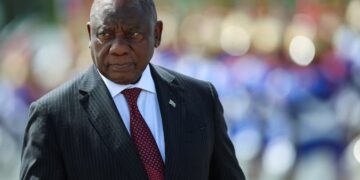
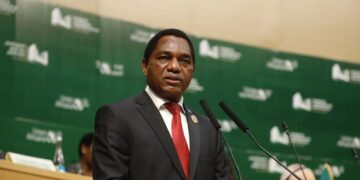
South African President Cyril Ramaphosa has announced the appointment of Mcebisi Jonas, the former Deputy Finance Minister, as his special envoy to the United States. The strategic decision emerges against a backdrop of strained diplomatic relations between Pretoria and Washington, a dynamic that has intensified since the inauguration of U.S. President Donald Trump earlier this year.
According to an official statement from the Presidency, Mr Jonas is tasked with spearheading efforts to recalibrate and strengthen the bilateral relationship. His portfolio will include diplomatic engagement, economic diplomacy, and the advancement of South Africa’s foreign policy interests in the United States. The statement noted that Jonas will “lead negotiations, foster strategic partnerships, and engage with U.S. government officials and private-sector leaders to promote our nation’s interests.”
Jonas, who presently serves as the independent non-executive chairman of MTN Group, a leading African telecommunications operator, will retain his position at MTN alongside his new diplomatic assignment. His selection reflects Ramaphosa’s confidence in Jonas’ technocratic expertise, diplomatic temperament, and extensive international networks.
This appointment comes at a time of visible diplomatic dissonance between the two nations. Earlier this year, the United States expelled South Africa’s ambassador to Washington following escalating disagreements over domestic policy developments in South Africa. Central among these has been South Africa’s land reform agenda, which the Trump administration has vocally criticised.
In February, President Trump signed an executive order terminating financial assistance to South Africa. The order explicitly cited opposition to the country’s land expropriation policies, accusing the South African government of unlawfully confiscating property belonging to ethnic minority Afrikaner farmers. The U.S. administration also announced a policy granting refugee status to Afrikaners, a move that South African authorities have described as politically inflammatory and based on misleading premises.
South Africa’s Cabinet responded with a firm rebuttal, describing the U.S. executive order as “riddled with misinformation.” A government spokesperson stated that “the executive order lacks factual accuracy and is rooted in misinformation and falsehood aimed at misrepresenting the actual purpose of the law and sowing racial divisions in our nation.” The government reaffirmed that the land policy is constitutionally grounded and consistent with international precedents that balance public interest with the protection of private property rights.
“This law is not unique to South Africa, as many countries around the world have always had expropriation laws that balance the need for public usage of land and the protection of rights of property owners,” the Cabinet’s official response declared.
President Ramaphosa’s decision to deploy a high-profile envoy underscores a renewed commitment to diplomatically engage Washington through structured dialogue and economic diplomacy. “We are committed to rebuilding our relationship with the United States on the basis of mutual respect, recognition of each other’s sovereignty, and the interests of our peoples,” he said.
For his part, Jonas has conveyed a realistic but resolute tone regarding his new role. “There are no quick fixes in this complex situation,” he said in a press briefing on Monday. “Our focus must be on restoring healthy relations and countering misinformation through dialogue and fact-based engagement.”
The bilateral tensions are not confined to executive policies alone. Last Friday, President Trump posted on his Truth Social platform, threatening to boycott the G20 Leaders’ Summit scheduled to take place in South Africa this November. While the threat remains informal, such a diplomatic posture may have broader geopolitical implications, especially given South Africa’s prominent role in multilateral forums such as BRICS and the African Union.
Analysts have noted that the Trump administration’s stance towards South Africa marks a significant departure from the historically cooperative nature of U.S.-South African relations. Traditionally, the relationship has encompassed development assistance, trade partnerships under AGOA, and mutual interests in regional peace and security. The recent shift suggests a politicisation of foreign aid and refugee policy to advance ideological narratives.
Jonas’s diplomatic efforts will likely focus on reestablishing trust and clarifying the legal and constitutional basis of South Africa’s domestic reforms. His dual expertise in governance and economics places him in a strong position to navigate this delicate mission. Observers have also pointed to his history of integrity and independence, especially his role in exposing state capture under the previous administration, as an indication of the seriousness with which Pretoria is approaching this diplomatic challenge.
Whether the deployment of a special envoy will catalyse a recalibration of relations remains to be seen. However, it does signal a proactive and principled approach by South Africa in responding to what it views as unjustified and damaging international rhetoric.