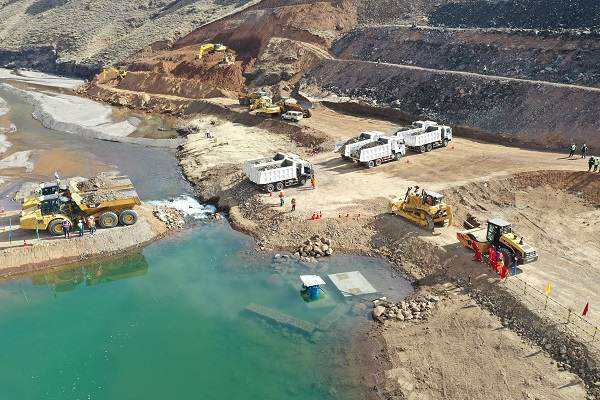
The Lesotho Highlands Development Authority (LHDA) along with a consortium of consultants and contractors celebrated a pivotal achievement on Friday. The milestone marked the successful diversion of the Senqu River by the pre-cofferdam, signaling progress in the construction of the monumental Polihali Dam.
Tente Tente, Chief Executive of the LHDA, hailed this achievement as a triumph for the engineering community. He underscored the significance of the moment, affirming that this milestone was essential for the subsequent stages of the dam’s construction. “This is quite an achievement to the engineering fraternity. It is a key moment of the construction programme because unless this happens, no other elements of dam construction can happen. We are proud of everyone who has had a hand in this work,” Tente expressed.
The meticulous timing of this achievement bears testament to its critical nature. Tente highlighted, “It had to happen now because the timing of it during the winter season without rain was critical. If you miss it by a week or two, you may miss the entire window by another twelve months.”



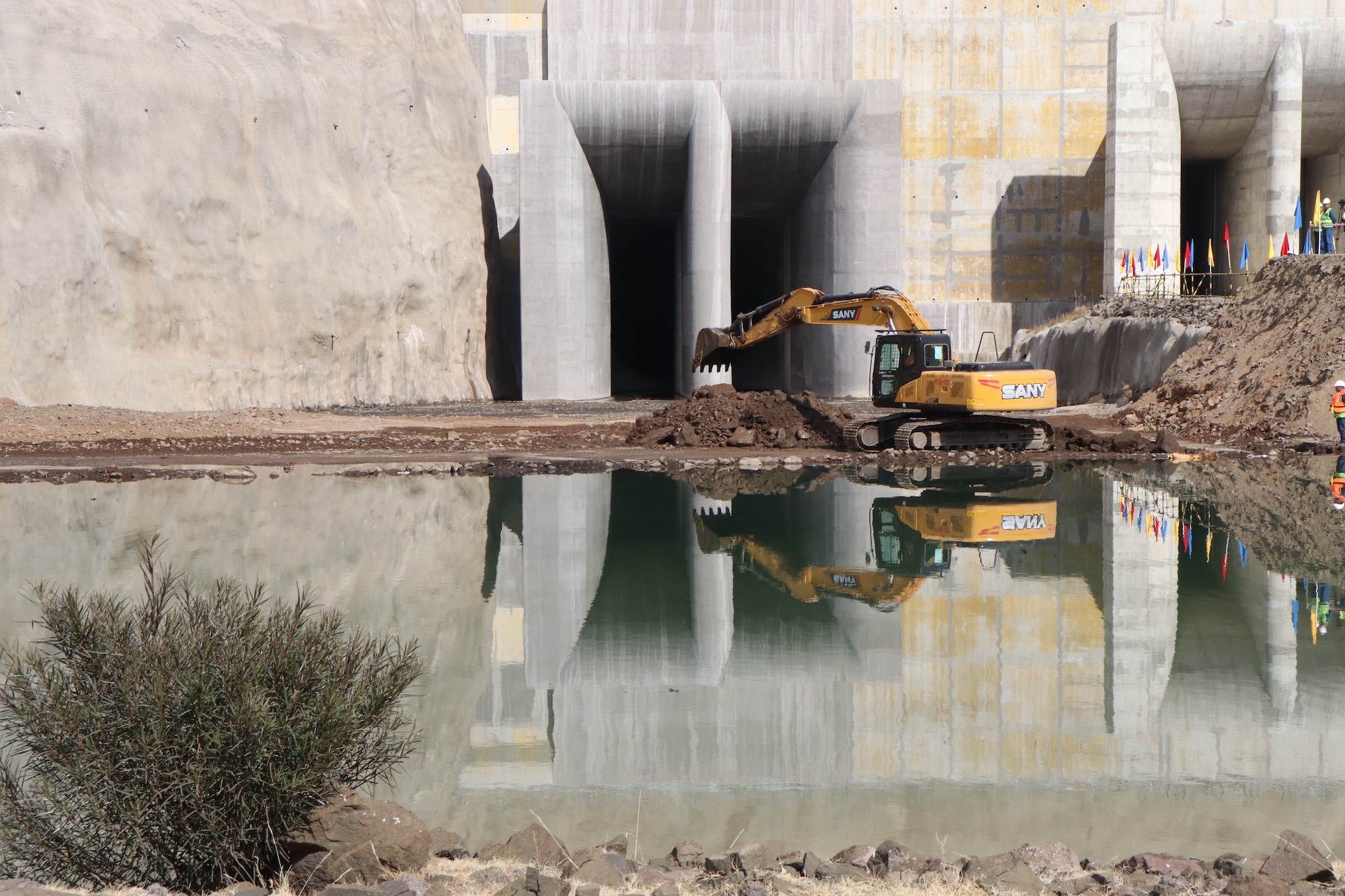
The Polihali Dam project entails extensive excavation of foundations before raising the dam’s height. Dry access is essential for foundational work, including rock excavation and grouting. To facilitate this, a cofferdam is being constructed upstream of the main dam, shielding it from potential floods until the main dam’s concrete face reaches a sufficient height. Preceding this, the pre-cofferdam was designed to divert the river through diversion tunnels, enabling construction to proceed without interruption.
Chris Hall, Project Manager of the Matla a Metsi Joint Venture, elucidated the sequence of events following the pre-cofferdam’s closure. “Now the Senqu River level will rise and the water will then enter the diversion tunnels to bypass the dam construction site. Whilst the riverbed is drained of water, the coffer dam foundations will be excavated within the river and the flanks of the valley. The plan is to complete the cofferdam before the end of October this year, according to the current master programme, and then to start on the main dam in earnest.”
The Polihali Dam construction, a concrete-faced rockfill dam, embarked in November 2022 under a contract awarded to the SUN Joint Venture, a consortium comprising partners from China, South Africa, and Lesotho. Key subcontractors, including Melki Civils and Plant Hire, MECSA Construction, SIGMA Construction, and Kunming Engineering, are instrumental in contributing to the project’s success.
The Polihali Dam is poised to create a reservoir on the Senqu and Khubelu rivers with a sprawling surface area of 5053 hectares. This ambitious endeavor encompasses various components such as a spillway, an intake tower, bottom outlet works, a compensation outlet structure, bridges, roads, and a mini-hydropower station.

Beyond its impressive scale, the Polihali Dam will enhance water storage capacity by 2,325 million cubic meters for the LHWP, significantly bolstering the current annual supply rate capacity. This augmentation will cater to South Africa’s mounting water demands, simultaneously fortifying Lesotho’s domestic water supply and diminishing its reliance on electricity imports.
This remarkable construction milestone achieved during Phase II of the Lesotho Highlands Water Project is a testament to its progress following the completion of Phase I in 2003. As the Polihali Dam project continues to unfold, it holds the promise of not only transforming the infrastructure landscape but also forging a stronger future for both Lesotho and South Africa.