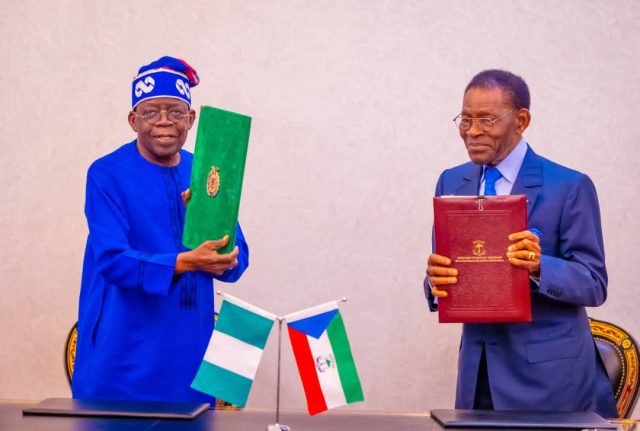
Nigeria and Equatorial Guinea have formalised an agreement to establish and operate a gas pipeline, as announced by Nigerian presidential spokesperson Ajuri Ngelale on Thursday. The accord, signed during a pivotal meeting between Nigerian President Bola Tinubu and Equatorial Guinea’s President Teodoro Obiang Nguema Mbasogo in Malabo, marks a significant stride in the ongoing collaboration between the two nations.
The dialogue, which unfolded over the course of a three-day state visit by President Tinubu to the Central African nation, encompassed a range of critical issues including employment, conflict resolution, and food security. The resultant gas pipeline agreement delineates the legislative and regulatory frameworks essential for its establishment and operation, as well as provisions concerning the transit and ownership of the natural gas it will convey.
This agreement comes in the broader context of Nigeria’s ambition to bolster regional integration and enhance energy security across the continent. It builds upon Nigeria’s prior accord with Morocco, initiated in 2016, to construct a transcontinental gas pipeline intended to serve as a conduit for African gas to European markets. This monumental project, championed by the Economic Community of West African States (ECOWAS), is anticipated to cost $25 billion and is projected to handle a capacity of 30 billion cubic metres annually upon its completion. The pipeline’s construction will unfold in three phases, interfacing with existing infrastructural assets along its route.
President Mbasogo underscored the strategic importance of the agreement, framing it within the broader context of Africa’s developmental aspirations and the continent’s bid for greater representation on the global stage, specifically, in securing a permanent seat on the United Nations Security Council. The collaboration between Nigeria and Equatorial Guinea is emblematic of Africa’s collective endeavour to harness its natural resources for the continent’s sustainable development, positioning African nations as pivotal players in global energy markets.
This gas pipeline agreement signifies not only a deepening of bilateral relations between Nigeria and Equatorial Guinea but also a crucial advancement in the shared goal of regional development. By aligning their energy strategies, these two nations are poised to make a substantial contribution to Africa’s long-term economic stability and global influence.