Tuesday, May 26, 2026
  • Login
The Southern African Times
  • Home
  • Southern Africa
  • Business
    • African Start ups
    • African Continental Free Trade Area
  • Technology
    • Lifestyle
      • Health
      • Culture
      • Food and Drink
      • Entertainment
  • Opinion
  • Sports
  • SAT Jobs
    • Events
  • About Us
    • Advertise with Us
    • Contact Us
No Result
View All Result
  • Home
  • Southern Africa
  • Business
    • African Start ups
    • African Continental Free Trade Area
  • Technology
    • Lifestyle
      • Health
      • Culture
      • Food and Drink
      • Entertainment
  • Opinion
  • Sports
  • SAT Jobs
    • Events
  • About Us
    • Advertise with Us
    • Contact Us
No Result
View All Result
The Southern African Times
No Result
View All Result
Home Opinion

New investments are needed in transition from fuel to material-based energy systems

by SAT Reporter
October 3, 2022
in Opinion
0
New investments are needed in transition from fuel to material-based energy systems

Our world would witness a global transition from fuel to material-intensive energy systems. And this transition must be done at an accelerated pace. Will there be enough minerals to meet the demand for low-carbon technologies, and how can we best deal with the challenges limiting investment in the mining and processing industries and stable supply of needed materials?

Investment dynamics in the exploration and production of critical materials need to transition to carbon-free technologies in recent years. A significant increase in investment is visible, especially evident since the Paris climate change summit in 2015. It turns out that even this growth is insufficient for a sustainable clean energy transition.

International Monetary Fund (IMF) estimated that replacing fossil fuels with low-carbon technologies will require at least an eight-fold increase in investment in renewable energy sources. However, the development of deposits is a lengthy process that can last for decades. According to the calculations of the International Energy Agency (IEA) and IMF experts, considering the projected consumption of materials until 2050, the current production volumes of vanadium, cobalt and nickel should increase several times. The gap between supply and demand for these materials ranges from 75 to 85 percent. The current production of copper, lithium and platinum is also inadequate to meet future demand, and the gap between supply and demand for these materials reaches 30 to 40 percent.


ADVERTISEMENT

The lack of funding for investments in the metals and mining industry is directly linked to the growing attention of investors to the principles of ESG (environmental, social and governance) financing. Mining is associated with significant environmental impacts and social problems with the local population and contributes to global warming.

Many mining companies with a low ESG rating cannot access concessional financing, which creates an additional bottleneck in the material supply chain. Lately, it has been seen that the miners are trying hard to improve their ESG ratings. Analysis by S&P Global shows that the average ESG score of the S&P Global 1200, an index representing about 70 per cent of the global stock market capitalization, was 46 out of 100. At the same time, the metals and mining sectors’ score rose to an impressive 52 last year from 39 in 2018. Miners are catching up with other sectors to become more attractive to institutional and socially responsible investors.

The “green” energy transition creates an unprecedented demand for essential materials, and Earth can provide humanity with all the materials mentioned. Still, there is a need to scale up responsible investment in the mining industry and overcome economic and political constraints in various jurisdictions.

The global and uncontested transition from fuel-intensive to material-intensive energy systems taking place before our eyes, as well as the expected huge costs of this transition, will require humanity to concentrate on optimizing those costs. An additional complication is that the extraction of concentrates by mining companies, enrichment of these concentrates by processing companies, and receipt of the final product by manufacturers occur in geographically distant territories.
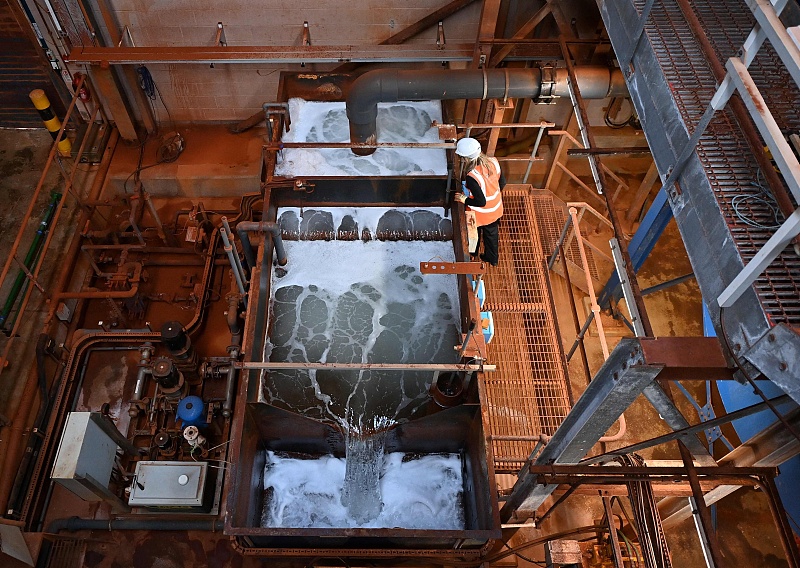
The water drawn from the former pit at the Dawdon Mine water treatment scheme in Seaham, UK, October 7, 2021. /CFP

All this entails optimizing supply chains and managing environmental, social and governance risks throughout all processes. It will require efficient international cooperation to manage risks since the peculiarities of the regulatory frameworks of various jurisdictions may require longer processing time and additional financial costs.

Sometimes the financial and reputational costs of moving through complicated supply chains can become unmanageable. One of the most notable cases was the initiation of criminal cases against mining companies and traders and economic sanctions due to political corruption in running their cobalt supply chains from the Democratic Republic of the Congo. Risk mitigation strategies should include efficient cooperation in standardizing traceability procedures, transparent reporting, independent audits and other measures that allow companies to assess the quality of their supply chains.

An analysis of recent developments in the energy market underlines that the transition from fuel-intensive to material-intensive energy systems must be fastened. It will require applying all available resources to develop and implement clean energy technologies, optimize supply chains and strengthen international cooperation. The direction and speed of technological change cannot be predicted, so the effectiveness of the energy transition depends on the quality of both global and local political decisions.

A necessary step to accelerate progress toward a green economy would be creating an international body with a mandate related to minerals, like the Food and Agriculture Organization of the United Nations for food or the IEA for energy. It could be critical in facilitating global collaboration, qualitative data analysis and setting industry standards. All this must be done to protect our planet from overheating.


Djoomart Otorbaev is the former prime minister of the Kyrgyz Republic, a distinguished professor of the Belt and Road School of Beijing Normal University, and a member of the Nizami Ganjavi International Center. The article reflects the author’s views and not necessarily those of The Southern African Times. 

Previous Post

Burkinabe coup leader says situation is under control

Next Post

WHO chief urges focus on primary healthcare to achieve universal health coverage

SAT Reporter

Related Posts

Africa Day 2026 | The Century Is Quietly Turning Towards Africa
The Editorial Board

Africa Day 2026 | The Century Is Quietly Turning Towards Africa

by The Editorial Board
May 25, 2026
How China-Africa Cooperation Can Accelerate Africa’s Industrialisation
Opinion

How China-Africa Cooperation Can Accelerate Africa’s Industrialisation

by SAT Reporter
May 25, 2026
France Is Trying to Get New Stripes in Africa – but will it work?
Opinion

France Is Trying to Get New Stripes in Africa – but will it work?

by Development Reimagined
May 14, 2026
When AI Gets It Wrong, Humans Must Get It Right
Opinion

When AI Gets It Wrong, Humans Must Get It Right

by Dr Brighton Chireka
May 14, 2026
Can the United States Still Sanction China Into Compliance?
Opinion

Can the United States Still Sanction China Into Compliance?

by SAT Reporter
May 12, 2026
Next Post
WHO chief urges focus on primary healthcare to achieve universal health coverage

WHO chief urges focus on primary healthcare to achieve universal health coverage

Browse by Category

  • Africa AI
  • African Continental Free Trade Area
  • African Debt
  • African Start ups
  • Agriculture
  • AI Africa
  • Algeria
  • All News
  • Analysis
  • Angola
  • Arts / Culture
  • Asia
  • Botswana
  • BOTSWANA
  • BREAKING NEWS
  • BRICS
  • Burkina Faso
  • Burundi
  • Business
  • Business
  • Business Wire
  • Cameroon
  • Central Africa
  • Chad
  • China
  • Climate Change
  • Climate Changev
  • Community
  • Congo Republic
  • Conservation
  • Côte d’Ivoire
  • COVID 19
  • CRYPTOCURRENCY
  • Culture
  • Democratic Republic of Congo
  • Diplomacy
  • Eastern Africa
  • Economic Development
  • Economy
  • Education
  • Egypt
  • Elections 2024
  • Energy
  • Entertainment
  • Environment
  • Eritrea
  • Ethiopia
  • Europe
  • Fashion
  • Feature
  • Finance
  • Financial Inclusion
  • Food
  • Food and Drink
  • Foods
  • GABON
  • Ghana
  • Global
  • Global Africa
  • Guinea
  • Health
  • Humanitarian Aid
  • Immigration
  • in Southern Africa
  • International news
  • International Relations
  • Investment
  • Ivory Coast
  • Just In
  • Kenya
  • Lesotho
  • Libya
  • Life Style
  • Lifestyle
  • Literature
  • Malawi
  • Malawi
  • Mali
  • Markets
  • Mauritius
  • Middle East
  • Mining in Africa
  • Morocco
  • Mozambique
  • Namibia
  • Niger
  • niger
  • Nigeria
  • North Africa
  • North-Eastern Africa
  • Obituaries
  • Obituary
  • Opinion
  • PARTNER CONTENT
  • Politics
  • Property
  • Racism
  • Rwanda
  • Rwanda
  • SADC
  • SAT Interviews
  • SAT Investigation
  • SAT Jobs
  • Saudi Arabia
  • Senegal
  • Seychelles
  • Somaliland
  • South Africa
  • South Sudan
  • Sports
  • Startup Africa
  • STOCK EXCHANGE
  • Sudan
  • Sustainability
  • Sustainablity
  • Tanzania
  • Technology
  • Telecommunications
  • The Editorial Board
  • The Power Of She
  • Togo
  • Trade
  • Travel
  • Travel
  • Tunisia
  • Uganda
  • Uncategorized
  • Wealth
  • West Africa
  • World
  • World
  • Zambia
  • ZAMBIA
  • ZIMBABWE
  • Zimbabwe

Browse by Tags

#NewsUpdate #SouthAfrica #SouthernAfricanTimes #TheSouthernAfricanTimes AfCFTA africa African Continental Free Trade Area African development African Development Bank African economies African economy African Union Agriculture Angola Botswana China Climate change Cyril Ramaphosa Economic Development economic growth energy transition governance IMF industrialisation Inflation Infrastructure Infrastructure Development International relations Investment Kenya Mozambique Namibia news Nigeria Regional Integration renewable energy Rwanda SADC South Africa Southern Africa sustainable development Tanzania United States Zambia Zimbabwe
ADVERTISEMENT

WHO WE ARE

The Southern African Times is a regional bloc digital newspaper that covers Southern African and world news. The paper also gives a nuanced analysis on news and covers a wide range of reporting which include sports, entertainment, foreign affairs, arts and culture.

Welcome Back!

Login to your account below

Forgotten Password?

Retrieve your password

Please enter your username or email address to reset your password.

Log In
  • Home
  • Southern Africa
  • Business
    • African Start ups
    • African Continental Free Trade Area
  • Technology
    • Lifestyle
      • Health
      • Culture
      • Food and Drink
      • Entertainment
  • Opinion
  • Sports
  • SAT Jobs
    • Events
  • About Us
    • Advertise with Us
    • Contact Us
Not enough quota to unlock this post
Unlock left : 0
Are you sure want to cancel subscription?