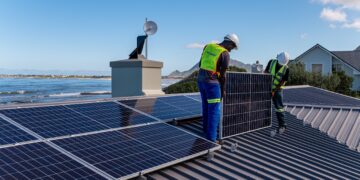
Namibia has inaugurated its first large-scale, solar-powered green hydrogen production facility in Walvis Bay, signalling a decisive step in the nation’s ambition to position itself at the forefront of sustainable industrialisation in Africa.
The Cleanergy Solutions Namibia Hydrogen Dune Project, a joint venture between CMB.Tech of Belgium and Namibia’s Ohlthaver & List Group, is powered entirely by solar energy. The facility is designed to produce green hydrogen to supply dual-fuel trucks, buses, port equipment, locomotives, generators, and small vessels, contributing to the decarbonisation of both local and regional transport networks.
Prime Minister Elijah Ngurare, speaking on behalf of President Netumbo Nandi-Ndaitwah at the launch, described the initiative as a landmark moment in Namibia’s pursuit of inclusive growth and long-term economic transformation. He highlighted that investment in green hydrogen could generate employment opportunities, expand technical skills, and empower communities, while also positioning Namibia as a credible player in the global clean energy economy.



The facility has attracted strong interest from Europe, with Jozef Sikela, European Commissioner for International Partnerships, describing it as the beginning of Namibia’s hydrogen and ammonia production journey. He emphasised that under the European Union’s Global Gateway initiative, support will extend to education, training, and the development of regulatory frameworks aimed at strengthening skills and local enterprise.

An integral feature of the project is the establishment of Namibia’s first hydrogen academy. Developed in collaboration with European and Namibian universities, the academy will train engineers, technicians, and operators to manage and expand the sector, thus embedding local expertise into future growth.

This development comes as Namibia consolidates its role in Africa’s broader green energy landscape. The project reflects a trend of African nations seeking to harness renewable energy for economic diversification, social development, and continental industrialisation strategies. While the global demand for green hydrogen is driven largely by industrial economies, initiatives such as this suggest that African states are carving out their own pathways, informed by local needs and transcontinental opportunities.
By anchoring hydrogen development in renewable solar power, Namibia is not only seeking to strengthen its domestic energy security but also to contribute to Africa’s collective climate resilience. The country’s approach contrasts with extractive models of the past, as it integrates skills transfer, education, and regional linkages into the sector’s foundations.