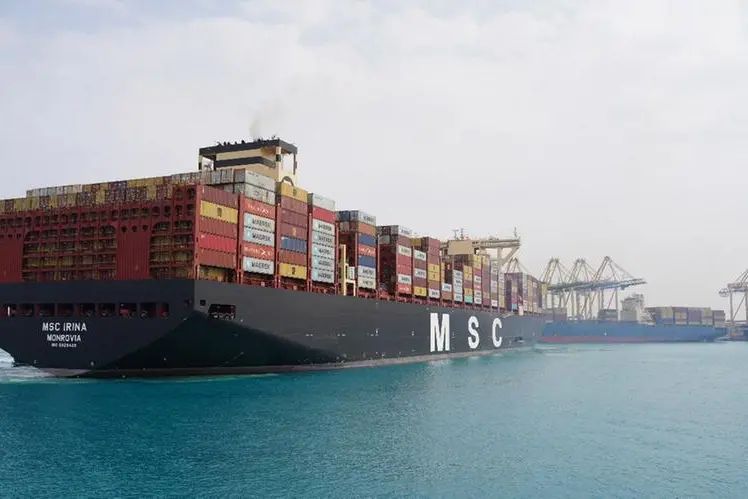
Mediterranean Shipping Company (MSC), the world’s largest container shipping line by capacity, has announced the introduction of an emergency fuel surcharge on cargo transported from the Mediterranean and Black Sea to the Red Sea, East Africa and the Indian Subcontinent. The measure is scheduled to take effect on 16 March 2026 and will apply to both dry and refrigerated containers across several trade corridors that connect European and African markets.
According to information reported by Reuters, the surcharge reflects adjustments linked to rising operational and fuel related costs affecting international shipping routes. The policy applies to cargo departing from the West Mediterranean, Adriatic, East Mediterranean, Greece and Turkey as well as ports in the Black Sea region.
Under the new structure, shipments from the Mediterranean and Black Sea to the Red Sea will incur a surcharge of 30 US dollars per twenty foot equivalent unit for dry containers and 50 dollars per twenty foot equivalent unit for refrigerated containers. Cargo moving toward East Africa will face a higher rate. Dry containers will be charged 60 dollars per twenty foot equivalent unit while refrigerated containers will incur a surcharge of 90 dollars per twenty foot equivalent unit.



For routes connecting the Mediterranean and Black Sea with the Indian Subcontinent, MSC confirmed that dry containers will be subject to a surcharge of 40 dollars per twenty foot equivalent unit and refrigerated containers will incur a charge of 60 dollars per twenty foot equivalent unit.
MSC stated that the charges are intended to address changes in fuel related operating conditions within the maritime sector. Global shipping companies have increasingly relied on flexible surcharges as a mechanism to manage volatility in fuel prices, regulatory requirements and security related route adjustments. The company has not indicated how long the emergency surcharge will remain in place.

MSC is headquartered in Geneva and operates a fleet that serves more than 500 ports worldwide through an extensive global network. According to the company’s official information, its services connect major trade corridors linking Europe, Asia, Africa and the Americas, making it a significant actor in the logistics systems that underpin international commerce. Further details about the company and its services are available through the MSC corporate website.
For African economies, shipping costs remain a central component of trade competitiveness. Maritime routes connecting the Mediterranean basin with the Red Sea and East African coastline are particularly significant for the movement of manufactured goods, agricultural products and energy related cargo. Institutions such as the United Nations Conference on Trade and Development have consistently noted that freight costs play a critical role in shaping the ability of African producers to access global markets.
The Red Sea corridor also forms part of a broader network linking the Suez Canal to ports across eastern and southern Africa. These routes remain vital for supply chains supporting trade under frameworks such as the African Continental Free Trade Area, which aims to strengthen intra African commerce and regional value chains.
Industry analysts note that surcharges of this kind illustrate the interconnected nature of maritime logistics and energy markets. Changes in operating costs within one region can reverberate across global trade networks, including routes that sustain economic exchange with African ports and hinterland economies.
While the surcharge is primarily a commercial response by MSC to shifting cost conditions, its wider implications will be monitored by exporters, importers and port authorities across Africa. For economies that rely on maritime connectivity to move commodities, manufactured goods and essential imports, fluctuations in shipping charges can influence supply chain planning, pricing structures and trade flows.
As global shipping continues to navigate evolving operational realities, including energy transitions and regulatory requirements from organisations such as the International Maritime Organization, the balance between operational sustainability and affordable freight remains a subject of ongoing discussion within the maritime sector.