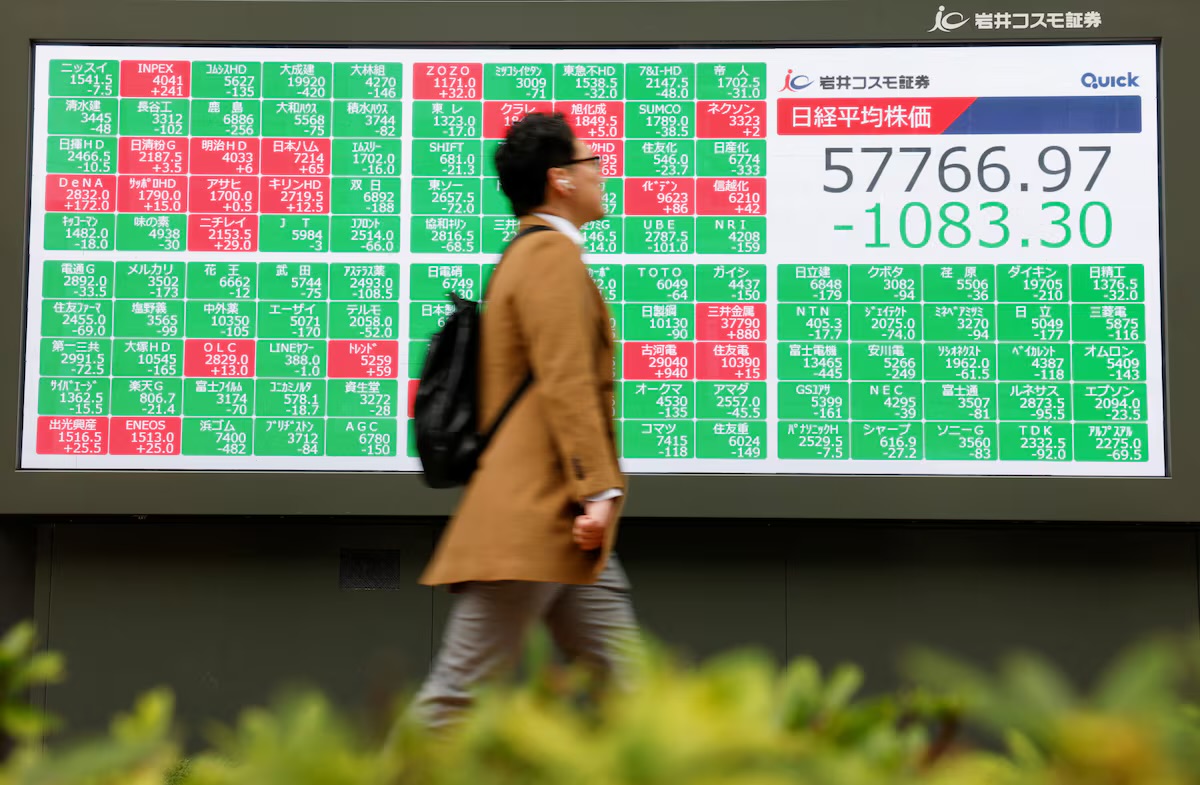
Asian equities rallied sharply on Thursday as signs of limited shipping activity returning to the Strait of Hormuz combined with strong momentum in the semiconductor sector to lift investor sentiment, even as geopolitical risks in the Middle East continued to cast a long shadow over global markets.
MSCI’s broadest index of Asia Pacific shares outside Japan climbed 2.7%, snapping a four day losing streak and signalling a renewed appetite for risk across the region. South Korea’s benchmark surged more than 8%, while Taiwanese equities gained close to 4%, driven largely by strength in technology stocks. In contrast, mainland Chinese markets lagged, with blue chip shares edging 0.5% lower, reflecting a more cautious domestic outlook.
The rebound in Asia followed a positive session on Wall Street, where the S&P 500 rose 1.1% and the Nasdaq Composite advanced 1.5%, buoyed by easing bond yields and optimism around the outlook for artificial intelligence driven growth. Futures trading in early hours suggested a more subdued tone ahead, with both indices holding broadly flat.



At the centre of the market’s momentum was Nvidia, whose latest results exceeded expectations and reinforced its dominant position in the global semiconductor industry. Chief executive Jensen Huang sought to reassure investors that demand for advanced chips powering artificial intelligence would remain robust, despite concerns about supply constraints and geopolitical headwinds.
Analysts noted that the company continues to shape the direction of the broader technology sector. While its shares dipped slightly in extended trading, the wider impact on chipmakers across Asia was significant, lifting sentiment in a sector that has become central to global equity performance.
In South Korea, shares in Samsung Electronics jumped more than 8% after the company’s union agreed to suspend industrial action following a tentative wage agreement. The move averted a large scale strike involving tens of thousands of workers, easing concerns about potential disruptions to global semiconductor supply chains at a time when demand remains elevated.

Beyond equities, developments in energy markets also played a role in shaping investor mood. Brent crude rose 0.9% to around 106 dollars per barrel, recovering some recent losses after reports that several supertankers had successfully navigated the Strait of Hormuz. The waterway remains a critical artery for global energy flows, and any sign of normalisation, however limited, is closely watched by markets.
Tensions remain high, however, following recent exchanges between the United States and Iran. President Donald Trump said Washington remained prepared to escalate military action if necessary, although he indicated there could be a brief window for diplomacy. The uncertainty has kept traders sensitive to headlines, particularly given the potential impact on oil supply and inflation.
European markets appeared more cautious in early trading, with futures for major indices pointing slightly lower. The divergence highlights the uneven nature of the current recovery in risk appetite, where optimism around technology and earnings is tempered by persistent geopolitical and macroeconomic risks.
For now, the combination of easing immediate supply fears in energy markets and continued strength in artificial intelligence driven sectors has been enough to lift Asian equities. Whether that momentum can be sustained will depend on the trajectory of both geopolitical developments and the durability of the global technology rally.