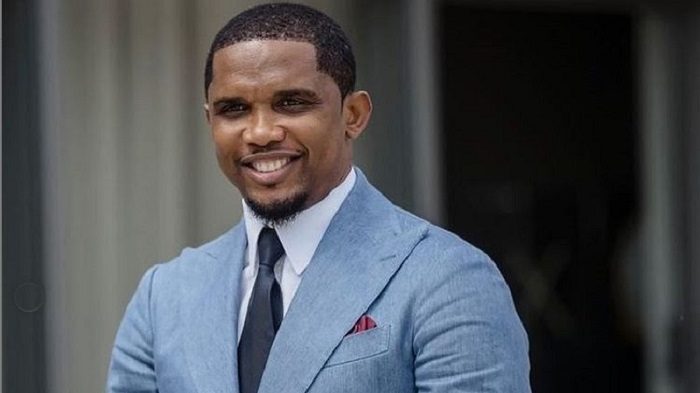
Samuel Eto’o, the current president of the Cameroonian Football Federation (Fecafoot) and one of Africa’s most iconic football figures, has been handed a six-month ban by FIFA, preventing him from attending any international matches involving Cameroon. The decision was made by a FIFA disciplinary panel after Eto’o was found to have violated two key articles of the governing body’s disciplinary code.
The ban stems from Eto’o’s behavior during the Under-20 Women’s World Cup round of 16 match between Cameroon and Brazil on September 11, 2024. Brazil emerged victorious 3-1 after extra time, but the match, held in Bogota, Colombia, was marred by what FIFA described as “offensive behavior” and violations of “fair play” principles. These infractions were committed by Eto’o, who was in attendance at the game. FIFA’s disciplinary committee cited misconduct by players and officials as reasons for the ban. As a result, the 43-year-old football icon is prohibited from attending any football match involving Cameroon’s national men’s or women’s teams at all levels and age groups for the duration of the suspension.
FIFA confirmed that the sanction is effective immediately, and Eto’o has been notified. However, the former Barcelona and Chelsea striker retains the right to appeal the decision.




The timing of this suspension comes at a critical moment for Cameroon’s footballing calendar. The men’s national team, the Indomitable Lions, are set to face Kenya in a crucial double-header of Africa Cup of Nations (AFCON) 2025 qualifiers in October. Eto’o had chaired a meeting in Douala just before the announcement to discuss preparations for these matches, scheduled for October 11 and 16. His absence is likely to cast a shadow over the team’s morale and organizational efforts.
This ban marks the latest in a series of controversies that have surrounded Eto’o since he became Fecafoot president in 2021. In July 2024, he was fined $200,000 by the Confederation of African Football (CAF) after being found guilty of breaching ethical standards by signing a contract to serve as an ambassador for the betting company 1XBET. CAF’s investigation found that Eto’o had “seriously violated the principles of ethics, integrity, and sportsmanship,” although charges related to match-fixing allegations were ultimately dismissed due to insufficient evidence. Eto’o’s legal team indicated at the time that they intended to appeal the CAF ruling.
Despite an illustrious career that saw Eto’o claim multiple honors with Barcelona, Inter Milan, and Chelsea, his tenure as the head of Fecafoot has not been without turbulence. Since taking office, he has faced mounting criticism from various sectors of Cameroonian football. In 2022, a coalition representing amateur football clubs in the country called for his resignation, citing what they described as “grave irregularities” in the management of the federation. Furthermore, Eto’o has been labeled as a “dictator” by some of his former teammates, criticizing his leadership style and decision-making.

One of the most publicized disputes involved a rift between Eto’o and Cameroon’s Ministry of Sport over the appointment of Belgian coach Marc Brys to lead the men’s national team. After a lengthy standoff, Eto’o eventually conceded to the ministry’s decision, but the clash raised questions about his approach to governance and collaboration with other stakeholders.
With this latest sanction from FIFA, Eto’o’s leadership at Fecafoot faces yet another challenge, as he navigates a crucial period in Cameroon’s football history. The coming months will determine not only the fate of the national teams but also Eto’o’s future as the head of Cameroonian football.