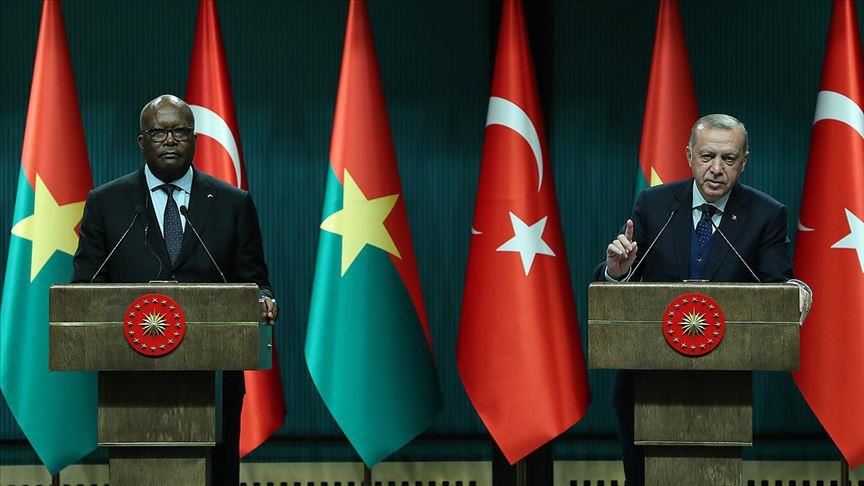
JOHANNESBURG, (The Southern African Times) – Turkish President Recep Tayyip Erdogan kicked off a whistle-stop tour of African countries on Monday, meeting leaders and investors in Angola, Nigeria and Togo ahead of a Turkey-Africa trade summit on Thursday.
The Turkey-Africa Economic and Business Forum, held in Istanbul from 21-22 October, aims to provide a platform for Turkish businesses to gain a foothold on the continent.
Organised by the Turkish government and African Union, Rwakakamba Morrison, the chairman of Uganda’s Investment Authority called it an opportunity to “catch up with prospective investors here in Istanbul.”



The first day of the two day summit will see Turkish and African ministers of trade, investment, technology and logistics hold closed door meetings on ‘Deepening Turkey-Africa Partnership’.
The agenda for day one also schedules bilateral meetings with business leaders and ministers, as well as panel discussions on emerging opportunities in agriculture, healthcare and the new regional free-trade zone – the African Continental Free Trade Area (AfCFTA).
The second day of the forum will host sessions promoting innovation, Turkish-African banking cooperation, trade finance and women’s leadership.
The last edition of the biannual event launched in 2016 was held online in October 2020 due to the pandemic.
Battle for hearts and minds
Since 2009, Ankara has engaged with African countries, big and small, at feverish speed, with Erdogan’s overriding ambition on the continent driven by trade and investment, says Tim Ash, an emerging markets economist at BlueBay Asset Management.
During a visit to Angola on Monday, the Turkish president said there were significant bi-lateral opportunities in the energy and defence sectors, with seven deals signed so far between the two countries.
“For quite a long time Turkey has been very Africa focussed. Under Erdogan, Turkey embassies have expanded massively globally as part of their effort to boost trade and investment,” Ash says.
That building spree has taken the number of Turkish embassies in Africa from a dozen in 2009 to 43 today. This year, it will open its 44th, in Guinea-Bissau.

Erdogan’s foreign policy is also moulded by efforts to counter the growing influence of rival Islamic powers in Africa such as the UAE and Egypt.
With strong historical trading links, the UAE has become an increasingly vital partner for the continent, and its second-largest investing country, second only to China, according to the Financial Times’ fDI Intelligence.
Ankara’s allegiance with Qatar has pitted Turkey against Saudi Arabia, Egypt and the UAE in a “battle for hearts and minds” on the continent, Ash says.
Saudi Arabia, Egypt and the UAE are fiercely opposed to the Muslim Brotherhood and its associated brand of political Islam, Ash says. Doha and Ankara have provided support for the Muslim Brotherhood in Egypt and backed rebels fighting to overthrow Syrian President Bashar al-Assad.
This has manifested itself in Turkey’s sweeping investments in education projects on the continent, building 17 schools in Nigeria alone.
“Turkey’s been a big investor in education. Expanding Turkish cultural-religious influence as a conduit to boosting Turkish trade,” Ash says.
Africa also represents a huge success story for Erdogan as Turkey’s tourist economy weathers a battering from Covid-19, Ash says.
“Erdogan has massive problems at home, the economy’s not doing well and and Africa has been one of that has been relatively successful for him in terms of business and trade. So he probably wants some nice photo shoots of him shaking hands and doing stuff in Africa.

As Turkey’s relations with Europe unravel, Ankara has been keen to diversify its trade away from Europe. Two-thirds of Turkey’s trade investment financing comes from Europe, but amid political tensions Erdogan has tried to kindle trade ties elsewhere, starting with the Middle East. Souring relations with Saudi Arabia, the UAE and Egypt, and a deteriorating regional security situation refocussed the president’s sights on the continent.
“Africa has been a relatively low hanging fruit, with less geopolitical problems. So Africa is part of this diversification ploy,” Ash adds.

Trade between Turkey and Africa has ballooned from $5.5bn in 2003 to more than $25.3 billion by 2020, despite the coronavirus pandemic.
“Africa has been very beneficial for Turkish companies, manufactured products, food, its been a big market, they’ve also been a conduit of transit trade and travellers from Africa.”
Today, Turkish fingerprints are all over Africa, from the Kigali Arena in Rwanda, east Africa’s biggest stadium, built by a Turkish construction firm, to an Olympic swimming pool in Senegal, a colossal mosque in Djibouti and Turkish military hardware on Libya’s battlefields. But while most African countries have welcomed the new partnership, experts wonder about the long-term ambitions behind Erdogan’s Africa strategy.
The Turkey-Africa Economic and Business Forum takes place from the 21-22 October in the Istanbul Congress Center.
Additional reporting by Charlie Mitchell.