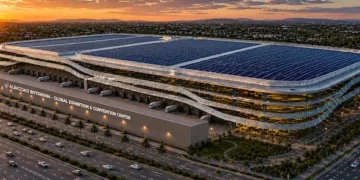
Plans by Econet InfraCo to develop a large scale industrial park near Harare’s main international airport have drawn attention to the evolving role of private capital in Zimbabwe’s infrastructure and industrial ambitions. The project, which is still subject to regulatory and planning approvals, is intended to combine renewable energy generation, digital infrastructure and logistics access within a single development.
According to information published by Marketscreener, Econet InfraCo proposes a 300 hectare industrial park adjacent to Robert Mugabe International Airport. The development would be anchored by a 100 megawatt solar power plant and supported by a large scale data centre. Econet InfraCo has stated that the aim is to attract manufacturers and export oriented businesses by reducing exposure to power interruptions and infrastructure bottlenecks, which have historically affected industrial activity in Zimbabwe and parts of Southern Africa.
The project is being advanced under the broader corporate restructuring of Econet Wireless Zimbabwe, which announced in December 2025 that it would separate its infrastructure assets into a distinct entity. Econet InfraCo has long managed fibre networks, towers, power systems and data facilities within the group. The separation is intended to allow these assets to be valued independently and potentially opened to external investment.



Douglas Mboweni, group chief executive of Econet, has said the proposed industrial park is designed to provide serviced land, energy and connectivity in one location, with the intention of shortening the time between investment commitment and operational activity. He has also indicated that the solar power plant would be developed in phases, allowing capacity to expand in line with tenant demand rather than being built in full at the outset.
Construction work on initial site preparation has begun, although the company has emphasised that further progress depends on regulatory clearances and planning permissions. Econet has not yet disclosed capital expenditure figures or a detailed timeline for full completion, and it remains unclear how quickly tenants will be secured in a market that continues to face macroeconomic and currency challenges.
The development has been approved by Strive Masiyiwa, the founder of Econet, whose recent public statements have highlighted a growing emphasis on digital infrastructure and artificial intelligence within the group’s long term strategy. In late 2025, Masiyiwa described artificial intelligence as a central focus of his current entrepreneurial work, noting that he had taken a more direct role in guiding AI related initiatives across Econet’s businesses.

This shift has included the establishment of an AI focused computing facility in Cape Town, South Africa, where Econet has invested in high performance data infrastructure with technical support from Nvidia. While the Harare industrial park has not been described as an AI facility in itself, the inclusion of a data centre within the development suggests an intention to support digitally enabled industrial activity alongside traditional manufacturing.
Across Africa, there has been growing interest in industrial zones that integrate energy generation, logistics and data infrastructure, particularly in response to persistent power shortages and rising demand for digital services. Similar approaches have been explored in countries including Morocco, Kenya and Egypt, often with varying degrees of state involvement. Econet InfraCo’s proposal differs in that it is being led by a private telecommunications group rather than a government or development finance institution.
The project also intersects with broader capital market developments in Zimbabwe. Econet has stated that it is considering listing Econet InfraCo on the Victoria Falls Stock Exchange, subject to shareholder and regulatory approval. The Victoria Falls exchange, which operates in United States dollars, was established to attract foreign investment and mitigate currency risk for investors. A potential listing would add a sizeable infrastructure focused company to the exchange, although no timeline has been confirmed.
Supporters of the project argue that private sector led infrastructure investment could help address long standing deficits in power supply and industrial facilities, particularly at a time when public finances remain constrained. They also point to the potential for job creation and export growth if manufacturers are able to operate with more reliable energy and connectivity.
At the same time, analysts note that industrial parks in Zimbabwe and elsewhere in the region have faced challenges related to occupancy rates, financing costs and policy uncertainty. The success of the Econet InfraCo development is likely to depend not only on infrastructure delivery but also on wider economic conditions, regulatory stability and the ability to attract tenants operating at sufficient scale.
From a continental perspective, the project reflects an ongoing debate about how African economies can industrialise in ways that are both locally grounded and globally competitive. The integration of renewable energy and data infrastructure aligns with broader climate and digital transformation goals, while the focus on export oriented production connects to ambitions under the African Continental Free Trade Area.
Whether the Harare airport industrial park becomes a model for similar developments elsewhere in Africa will depend on its implementation and performance over time. For now, it represents a significant proposal within Zimbabwe’s private sector landscape, highlighting both the opportunities and uncertainties that accompany large scale infrastructure investment in the region.