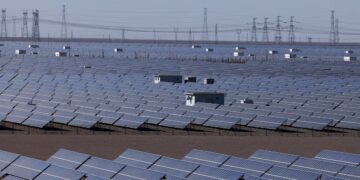
China’s solar panel exports to Africa increased markedly in 2025, reflecting a broader shift in global renewable energy supply chains and growing demand across the continent. Analysis by the energy think tank Ember indicates that exports reached approximately 18.8 gigawatts, representing a year on year rise of about 48 percent. This volume is equivalent to more than three times the installed capacity of the Grand Ethiopian Renaissance Dam, currently the largest hydropower project in Africa.
The increase comes at a time when many African countries are seeking to diversify their energy mix amid persistent electricity access challenges. Despite the continent’s extensive solar resources, solar power currently contributes less than 5 percent of Africa’s total electricity generation, according to data compiled by the International Energy Agency. This gap between potential and actual generation continues to shape policy discussions across regions including Southern, Eastern and West Africa.
China remains the dominant global manufacturer of solar photovoltaic equipment. Industry estimates suggest that Chinese firms accounted for approximately 86 percent of global solar panel production capacity by 2024, underscoring the scale of its industrial base and export capability. The redirection of exports towards African markets coincides with a decline in shipments to the United States and parts of Europe, where tariffs and trade measures have altered market dynamics. Further detail on trade policy developments can be accessed via the World Trade Organization.



Across Africa, the influx of lower cost solar technology has been met with both opportunity and scrutiny. For some governments and regional power pools, increased availability of panels has supported the acceleration of utility scale and decentralised solar projects, including mini grids and off grid solutions in rural communities. Initiatives supported by institutions such as the African Development Bank continue to emphasise solar as a key pathway to expanding electricity access while managing climate commitments.
At the same time, analysts and policymakers have raised questions regarding industrial development and long term value creation within African economies. While imports can help address immediate energy deficits, there is ongoing debate about how to strengthen local manufacturing ecosystems and ensure that the energy transition contributes to employment and skills development across the continent.

Regional perspectives further illustrate the complexity of this transition. In Southern Africa, where coal has historically underpinned energy systems, solar expansion is increasingly framed within broader strategies for economic diversification and energy security. In North and East Africa, solar deployment is often linked to export oriented green energy ambitions, including hydrogen production. These varied approaches highlight that Africa’s energy transition cannot be reduced to a single narrative, but rather reflects diverse national priorities and resource contexts.
The growth in solar panel imports also intersects with questions of infrastructure readiness, grid integration and financing. While falling technology costs have improved project viability, constraints related to transmission networks and investment frameworks remain significant in several countries. Multilateral partnerships and regional cooperation mechanisms are therefore likely to play a central role in shaping outcomes.
As global energy systems continue to evolve, Africa’s position within renewable supply chains is gaining renewed attention. The recent increase in Chinese solar exports may signal both an opportunity to accelerate electrification and a moment for deeper reflection on how the continent can shape its own industrial and energy future in ways that align with local priorities and lived realities.