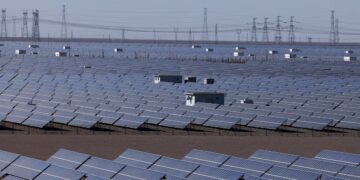
In a groundbreaking report released by Boston University, China emerges as a pivotal player capable of catalyzing Africa’s renewable energy revolution. The study underscores China’s historic neglect of green power investments in Africa, spanning nearly two decades, and highlights the urgent need for a paradigm shift in its approach to the continent’s energy landscape.
Despite solidifying its position as Africa’s largest bilateral trading partner and bankrolling numerous infrastructural ventures, China’s commitment to fostering Africa’s energy transition has been lackluster. While President Xi Jinping’s declaration to eschew new coal-fired power projects abroad provided a glimmer of hope, the report reveals a stark reality: Chinese lending for renewables in Africa remains alarmingly minimal. From 2000 to 2022, only 2% of the $52 billion in energy loans extended by China’s primary development finance institutions were allocated to renewable energy projects like solar and wind.
Shockingly, over half of these investments were channeled into fossil fuel initiatives, perpetuating Africa’s reliance on non-renewable energy sources.The report underscores the critical role China could play in bolstering Africa’s energy access and transition. By leveraging its extensive trade networks, financial resources, and foreign direct investment, China has the potential to spearhead a green energy revolution across the continent.




However, the current trajectory of Chinese investments in Africa paints a different picture. With a disproportionate focus on commodity extraction and electrification projects, Chinese lending often mirrors Africa’s traditional economic sectors, such as oil and mineral extraction.
Moreover, while Chinese funding has fueled the development of several hydropower projects, primarily intended to support resource extraction, the report warns that African nations are not reaping the full benefits of renewable energy technologies.
According to the report, fossil fuels continue to dominate Africa’s energy landscape, accounting for approximately 75% of total electricity generation and 90% of energy consumption in 2022.As the world grapples with the urgent imperative of combating climate change, the spotlight is now on China to recalibrate its investment strategy in Africa. By prioritizing renewable energy initiatives over fossil fuel projects, China can unlock Africa’s vast potential for sustainable energy production while simultaneously mitigating the adverse effects of climate change.
 With the stakes higher than ever, the time has come for China to heed the call and lead the charge towards a greener, more sustainable future for Africa and the planet at large.