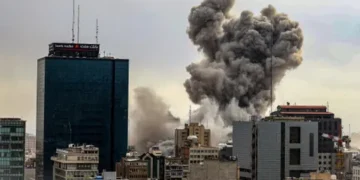
President Donald Trump has confirmed that US aircraft conducted strikes on Iran’s principal nuclear facilities—Fordow, Natanz and Isfahan—marking the United States’ most direct engagement in the Israeli-Iranian conflict to date. According to Iranian state media, personnel had been evacuated prior to impact.
Trump announced the operation on social media and scheduled a televised address for 10 p.m. Eastern Time. The strikes represent a significant escalation in regional dynamics and follow a wave of Israeli air assaults earlier this month that elicited Iranian missile and drone reprisals.
Analysts suggest the strikes further complicate an already volatile geopolitical landscape, with the NATO summit scheduled for later this month now assuming heightened urgency. Meanwhile, US public sentiment appears cautiously sceptical, with many citizens wary of another military entanglement in the Middle East.



The US action follows Israel’s earlier campaign which targeted approximately 100 military and nuclear-related facilities across Iran, involving more than 200 jets and hundreds of munitions. Although Israel denied direct US involvement in that operation, it is understood that Washington had been informed in advance.

In response to the Israeli attacks, Iran launched ballistic missiles and drones targeting Israel. Further escalations included a strike by Yemen’s Houthi movement on the West Bank town of Hebron, which resulted in several injuries. Additional drone incursions were reported over Jordanian, Saudi, and Syrian airspace.
The global reaction has been swift and critical. Several governments have voiced concern, citing violations of sovereignty and the potential collapse of diplomatic frameworks. The escalation has prompted renewed calls for restraint and a return to negotiations.

Iran’s leadership has condemned the latest US strikes as a grave provocation and affirmed the country’s right to respond. The Iranian military has signalled readiness to retaliate, including against US military assets in the region, and indicated a suspension of participation in ongoing nuclear talks.
As of 22 June 2025, the confrontation between the United States and Iran has shifted the focus of global diplomacy, placing pressure on all stakeholders to avert further military escalation. The outcome of the upcoming NATO summit and suspended nuclear discussions may shape the direction of this unfolding crisis.