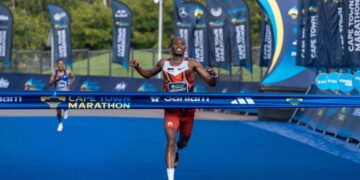
In a spectacular display of speed and determination, Bayanda Walaza has claimed the 100m gold medal at the World U20 Championships with an electrifying time of 10.19 seconds, reinforcing the growing dominance of African sprinters on the global stage. The race, marked by high stakes and fierce competition, saw Walaza surge ahead of the pack, adding yet another prestigious title to his already illustrious career. This victory follows his silver medal win in the 4x100m relay at the Paris Olympics, where he and his South African teammates showcased their remarkable talent.

This gold medal is not just a personal triumph for Walaza; it is a significant chapter in a larger story that has seen African sprinters increasingly dominate the world of athletics. Walaza’s victory was accompanied by a bronze medal performance from his fellow South African, Bradley Nkoana, who clocked in at 10.26 seconds. Nkoana’s success further underscores South Africa’s growing influence in the sprinting arena and highlights the depth of talent that the continent is now producing.



The rise of African sprinters like Walaza and Nkoana is part of a broader trend that has seen the continent steadily challenge the traditional powerhouses of sprinting. This shift was further evidenced just weeks ago at the Paris Olympics, where Botswana’s sprinting sensation, Letsile Tebogo, captured the world’s attention with his remarkable performances, earning multiple medals and proving that Africa is now a formidable force in global track and field.
Adding to this narrative of African dominance is Akani Simbine, the veteran South African sprinter who, alongside Walaza, Nkoana, and Shaun Maswanganya, helped secure a silver medal in the 4x100m relay at the Paris Olympics. Simbine, a seasoned athlete with numerous accolades, continues to play a pivotal role in mentoring the next generation of sprinters, ensuring that Africa’s sprinting legacy is in capable hands.
The depth of African talent was further showcased in the 100m finals at the Paris Olympics, where Zimbabwe’s Makanakaishe Charamba and Tapiwanashe Makarawu finished 6th and 8th, respectively. These performances underline the fact that Africa’s sprinting revolution is not confined to one or two nations; it is a continental phenomenon. The majority of these athletes, including Walaza, Nkoana, Charamba, and Makarawu, are still in college, highlighting the potential for even greater achievements as they mature and gain more experience on the world stage.
The emergence of these young African athletes at the forefront of sprinting marks a significant turning point in the history of the sport. For decades, sprinting has been dominated by athletes from other regions, but recent years have seen a profound change as African sprinters rise through the ranks, consistently delivering world-class performances. Walaza’s journey from a promising young talent to a world-class sprinter is emblematic of the dedication, resilience, and raw talent that characterize this new generation of African athletes.
As the national anthem played and the South African flag was hoisted during the medal ceremony, the significance of the moment was palpable. This victory is not just about individual glory; it represents the collective ascent of African sprinters on the world stage. Walaza’s triumph is a beacon of pride and inspiration, not just for South Africa, but for the entire continent. It is a powerful reminder that Africa is not only keeping pace with the world’s best but is now setting the pace, redefining what is possible in the world of sprinting.

The sprinting world is witnessing a seismic shift, with Africa at the epicenter. The achievements of Walaza, Nkoana, Tebogo, Simbine, Maswanganya, Charamba, Makarawu, and other rising stars signal the dawn of a new era where the future of sprinting is decidedly Afrocentric. This wave of success is likely to inspire a new generation of African athletes, who will look to these young sprinters as role models and trailblazers.
As the dust settles on this latest chapter in the history of athletics, one thing is clear: Africa’s time has come. The continent is no longer just a participant in the world of sprinting—it is a leader. And with athletes like Bayanda Walaza and his peers at the forefront, the world of track and field is sure to witness even more extraordinary achievements from Africa in the years to come.