There is a particular kind of political cowardice that mistakes noise for accountability. Over the past several weeks, South Africa’s Department of Home Affairs has produced arrest after arrest, statement after statement, each one framed as evidence of a system finally being cleansed. What has been rather more difficult to locate, from the Union Buildings to the ministries responsible for policing, social cohesion and public communication, is anything resembling an admission that the rot was institutional long before it became a street-level crisis. The distinction matters enormously, because a government that treats corruption as an unfortunate inheritance rather than a structural failure of its own oversight is a government still evading the reckoning it owes its citizens, and owes the migrants it has allowed to become scapegoats for that failure.
The scale of what the Special Investigating Unit has uncovered inside Home Affairs deserves to be stated plainly, because plain statement is precisely what has been missing from the political discourse. The SIU’s own findings, made public in February, describe South Africa’s immigration system as having been run as a marketplace, in which permits and residence documents were sold to the highest bidder over a period stretching back more than two decades. Acting SIU head Leonard Lekgetho did not mince his words when he said the country’s borders were not protected by law but auctioned off through corruption. The financial trail alone, exceeding one hundred and eighty million rand in identified gains, tells a story of an internal syndicate operating with the confidence of an institution that knew it would not be caught. Adjudicators earning twenty five thousand rand a month were found to have amassed fortunes, in one instance building a mansion complete with its own tarred access road, funded through bribes for permanent residence permits processed on WhatsApp and settled within a day of approval. Two hundred and seventy five criminal referrals have since gone to the National Prosecuting Authority, alongside more than a hundred completed internal investigations, a body of evidence that ought to reframe entirely how the public understands the migration debate in this country.
This is the material fact that vigilante movements such as Operation Dudula and March and March have persistently obscured, whether through genuine confusion or convenient omission. The grievance economy that sustains these movements requires a simple villain, and the undocumented migrant, powerless, often destitute, rarely able to answer back in the register of a press conference, has proved the most expedient one available. Yet the SIU’s own findings make clear that the architecture enabling large scale fraudulent status, from asylum permits issued without any assessment of the underlying claim, to citizenship secured through fingerprint substitution and DNA manipulation, was built and operated by officials inside the South African state, in collusion with well resourced syndicates rather than desperate individuals crossing the Limpopo on foot. The department’s own retirement visa category, requiring a monthly income threshold of thirty seven thousand rand, was found to have no meaningful post issuance monitoring at all. None of this required a single undocumented Zimbabwean, Malawian or Mozambican labourer to set foot in the country. It required a civil service willing to look away, and a political leadership that, until relatively recently, showed little appetite to look back.



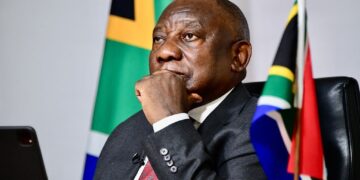
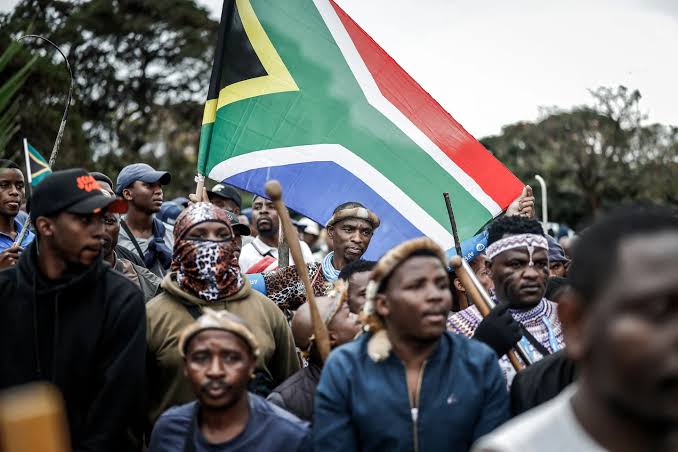
What has followed this year is not a policy response so much as a permission structure. March and March, led by Jacinta Ngobese-Zuma, and Operation Dudula, whose founding leadership was restrained by a South Gauteng High Court injunction in November 2025 after courts found the movement had no lawful authority to demand identity documents from private citizens, have nonetheless continued to organise, mobilise and, in numerous documented instances, intimidate. Human Rights Watch has recorded assaults on foreign shopkeepers in Durban this April, attacks that continued with apparent impunity despite an existing court order explicitly prohibiting such conduct. By late June, a self declared deadline for undocumented migrants to leave the country had produced scenes that ought to trouble any government claiming constitutional seriousness: an Ethiopian community suffering fatal shootings inside a Johannesburg fast food restaurant, families boarding buses out of Pietermaritzburg with their possessions strapped to their backs, a Malawian man killed by a mob in an informal settlement. President Cyril Ramaphosa’s public appeal for the protests to remain peaceful was, on the evidence of the past month, wholly insufficient to the moment. An appeal is not a policy, and a warning issued after the fact is not the same as the enforcement of a court order that already existed.

There is also a quieter, more insidious failure, and it is one of communication rather than policing. Research tracking almost four million posts on X between January and May of this year found that a single Dudula aligned cluster of accounts was responsible for well over a third of all anti migrant content in the dataset, despite representing a small fraction of the users engaged in the conversation, a level of concentration that speaks to coordinated amplification rather than organic sentiment. That this online architecture has migrated, with troubling ease, into formal party politics, with former Dudula leadership taking up candidacies under the ActionSA banner, illustrates precisely how a vacuum in government messaging gets filled. Where the state has been reluctant to state clearly and repeatedly that its own department failed, that the criminals were largely its own employees, and that the economic anxiety driving these marches has structural causes unrelated to migration, others have filled that silence with a narrative that is simpler, angrier and considerably more marketable.
That narrative also happens to be economically illiterate, a point South Africa’s own research institutions and international partners have made with some consistency. The OECD and International Labour Organisation’s joint assessment of the South African labour market found immigrant workers contributing somewhere in the region of nine per cent of national GDP, with a positive effect on income per capita and no significant displacement of native born employment at a national level. The Helen Suzman Foundation’s review of this same evidence base reached a similar conclusion, noting that immigrants in South Africa tend to be either highly skilled or engaged in labour that complements rather than competes with the domestic workforce. Set against an unemployment rate that stood at thirty two per cent in the first quarter of this year, following the loss of some three hundred and fifty thousand jobs, the temptation to locate blame in the roughly five per cent of the population born outside the country is politically understandable. It is also, on the government’s own evidentiary record, false, and a state that possesses this data and declines to communicate it with equivalent vigour to its anti corruption press briefings is failing its citizens in a different but no less serious way.
None of this is to romanticise migration policy or to suggest that South Africa’s borders should function without regulation, credible verification or consequence for genuine fraud. It is to insist on a distinction that has been allowed to collapse entirely in the public conversation this year: between the migrant, who is overwhelmingly a participant in the economy rather than a parasite upon it, and the institution, which permitted, and in places actively monetised, the very disorder it now invokes to justify further restriction. A government serious about restoring public trust would lead with its own accountability. It would publish the SIU’s findings in full and keep publishing them until the officials responsible, not only the foreign nationals who benefited from their corruption, have faced the courts. It would enforce, without further delay, the injunctions its own judiciary has already granted. And it would speak to its citizens with the same fluency about the economics of migration that it has, belatedly, begun to apply to the economics of corruption. Anything less leaves the field open to those who have found, in the migrant, a far more convenient subject than the mirror.