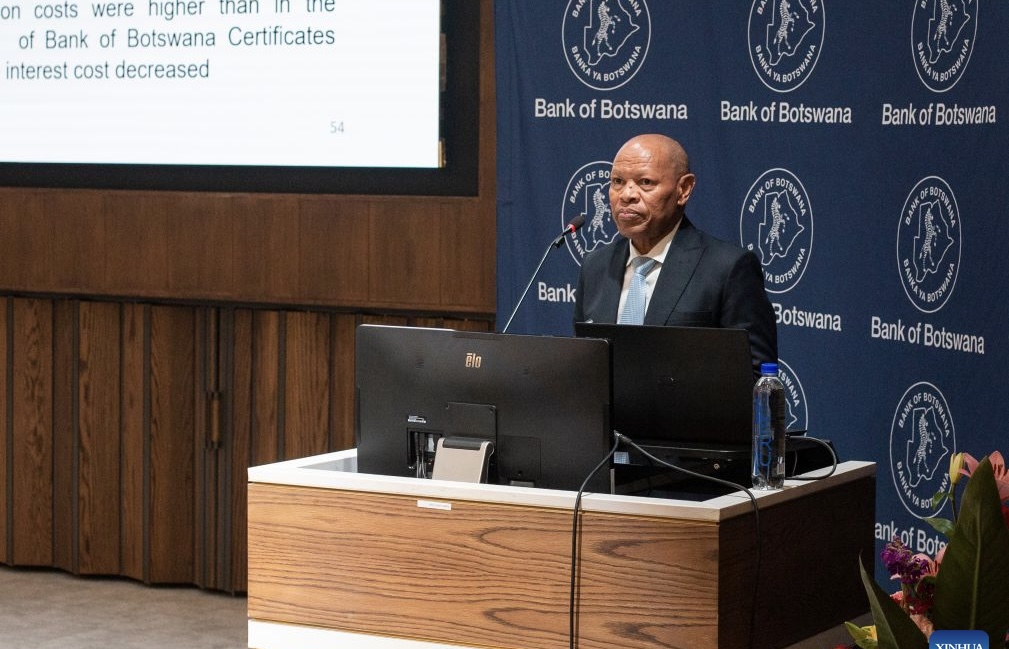
The Governor of the Bank of Botswana, Lesego Moseki, has called for accelerated structural reforms aimed at broadening the country’s productive base and reinforcing fiscal resilience, as the southern African economy continues to adjust to sustained pressures in its diamond industry and shifting global conditions.
Speaking in Gaborone during a briefing on the central bank’s 2025 annual report, Moseki noted that Botswana’s macroeconomic position remains underpinned by relatively strong institutions, a stable financial system and a long-standing record of prudent economic management. However, he cautioned that these strengths are being tested by weaker external demand, geopolitical fragmentation and persistent uncertainty in global trade, which have collectively narrowed policy flexibility.
The remarks come at a time when Botswana’s growth trajectory has been heavily influenced by volatility in the diamond sector, which remains a central pillar of export earnings and fiscal revenues. According to data outlined by the central bank, the economy contracted by 2.8 percent in 2024 and a further 0.7 percent in 2025, with mining weakness offset only partially by resilience in non mining sectors such as services and parts of domestic consumption.



Moseki stressed that declining mineral revenues have placed pressure on both government finances and foreign exchange reserves, underscoring what he described as the urgency of restoring fiscal sustainability. The central message, he argued, is not one of crisis but of constrained space for incremental policymaking at a moment when structural adjustment is increasingly necessary.
Inflationary pressures are also expected to reassert themselves in the short term. The Bank of Botswana projects inflation to rise to 9 percent in 2026, up from an average of 2.7 percent in 2025, driven by adjustments in fuel and transport costs, healthcare related expenses and water tariffs. In response to tightening liquidity conditions, the central bank raised its policy rate to 3.5 percent in October 2025 and further to 5.5 percent in April 2026, maintaining that level in June 2026 in an effort to balance price stability with economic support.
Moseki’s comments were framed within broader national planning instruments, including the Botswana Economic Transformation Programme and National Development Plan 12, which together emphasise diversification beyond mineral dependency and a stronger role for private sector led growth. He argued that these frameworks require more consistent implementation discipline across state institutions and state owned enterprises if they are to translate into measurable economic restructuring.
At the centre of his argument was the view that Botswana’s current economic environment should be treated less as a temporary downturn and more as a structural inflection point. In this reading, the long standing reliance on diamonds, while historically foundational to national development, increasingly exposes the economy to external shocks beyond domestic control. The governor’s position reflects a wider policy debate across resource dependent economies in southern Africa on how to transition towards more diversified and labour absorbing sectors without undermining fiscal stability in the short term.
The Bank of Botswana has maintained that the country retains investment grade fundamentals, supported by relatively low levels of public debt compared to regional peers and a reputation for macroeconomic prudence. Yet officials acknowledge that these buffers are gradually being eroded by repeated revenue shortfalls linked to commodity cycles.
From a regional perspective, Botswana’s policy challenge is not unique. Several economies in southern Africa continue to grapple with balancing extractive sector dependence against diversification ambitions, often in contexts where global demand cycles and climate related transitions are reshaping commodity markets faster than domestic reforms can adjust. In this sense, Botswana’s current policy stance reflects both domestic constraints and broader structural shifts affecting resource intensive economies across the continent.
The Bank of Botswana, which remains central to monetary policy formulation and financial stability oversight, has indicated that maintaining price stability while supporting medium term growth will require continued coordination with fiscal authorities and the private sector. The institution has also reiterated the importance of strengthening external buffers to safeguard against future volatility in export earnings.

The governor’s remarks suggest a policy direction that prioritises long term structural adjustment over short term cyclical management. However, the effectiveness of this approach will depend on the pace at which reforms can be implemented across sectors that have historically been closely tied to mineral revenue flows.
Bank of Botswana continues to position monetary policy as one component within a broader national transformation agenda, rather than as a standalone stabilisation tool. The emphasis on diversification, productivity enhancement and institutional coordination signals an attempt to recalibrate the economy towards more sustainable growth pathways, even as external conditions remain uncertain.