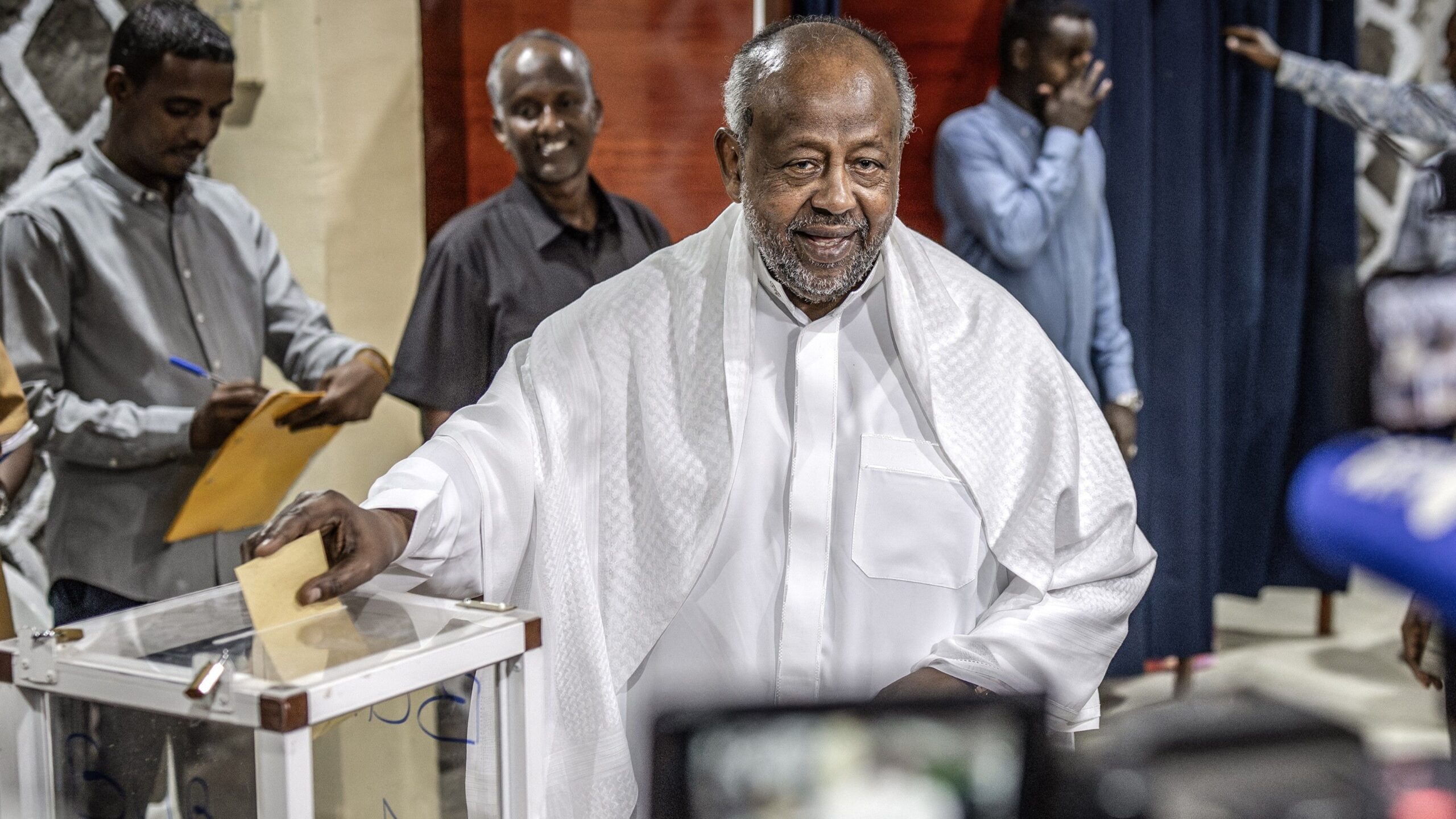
Djibouti’s long serving president Ismail Omar Guelleh has secured a sixth term in office following the country’s 2026 presidential election, according to provisional results released by the Ministry of Interior. The announcement indicates that Guelleh received 97.81 percent of the vote, while his challenger Mohamed Farah Samatar of the Unified Democratic Centre obtained 2.19 percent.
The outcome, which is consistent with previous electoral patterns in Djibouti, reflects both the entrenched dominance of the ruling political establishment and the limited competitiveness of the country’s electoral landscape. Guelleh, who first assumed office in 1999, has overseen a period marked by relative political stability in a strategically significant but geographically small state located at the entrance to the Red Sea. More information on Djibouti’s political system and electoral processes can be accessed via the African Union and the Intergovernmental Authority on Development.
Djibouti occupies a pivotal position in global maritime trade routes and regional security frameworks. Its ports serve as a critical gateway for neighbouring Ethiopia, a landlocked country whose economic activity is closely tied to Djibouti’s infrastructure. According to the World Bank, over 90 percent of Ethiopia’s trade passes through Djiboutian ports, underscoring the interdependence between the two countries and the broader Horn of Africa region.



The country’s geopolitical importance is further reinforced by its role in international security cooperation. Djibouti hosts several foreign military bases and participates in efforts to counter piracy and transnational threats in the Red Sea and Gulf of Aden corridor. This positioning has shaped both its domestic priorities and its international partnerships, as outlined by the United Nations Office on Drugs and Crime.
While official results point to a decisive victory, analysts have often highlighted concerns regarding political pluralism and the operational space available to opposition actors in Djibouti. Electoral processes in the country have historically been characterised by low levels of contestation, with opposition groups citing structural constraints. At the same time, the government has emphasised continuity, national cohesion and economic development as central pillars of its governance approach. Broader perspectives on electoral governance across Africa can be explored through the African Elections Database.
Guelleh’s re election occurs within a wider continental context in which African states continue to negotiate the balance between political stability, institutional reform and democratic participation. Across the Horn of Africa and beyond, electoral outcomes often reflect complex intersections of history, security considerations and socio economic priorities. These dynamics resist simplified interpretations and call for a more layered understanding of governance trajectories across the continent.

From a pan African perspective, Djibouti’s experience illustrates the diversity of political pathways within Africa. While some states have pursued competitive multi party systems with frequent alternation of power, others have prioritised continuity in leadership as part of broader state building strategies. Both trajectories continue to generate debate among policymakers, civil society actors and regional institutions.
The provisional nature of the results means that formal confirmation is expected following the completion of constitutional procedures. Nevertheless, the scale of the reported margin suggests continuity in leadership for the foreseeable future. As Djibouti navigates its next political cycle, attention is likely to remain focused on how governance frameworks evolve alongside economic ambitions and regional responsibilities.