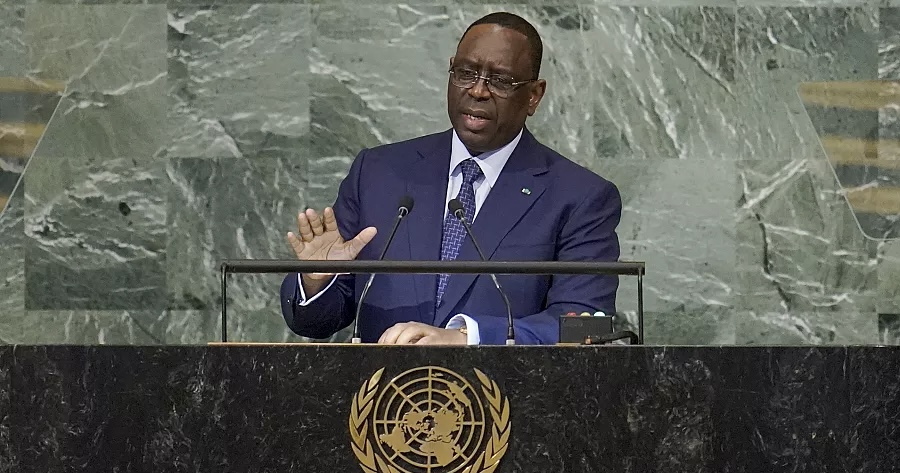
The recent failure to secure African Union endorsement for former Senegalese president Macky Sall’s reported candidacy for the next United Nations Secretary General has been widely interpreted in some quarters as a sign of continental division. A closer reading suggests a different conclusion. Rather than exposing institutional weakness, the episode appears to show that the African Union retained its procedural guardrails when confronted with an attempt to accelerate support for a high profile international nomination.
According to the AU’s own account, a draft decision circulated on 26 March did not obtain the level of support required under the process that had been initiated. In a statement issued on 27 March, the organisation said that 20 member states either objected to the proposal or requested more time for consideration. That outcome prevented the draft from being treated as adopted and, in practical terms, halted efforts to present Sall as a formally endorsed continental candidate for the post of United Nations Secretary General.
The significance of this development lies not only in the fate of one candidacy, but in the way the matter was handled. The AU has established channels for considering African candidatures to senior international offices. These processes are intended to move from technical review to political consultation, beginning with member state submissions and proceeding through the Committee of Permanent Representatives, the relevant ministerial structures and ultimately the Executive Council. In principle, such procedures are designed to protect collective decision making, to avoid ambiguity and to ensure that endorsement is rooted in consultation rather than diplomatic improvisation.



In this case, the reported effort to secure support for Sall appears to have departed from that standard route. His name was not part of the formal list of candidatures placed before the Executive Council during the AU summit in February. Nor was there, on the available record, a clear formal endorsement from Senegal itself. That omission mattered. In most regional and multilateral settings, a candidate for a post of this stature would ordinarily be expected to have unambiguous support from their home state before broader regional backing is sought.
The bid was reportedly submitted to the United Nations on 2 March by Burundi, whose president, Évariste Ndayishimiye, assumed the rotating AU chairmanship in February. That move appears to have created uncertainty around whether the initiative reflected a national diplomatic intervention, a chair driven effort or an already settled continental consensus. These are not equivalent things. The office of AU chair carries political visibility, but it does not displace the collective authority of the Union’s decision making structures. That distinction is central to understanding why several states appear to have objected.
A further source of concern was the use of a silence procedure. Such procedures are common in multilateral diplomacy and can serve a practical purpose where the matter at hand is administrative, routine or previously agreed in substance. They are less suited to politically sensitive questions where member states may reasonably expect deliberation, amendment and explicit discussion. In the present case, the circulation of a draft decision with a 24 hour deadline appears to have prompted objections not only to the substance of the candidacy, but to the method itself.
That objection should not be read simplistically as a split between those who supported Sall and those who did not. It is equally plausible to view the response as a defence of process. Where silence is treated as assent, the burden shifts to those with reservations to register opposition publicly and quickly. This can produce a misleading picture, especially on contentious matters. Silence may reflect support, but it may also reflect hesitation, incomplete consultation, diplomatic caution or discomfort with the procedure. A process that converts varied forms of silence into apparent endorsement risks overstating consensus.
The AU’s response therefore matters institutionally. It suggests that a significant number of member states were unwilling to allow implicit approval to substitute for explicit collective decision making. That is not necessarily evidence of dysfunction. On the contrary, it may indicate that states were attentive to precedent and to the implications of allowing a politically consequential nomination to proceed without the fuller scrutiny normally expected.

This is particularly relevant because the office in question carries symbolic and strategic weight well beyond one state’s diplomacy. The selection of a UN Secretary General is shaped by global power politics, informal regional expectations and negotiation among the permanent members of the Security Council as well as the wider UN membership. There is also a longstanding, though informal, understanding that regional rotation should be taken into account in the choice of Secretary General, with many diplomats having argued that the next office holder should come from Latin America and the Caribbean, since that region has never held the post. The United Nations process for selecting the Secretary General does not formally allocate the role by region, but regional balance has been an enduring part of diplomatic discussion. Any AU endorsement would therefore have had to weigh not only the credentials of the candidate, but also the wider feasibility and cost of advancing an African bid at this point.
Sall is, by any measure, a figure of continental and international stature. During his presidency he served as AU chair in 2022 and was associated with advocacy for expanded African representation in global governance, including efforts linked to the AU’s subsequent admission to the G20. He has remained visible in international policy circles since leaving office. Those credentials help explain why some actors may have considered him a plausible candidate for a major global role.
At the same time, it is also true that his domestic legacy remains contested within Senegal. His final term was marked by intense political tension, controversy around electoral timing and legal disputes involving opposition figures. Following the change of government in Dakar, debate over governance and public financial management has remained part of the national conversation. None of this automatically disqualifies a former head of state from international office. It does, however, underline why some AU member states may have preferred a more deliberate process, especially in the absence of an unequivocal Senegalese sponsorship.
Seen from a broader African perspective, the episode also touches on an enduring question, how should continental institutions balance flexibility with procedural legitimacy. The AU is frequently criticised for inconsistency, yet in this instance its member states appear to have drawn a line against procedural compression. That restraint may have spared the organisation a more damaging dispute. A rushed endorsement, particularly one later challenged on procedural grounds or disowned by the candidate’s own state, could have deepened mistrust and weakened the credibility of future AU backed candidatures.
There is an additional institutional dimension. Recent years have seen recurring debate over the respective roles of the AU chair, the Chairperson of the AU Commission and member states in representing the Union externally. Where mandates are not clearly separated, diplomatic initiative can shade into institutional overreach. The decision not to let this candidacy proceed by procedural shortcut may therefore be read as part of a wider effort to preserve the balance of authority within the Union’s own architecture.
For African observers, the more instructive lesson is not that the continent failed to speak with one voice. It is that African states did speak, though not uniformly, and did so through an institutional language centred on procedure, legitimacy and collective ownership. Continental unity cannot be measured only by whether all governments rally behind a single name. It must also be judged by whether shared rules are respected when pressure is applied. On that measure, the AU may have shown a degree of maturity.
This matters in a wider international context where multilateral institutions are under strain and where procedural shortcuts are often justified in the name of urgency or prestige. In resisting an ambiguous route to endorsement, AU member states appear to have affirmed that legitimacy is not a technical detail but part of political substance itself. That stance may be less dramatic than a united acclamation, but it is arguably more valuable for the long term credibility of African multilateral diplomacy.

The result leaves open a number of questions about how the AU will approach future candidatures for senior international office, and whether a more transparent and timely internal process might reduce room for confusion. But the immediate conclusion is relatively clear. The Macky Sall episode did not simply test African unity. It tested whether the AU’s procedures could withstand political pressure around a prominent name. In this instance, the institution appears to have held.