Sunday, May 31, 2026
  • Login
The Southern African Times
  • Home
  • Southern Africa
  • Business
    • African Start ups
    • African Continental Free Trade Area
  • Technology
    • Lifestyle
      • Health
      • Culture
      • Food and Drink
      • Entertainment
  • Opinion
  • Sports
  • SAT Jobs
    • Events
  • About Us
    • Advertise with Us
    • Contact Us
No Result
View All Result
  • Home
  • Southern Africa
  • Business
    • African Start ups
    • African Continental Free Trade Area
  • Technology
    • Lifestyle
      • Health
      • Culture
      • Food and Drink
      • Entertainment
  • Opinion
  • Sports
  • SAT Jobs
    • Events
  • About Us
    • Advertise with Us
    • Contact Us
No Result
View All Result
The Southern African Times
No Result
View All Result
Home International Relations

Madagascar Balances Russia and France Ties During Transition

by SAT Reporter
April 10, 2026
in International Relations
0
Madagascar Balances Russia and France Ties During Transition

Madagascar’s transitional leadership is navigating a complex diplomatic landscape as it engages both longstanding and emerging partners in a bid to stabilise the country and reposition its global relationships following the political upheaval of late 2025.

Colonel Michaël Randrianirina, who assumed power after a military intervention amid sustained youth led protests, has in recent months undertaken high level visits to both Moscow and Paris. These engagements reflect an approach that seeks to broaden Madagascar’s international partnerships while addressing pressing domestic challenges.

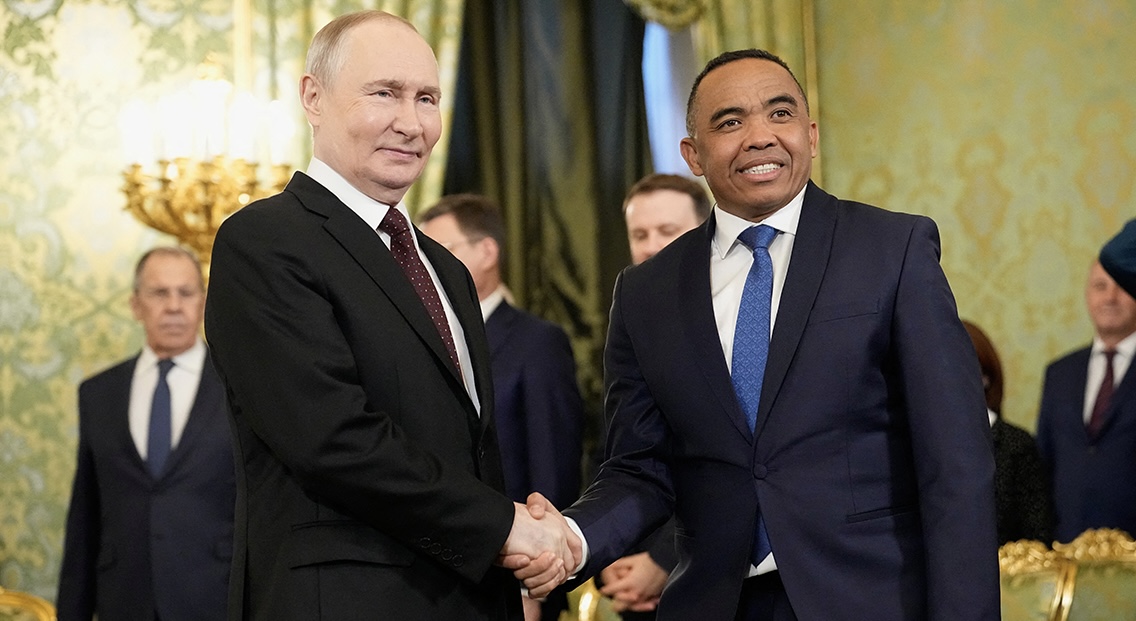
During a visit to Russia in February 2026, Randrianirina met President Vladimir Putin and expressed interest in deepening bilateral cooperation across sectors including agriculture, education and infrastructure. Russian officials indicated that discussions included a prospective agreement on agro industrial collaboration. Moscow has also signalled willingness to support Madagascar in areas such as geological exploration and security cooperation. Reports of military assistance, including equipment deliveries and training personnel, have drawn attention to the strategic dimension of the relationship.


ADVERTISEMENT

Within days of the Moscow visit, the Malagasy leader travelled to France where discussions with President Emmanuel Macron focused on political transition, economic recovery and institutional reform. France reaffirmed its role as a key development partner, with ongoing initiatives addressing urban sanitation in Antananarivo, food insecurity in the south and judicial reform. According to publicly available trade data, France remains one of Madagascar’s principal bilateral economic partners, with significantly higher trade volumes than those recorded with Russia. More details on France’s cooperation programmes can be found via the French Ministry for Europe and Foreign Affairs.

This dual engagement reflects a broader strategic posture that is not unprecedented in Madagascar’s history. Since independence in 1960, successive governments have at various points sought to diversify external partnerships beyond former colonial ties. Historical precedents include periods of closer alignment with the United States, as well as a shift towards non aligned and socialist oriented policies in the 1970s. Contemporary policy appears to echo this tradition of multi directional diplomacy, aimed at maximising economic and political options.

Madagascar’s resource endowment adds a further dimension to this diplomatic positioning. The country possesses significant deposits of nickel, cobalt, chromite and precious stones, alongside emerging interest in rare earth elements. These resources have attracted interest from a range of global actors. Information on Madagascar’s mining sector can be accessed through the Extractive Industries Transparency Initiative. Analysts suggest that engagement with multiple partners may enhance bargaining power, though tangible developmental outcomes remain uneven.

Domestically, expectations remain high. The protests that preceded the change in leadership were driven in part by economic grievances and demands for improved governance. While international partnerships may offer opportunities for investment and technical support, their effectiveness will likely be assessed by the extent to which they translate into measurable improvements in livelihoods.

Security considerations also shape Madagascar’s external relations. The Indian Ocean region has become increasingly significant in global strategic terms, given its major shipping routes and resource potential. France maintains a military presence in nearby territories such as Réunion and Mayotte, contributing to maritime security cooperation. At the same time, Russia, China and India have expanded their engagement across the region, reflecting a broader pattern of multipolar competition. Regional context can be explored further through the Africa Portal.

The question of the Îles Éparses, a group of islands administered by France but claimed by Madagascar, remains unresolved and continues to carry implications for maritime jurisdiction and resource access in the Mozambique Channel. Although not foregrounded in recent diplomatic exchanges, the issue remains part of the broader bilateral relationship.

Recent political developments within Madagascar indicate an ongoing process of consolidation. Changes in government leadership, including the appointment of a new prime minister, suggest efforts to stabilise governance structures during the transitional period, which is scheduled to run until 2027.

From a pan African perspective, Madagascar’s current trajectory reflects wider continental dynamics in which states seek to engage a diverse range of partners while asserting agency in shaping development pathways. The emphasis on diversified diplomacy underscores a broader shift away from singular external dependencies towards more complex and negotiated forms of international cooperation.

At the same time, the outcomes of such strategies remain contingent on domestic policy coherence, institutional capacity and the ability to align external partnerships with nationally defined priorities. As Madagascar continues its transition, the balance between geopolitical engagement and internal reform will remain central to its future direction.

Tags: African diplomacyFrance-Africa RelationsGeopoliticsIndian OceanInternational relationsMadagascarmineral resourcespolitical transitionRussia-Africa relationsSouthern Africa
Previous Post

Namibia’s Inflation Falls to 2.1 Percent as Price Pressures Continue to Ease

Next Post

Congo Enters Global Capital Markets with 1.25 Billion Dollar Debut Bond Issue

SAT Reporter

Related Posts

Eswatini Moves Early on Controversial US Deportation Plan
International Relations

Eswatini Moves Early on Controversial US Deportation Plan

by SAT Reporter
May 21, 2026
DR Congo, Rwanda face off over Francophonie leadership race
International Relations

DR Congo, Rwanda face off over Francophonie leadership race

by SAT Reporter
May 16, 2026
China and US Consider Extending Rare Earth Truce as Global Supply Pressures Persist
International Relations

China and US Consider Extending Rare Earth Truce as Global Supply Pressures Persist

by SAT Reporter
May 13, 2026
Zimbabwe and Equatorial Guinea Deepen Bilateral Cooperation
Diplomacy

Zimbabwe and Equatorial Guinea Deepen Bilateral Cooperation

by SAT Reporter
May 11, 2026
Rwanda and Botswana Sign Six Cooperation Agreements
Diplomacy

Rwanda and Botswana agree visa free travel

by SAT Reporter
May 8, 2026
Next Post
Congo Enters Global Capital Markets with 1.25 Billion Dollar Debut Bond Issue

Congo Enters Global Capital Markets with 1.25 Billion Dollar Debut Bond Issue

Browse by Category

  • Africa AI
  • African Continental Free Trade Area
  • African Debt
  • African Start ups
  • Agriculture
  • AI Africa
  • Algeria
  • All News
  • Analysis
  • Angola
  • Arts / Culture
  • Asia
  • Botswana
  • BOTSWANA
  • BREAKING NEWS
  • BRICS
  • Burkina Faso
  • Burundi
  • Business
  • Business
  • Business Wire
  • Cameroon
  • Central Africa
  • Chad
  • China
  • Climate Change
  • Climate Changev
  • Community
  • Congo Republic
  • Conservation
  • Côte d’Ivoire
  • COVID 19
  • CRYPTOCURRENCY
  • Culture
  • Democratic Republic of Congo
  • Diplomacy
  • Eastern Africa
  • Economic Development
  • Economy
  • Education
  • Egypt
  • Elections 2024
  • Energy
  • Entertainment
  • Environment
  • Eritrea
  • Ethiopia
  • Europe
  • Fashion
  • Feature
  • Finance
  • Financial Inclusion
  • Food
  • Food and Drink
  • Foods
  • GABON
  • Ghana
  • Global
  • Global Africa
  • Guinea
  • Health
  • Humanitarian Aid
  • Immigration
  • in Southern Africa
  • International news
  • International Relations
  • Investment
  • Ivory Coast
  • Just In
  • Kenya
  • Lesotho
  • Libya
  • Life Style
  • Lifestyle
  • Literature
  • Malawi
  • Malawi
  • Mali
  • Markets
  • Mauritius
  • Middle East
  • Mining in Africa
  • Morocco
  • Mozambique
  • Namibia
  • Niger
  • niger
  • Nigeria
  • North Africa
  • North-Eastern Africa
  • Obituaries
  • Obituary
  • Opinion
  • PARTNER CONTENT
  • Politics
  • Property
  • Racism
  • Rwanda
  • Rwanda
  • SADC
  • SAT Interviews
  • SAT Investigation
  • SAT Jobs
  • Saudi Arabia
  • Senegal
  • Seychelles
  • Somaliland
  • South Africa
  • South Sudan
  • Sports
  • Startup Africa
  • STOCK EXCHANGE
  • Sudan
  • Sustainability
  • Sustainablity
  • Tanzania
  • Technology
  • Telecommunications
  • The Editorial Board
  • The Power Of She
  • Togo
  • Trade
  • Travel
  • Travel
  • Tunisia
  • Uganda
  • Uncategorized
  • Wealth
  • West Africa
  • World
  • World
  • ZAMBIA
  • Zambia
  • ZIMBABWE
  • Zimbabwe

Browse by Tags

#NewsUpdate #SouthAfrica #SouthernAfricanTimes #TheSouthernAfricanTimes AfCFTA africa African Continental Free Trade Area African development African Development Bank African economies African economy African Union Agriculture Angola Botswana China Climate change Cyril Ramaphosa Economic Development economic growth energy transition Ghana governance industrialisation Inflation Infrastructure Infrastructure Development International relations Investment Kenya Mozambique Namibia news Nigeria Regional Integration renewable energy Rwanda SADC South Africa Southern Africa sustainable development Tanzania United States Zambia Zimbabwe
ADVERTISEMENT

WHO WE ARE

The Southern African Times is a regional bloc digital newspaper that covers Southern African and world news. The paper also gives a nuanced analysis on news and covers a wide range of reporting which include sports, entertainment, foreign affairs, arts and culture.

Welcome Back!

Login to your account below

Forgotten Password?

Retrieve your password

Please enter your username or email address to reset your password.

Log In
  • Home
  • Southern Africa
  • Business
    • African Start ups
    • African Continental Free Trade Area
  • Technology
    • Lifestyle
      • Health
      • Culture
      • Food and Drink
      • Entertainment
  • Opinion
  • Sports
  • SAT Jobs
    • Events
  • About Us
    • Advertise with Us
    • Contact Us
Not enough quota to unlock this post
Unlock left : 0
Are you sure want to cancel subscription?