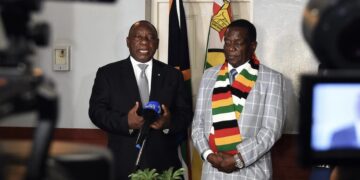
Ghana’s President John Dramani Mahama has received Zimbabwe’s President Emmerson Mnangagwa in Accra for a three day state visit aimed at consolidating diplomatic, economic and historical ties between the two African nations. The visit, which began with a formal استقبال at Kotoka International Airport, reflects a continuing pattern of intra African engagement that draws on shared liberation histories while addressing contemporary development priorities.
President Mnangagwa was accorded full state honours upon arrival, including a guard of honour and a ceremonial twenty one gun salute. According to official communication from the Government of Ghana, such protocols are reserved for visiting heads of state and signal the significance attached to the visit. The Zimbabwean leader is accompanied by a high level delegation, underscoring the intent to translate diplomatic symbolism into practical cooperation.
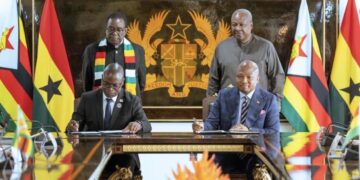
Central to the visit are bilateral discussions taking place at Peduase Lodge, where both leaders are expected to engage in private consultations followed by expanded talks involving their respective delegations. These engagements are expected to culminate in the signing of several Memoranda of Understanding, reinforcing frameworks for collaboration across multiple sectors. While specific agreements have not yet been publicly detailed, officials from both countries have indicated that trade facilitation, agricultural development and institutional cooperation are among the priorities.



The programme also includes a state banquet hosted by President Mahama, providing an opportunity for diplomatic exchange in a more informal setting. In addition, President Mnangagwa is scheduled to visit key sites in Accra, including the Sweden Ghana Medical Centre, which has become a notable institution in Ghana’s evolving healthcare landscape, and the Accra Compost and Recycling Plant, a project frequently cited in discussions on urban sanitation and sustainable waste management. These visits are expected to facilitate knowledge sharing on public service delivery, particularly in healthcare and sanitation systems.
A symbolic highlight of the visit will be the laying of a wreath at the Kwame Nkrumah Memorial Park, an act that situates the visit within a broader historical continuum. Ghana and Zimbabwe share longstanding political connections rooted in anti colonial struggles and pan African solidarity, with leaders such as Kwame Nkrumah playing influential roles in shaping continental political consciousness. The gesture is therefore both commemorative and indicative of a continued alignment with pan African ideals.
Officials from both governments have framed the visit as an opportunity to deepen cooperation in areas such as trade and investment, tourism development, and governance. Discussions are also expected to touch on youth employment and anti corruption measures, reflecting common policy challenges across the continent. The emphasis on mutual exchange rather than unilateral assistance aligns with a broader shift towards African led development frameworks that prioritise regional agency and contextual solutions.

While state visits often carry symbolic weight, their longer term significance is typically measured by the implementation of agreed initiatives. In this regard, observers note that both Ghana and Zimbabwe are navigating complex economic environments, which may shape the pace and scope of any outcomes. Nevertheless, the visit contributes to an ongoing pattern of diplomatic engagement that seeks to reinforce continental linkages beyond traditional external partnerships.
From a pan African perspective, the visit can be read as part of a wider effort to re centre African narratives within global discourse. By foregrounding shared histories alongside present day policy coordination, both countries signal an approach that recognises diversity within unity, and cooperation as a means of addressing structural challenges. The emphasis on partnership rather than hierarchy reflects an evolving diplomatic language that seeks to humanise state relations and