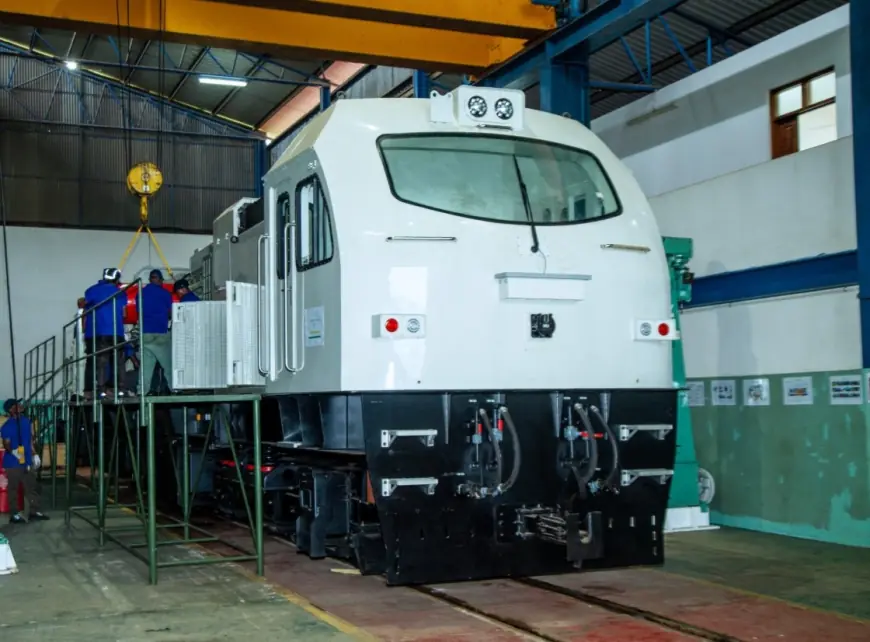
Tanzania has initiated the local assembly of mainline locomotives at the Pugu Railway Workshop in Dar es Salaam, marking a significant development in the country’s evolving railway sector and positioning it among the first states in East Africa to undertake such industrial activity domestically. The initiative reflects broader continental efforts to strengthen technical capacity, localise elements of industrial production and expand rail infrastructure as a foundation for economic integration and trade.
The development was highlighted during a recent inspection by Tanzania’s Parliamentary Standing Committee on Infrastructure, which visited the workshop operated by the Tanzania Railways Corporation (TRC). Committee chair Selemani Kakoso commended the corporation’s efforts and emphasised the importance of sustained technical training for Tanzanian youth involved in assembling and maintaining locomotives.
According to Kakoso, strengthening professional and technical skills among young engineers and technicians remains central to ensuring that railway expansion translates into durable institutional capacity. He noted that continued investment in advanced training, both domestically and internationally, could enhance efficiency, foster innovation and reinforce the long term sustainability of the national rail network.




Officials indicated that the decision to assemble locomotives locally emerged partly from supply chain disruptions affecting the delivery of spare parts. Delays associated with the Russia Ukraine conflict altered international logistics flows and highlighted vulnerabilities in global industrial supply systems. In response, TRC adopted a partial localisation strategy in which some locomotives were delivered fully assembled while others arrived in component form for assembly in Tanzania.
Two locomotives were assembled in Malaysia before shipment to Tanzania, while components for an additional six units were transported to the Pugu facility for assembly by local technicians. The approach has allowed the railway authority to maintain operational timelines while gradually building domestic technical competence within the sector.
TRC Director General Machibya Shiwa told officials during the visit that the assembly programme has already generated employment opportunities for Tanzanian technicians and trainees. The initiative currently involves dozens of young workers who are gaining hands on experience in locomotive assembly and maintenance. The programme also supports the government’s wider strategy of strengthening national technical expertise within key infrastructure sectors.
Beyond workforce development, the project has created opportunities for domestic suppliers providing engineering services and industrial materials. Local firms are contributing machining services, electrical components, construction materials, pipes, lubricants and other industrial inputs required for assembly and maintenance. Such linkages illustrate how infrastructure projects can stimulate wider economic participation across domestic value chains.
The initiative forms part of Tanzania’s broader rail modernisation agenda. The government has invested significantly in rail transport in recent years, including the construction of the Standard Gauge Railway network, which aims to improve connectivity between the port of Dar es Salaam and inland regions while strengthening regional trade corridors linking neighbouring countries. The multi stage railway programme has involved international contractors and significant capital investment as Tanzania seeks to position rail transport as a central pillar of economic development.
Within an African context, the localisation of locomotive assembly reflects a growing emphasis across the continent on developing technical capabilities within infrastructure projects rather than relying exclusively on imported equipment and expertise. While the scale of such initiatives remains modest, they illustrate emerging efforts to align industrial policy, infrastructure expansion and skills development in ways that support long term economic resilience.
For Tanzania, the Pugu workshop initiative signals an incremental shift toward local participation in railway engineering and maintenance. Observers note that the project’s broader significance lies not only in the number of locomotives assembled but also in the experience and technical knowledge accumulated by local engineers and technicians.
As African countries continue to expand rail networks to facilitate regional trade under frameworks such as the African Continental Free Trade Area, initiatives that combine infrastructure investment with skills development may play an increasingly important role in shaping the continent’s industrial landscape. Tanzania’s locomotive assembly programme therefore reflects both a national infrastructure milestone and a wider continental conversation about technology transfer, industrial participation and the future of African rail systems.