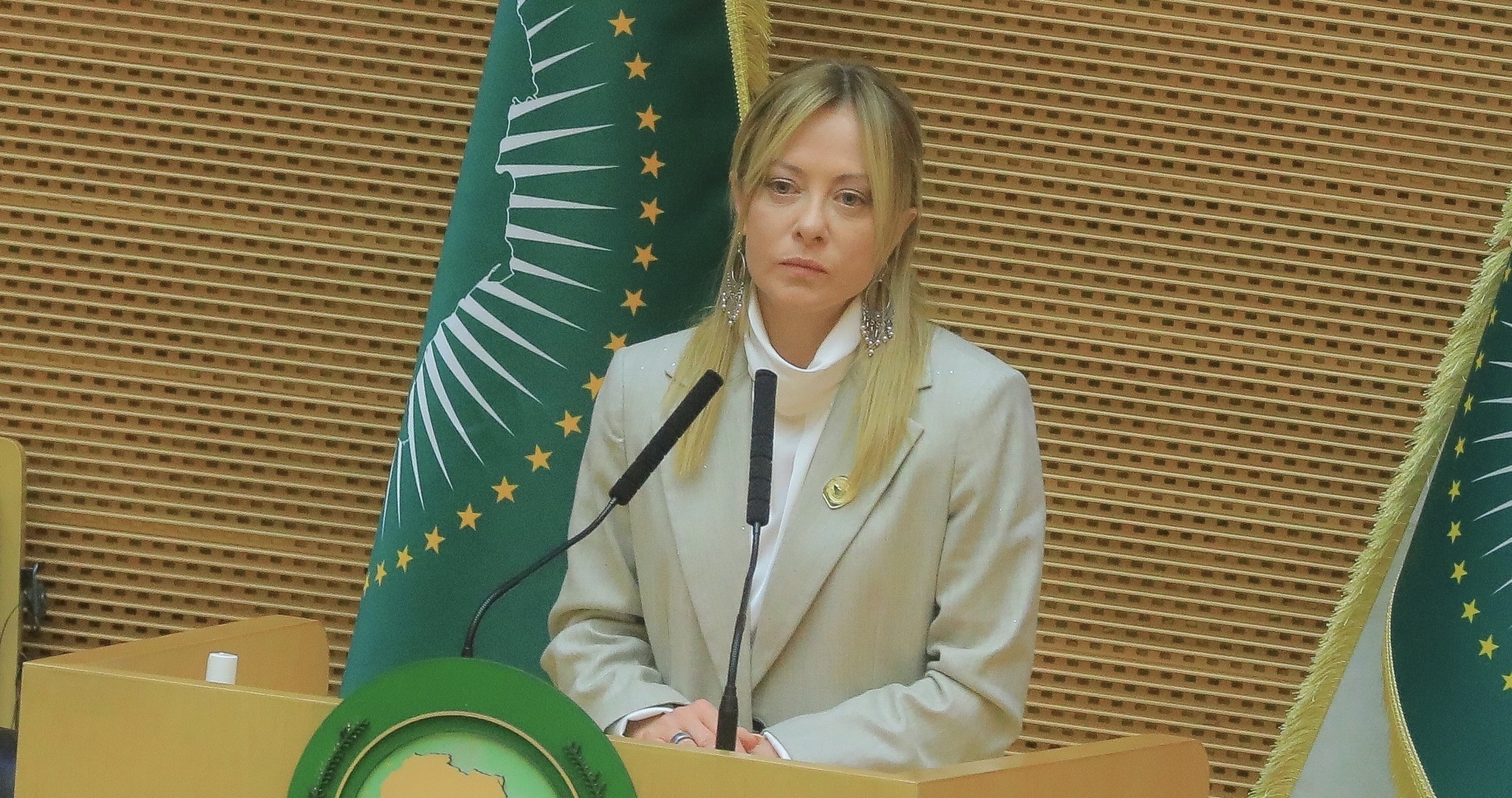
Italy has announced a proposal to allow African states to suspend debt repayments in the event of extreme climate shocks, positioning the initiative within a broader reconfiguration of its development engagement with the continent. Speaking at the Thirty Ninth Ordinary Session of the Assembly of the African Union in Addis Ababa, Prime Minister Giorgia Meloni stated that Rome would introduce mechanisms enabling vulnerable countries to defer repayments when confronted with climate related disasters, according to reporting by Reuters.
Meloni indicated that discussions with African counterparts had centred on sovereign debt sustainability and long term investment. She outlined what she described as a large scale programme to convert portions of African sovereign debt into development investments, particularly for countries deemed most fragile and vulnerable. While detailed policy instruments have yet to be published by the Italian government, Rome has previously framed its Africa strategy through the so called Mattei Plan, unveiled in January 2026 and named after Enrico Mattei, founder of the Italian energy company ENI. The plan is presented by the Italian government as a framework for partnership in energy, infrastructure, agriculture and education, with the stated objective of fostering economic growth and addressing structural drivers of irregular migration to Europe, as outlined by the Italian Presidency of the Council of Ministers.
African sovereign debt has risen markedly over the past decade, shaped by global financial tightening, currency volatility, commodity price fluctuations and the fiscal impact of the Covid 19 pandemic. According to the World Bank, several African economies are currently at high risk of debt distress or already in distress. The International Monetary Fund has similarly underscored the need for comprehensive debt treatments that incorporate climate vulnerability considerations. Climate linked debt suspension clauses have gained traction in international policy discussions, including within the Paris Club of official creditors, as tools to provide liquidity relief following natural disasters.



At the African Union summit, the question of representation in global governance structures was also foregrounded. United Nations Secretary General António Guterres reiterated his call for permanent African representation on the United Nations Security Council. Addressing heads of state and government, he described the absence of permanent African seats as inconsistent with contemporary geopolitical realities. The United Nations has documented ongoing reform debates through its Intergovernmental Negotiations on Security Council reform, as detailed on the UN General Assembly website. The African Union has long maintained a common position on this matter, articulated in the Ezulwini Consensus and reaffirmed in successive AU decisions, which can be accessed through the African Union Commission.
Peace and security deliberations at the summit encompassed the situation in South Sudan and the Democratic Republic of Congo. The United Nations Mission in South Sudan has warned of renewed tensions that could undermine the 2018 Revitalised Peace Agreement, while the United Nations Organization Stabilization Mission in the Democratic Republic of the Congo continues to support ceasefire and stabilisation efforts, according to updates published by UN Peacekeeping. These conflicts intersect with broader development and climate challenges, underscoring the multidimensional nature of policy responses under discussion.
The summit agenda also prioritised sustainable water availability and sanitation, in line with the African Union’s Agenda 2063 framework. Agenda 2063, adopted in 2015, sets out a long term vision for inclusive growth and sustainable development across the continent, emphasising African agency and continental integration. Its objectives are outlined in detail on the Agenda 2063 portal. Climate variability and water stress have intensified in several regions, with the Intergovernmental Panel on Climate Change identifying Africa as highly exposed to climate risks despite contributing a relatively small share of historical global greenhouse gas emissions.
Financial markets registered limited immediate reaction to the announcement, with the S and P Africa 40 Index marginally lower on the day of reporting, as reflected in market data from S and P Dow Jones Indices. Analysts note that the practical implications of Italy’s proposal will depend on eligibility criteria, creditor coordination, and alignment with existing multilateral debt frameworks such as the G20 Common Framework for Debt Treatments.

From an African policy perspective, debt conversion and suspension mechanisms are often evaluated not solely in terms of liquidity relief, but in relation to structural transformation, domestic revenue mobilisation, and policy autonomy. Civil society networks including the African Forum and Network on Debt and Development have argued that durable solutions require transparent negotiation processes and alignment with nationally determined development priorities.
Italy’s proposal therefore enters a complex landscape shaped by global financial governance, continental integration ambitions, and local development imperatives. Whether climate shock clauses and debt to investment conversions will translate into measurable developmental outcomes will depend on implementation modalities, institutional accountability, and the extent to which African states retain strategic ownership over investment priorities. As discussions continue within the African Union and with external partners, the emphasis from many African policymakers remains on equitable partnership, reform of international financial architecture, and recognition of the continent’s central role in shaping its own developmental trajectory.