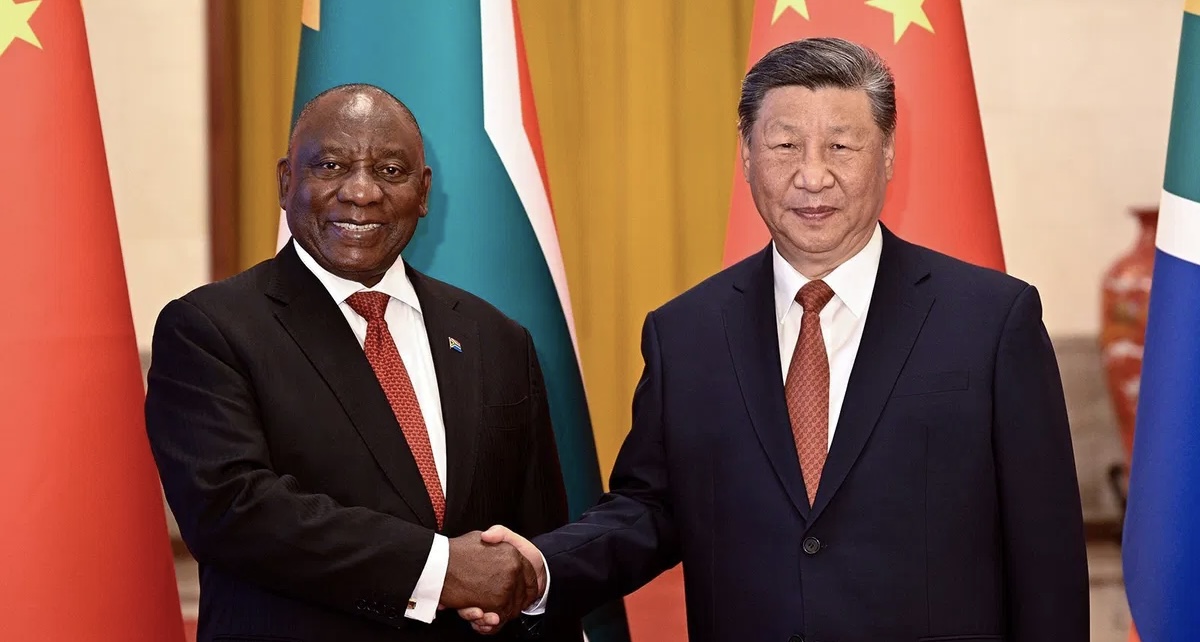
South Africa’s Minister of Trade, Industry and Competition, Parks Tau, travelled to China on Thursday as debates intensified in Washington over the future of the African Growth and Opportunity Act, the flagship United States trade preference programme for African economies. Tau’s visit, which concludes on Saturday, coincides with renewed uncertainty around South Africa’s access to the US market and highlights the strategic recalibration underway in Pretoria’s trade policy.
During the visit, Tau is expected to sign the China Africa Economic Partnership Agreement, a framework that would grant South African exports duty free access to the Chinese market. His office has said the trip forms part of South Africa’s broader objective of market diversification and export growth, particularly at a time of heightened geopolitical and commercial volatility.
AGOA, which has underpinned preferential access for eligible African countries to the United States market since 2000, is due to expire in September 2026 unless renewed by the US Congress and signed into law by President Donald Trump. According to recent reporting by Reuters and Bloomberg, the Trump administration has expressed support for a one year technical extension of AGOA, but legislation enabling a longer renewal has yet to secure presidential assent. The uncertainty has already begun to shape trade and investment decisions across the continent.




South Africa’s position within AGOA has been particularly contested. In August last year, the United States imposed a 30 per cent tariff on certain South African exports, the highest applied to any country in sub Saharan Africa. US officials have cited concerns around trade imbalances and industrial policy, while South African authorities have argued that the measures undermine the spirit of partnership that AGOA was designed to foster. Financial Times reporting this week notes that South Africa’s inclusion in any future iteration of AGOA is increasingly viewed in Washington through a geopolitical lens, shaped by Pretoria’s non aligned foreign policy stance and its deepening ties with China and other emerging economies.
Against this backdrop, Tau’s engagement in Beijing takes on added significance. China is South Africa’s largest bilateral trading partner and a major source of investment in infrastructure, manufacturing and energy. By seeking expanded duty free access to the Chinese market, South Africa is signalling an effort to reduce vulnerability to unilateral trade actions and to anchor its export strategy within a more diversified global framework.
From a continental perspective, the timing of the visit also reflects wider African concerns about the reliability of preferential trade regimes that remain subject to political cycles in advanced economies. Reuters analysis published earlier this week highlights growing frustration among African policymakers that AGOA, while beneficial in some sectors, has not evolved to support deeper industrialisation or value addition. Several governments have argued that long term development goals are better served through a combination of South South trade, regional integration under the African Continental Free Trade Area, and partnerships that prioritise productive investment.
Tau is also expected to meet Chinese companies exploring investment opportunities in South Africa during his visit. These discussions are likely to focus on sectors aligned with domestic industrial policy, including automotive manufacturing, renewable energy and agro processing. South African officials have repeatedly stressed that export access must be matched by investment that supports employment and skills development.
While Pretoria has been careful not to frame its China engagement as a response to tensions with the United States, the convergence of events this week underscores the strategic balancing act facing Africa’s most industrialised economy. The unresolved future of AGOA, combined with recent tariff actions, has reinforced the imperative for South Africa and other African states to pursue a more resilient and diversified trade architecture.
As Congress debates AGOA’s next phase and the White House weighs its broader Africa strategy, South Africa’s outreach to China illustrates a pragmatic approach shaped by lived economic realities rather than ideological alignment. For many African countries, the moment reflects not a shift away from Western markets, but a reassessment of how partnerships can be structured to recognise Africa as an active economic actor rather than a peripheral beneficiary.
How South Africa Is Rewriting Its Trade Strategy as AGOA Faces Uncertainty Under Trump