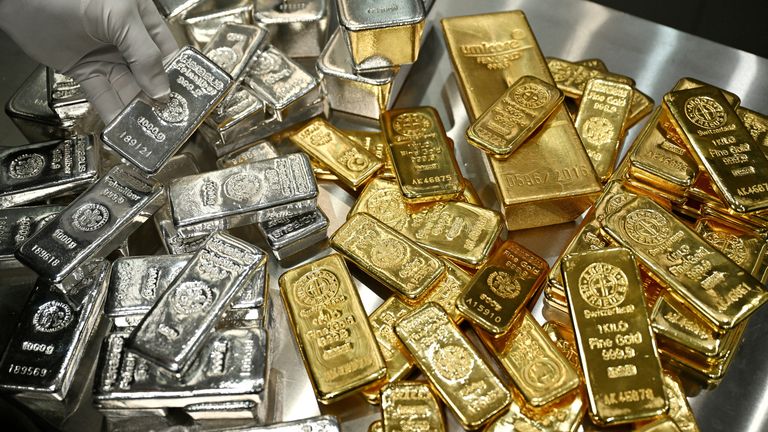
Gold and silver prices have surged to record levels in early January 2026, reflecting a wave of global uncertainty and shifting investor sentiment. On 12 January, gold climbed past 4,600 US dollars per ounce, touching a record 4,612.70, while silver rose to an unprecedented 84.65 US dollars per ounce. This marks one of the sharpest rallies in the precious metals market in recent history.
Analysts attribute the surge to a confluence of geopolitical volatility, institutional instability in the United States, and sustained industrial demand pressures. Markets reacted strongly following reports that the United States Department of Justice had warned the Federal Reserve of potential criminal proceedings concerning its governance and independence. The situation intensified when Federal Reserve Chair Jerome Powell was reportedly subpoenaed to testify before Congress. These developments fuelled investor unease, prompting capital flows into safe-haven assets.
In parallel, international tensions have remained elevated. Protests in Iran, which have turned deadly, have raised fears of regime instability, while renewed hostilities in Ukraine and the reported capture of Venezuelan leader Nicolás Maduro by United States forces have further unsettled global markets. These factors have reinforced gold’s traditional status as a hedge against political risk and uncertainty.



Monetary policy expectations have also played a pivotal role. Futures markets are now pricing in at least two interest rate reductions by the Federal Reserve in 2026, a shift that decreases the opportunity cost of holding non-yielding assets such as gold and silver. This has contributed to a bullish sentiment across commodity markets.
Silver’s performance has been particularly striking, continuing a momentum that began in 2025 when the metal gained nearly 145 percent. Analysts cite structural shortages in global supply chains as a key driver. Demand for silver has outstripped supply for five consecutive years, largely due to its integral role in solar energy production, electric vehicle manufacturing, and advanced computing infrastructure, including artificial intelligence data centres. The physical deficit in the silver market has been confirmed by research from Fitch Solutions’ BMI unit, which anticipates continued tightness throughout 2026.

Several major financial institutions have revised their precious metals forecasts upward. Goldman Sachs, JPMorgan, and Bank of America now project that gold prices could approach or even surpass 5,000 US dollars per ounce by year-end. BMI expects that silver could reach between 100 and 130 US dollars per ounce if current industrial and geopolitical catalysts persist.
For Southern Africa, these developments carry complex implications. While high gold and silver prices could bolster export revenues for mineral-rich economies such as South Africa and Zimbabwe, they also highlight the vulnerability of commodity-dependent markets to global instability. Economists note that such price rallies often reflect structural weaknesses in global governance rather than sustainable economic growth. As a result, African policymakers are urged to view the rally not only as a temporary windfall but also as an opportunity to strengthen domestic value chains, deepen beneficiation, and reduce dependence on external shocks.

In this sense, the record-breaking highs in gold and silver are not merely a reflection of crisis but also a reminder of Africa’s enduring role in the global metals economy and the importance of reimagining that role in ways that affirm both sovereignty and shared resilience.